Revise Nat 5
← All Modern Studies

📊 Source-based skill · 10 marks

Conclusions

Every conclusions question, with its source material and marking scheme. Refine by year or section.

Filter
Year
Section
View

Showing 18 of 18 questions

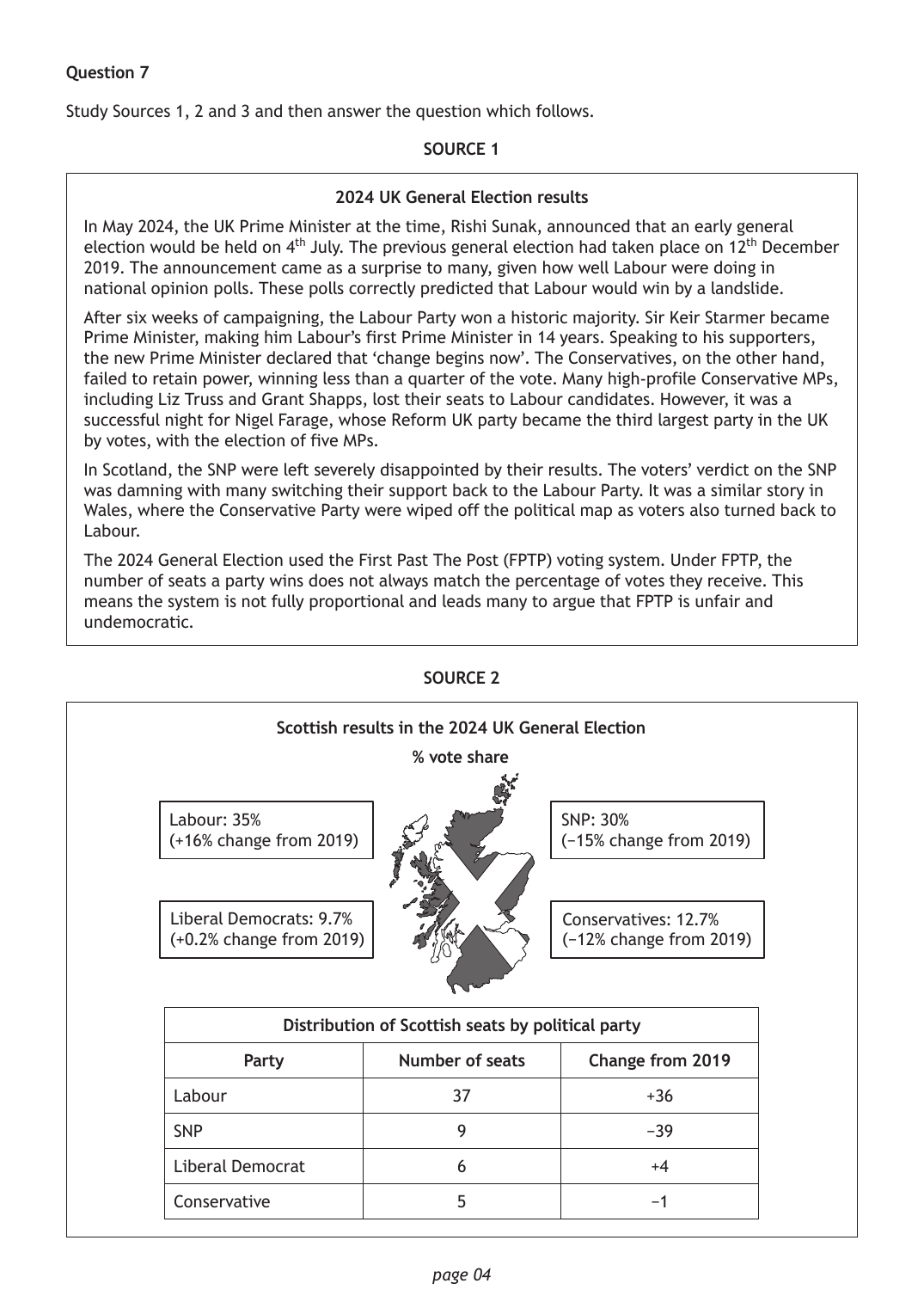
Conclusions10 marks2026Q7Democracy in Scotland and the United Kingdom

Study Sources 1, 2 and 3 and then answer the question which follows.

Using Sources 1, 2 and 3, what conclusions can be drawn about the 2024 UK General Election?

You should reach a conclusion about each of the following:

  • the dominant political party in Scotland after the election
  • the electoral performance of the Labour Party in 2024 compared to 2019
  • the electoral performance of the Conservative Party in 2024 compared to 2019
  • the proportionality of the results of the election.

Your conclusions must be supported by evidence from the sources. You should link information within and between the sources in support of your conclusions.

Your answer must be based on all three sources.

Sources (Source 1, Source 2, Source 3)
Source page 1 for this questionSource page 2 for this question
📝 Structure template — how to structure your answer

Conclusions · A source-based skills question

WFQ (words from the question)

  1. For EACH bullet point in the question, write the bullet point as a subheading, then:
  2. One conclusion that can be made about insert bullet point is insert valid conclusion.✓ 1 mark — valid conclusion
  3. Evidence to support this is shown in insert source which says/shows “insert evidence”.✓ 1 mark — evidence
  4. This clearly shows / strongly suggests insert valid conclusion — evaluative language earns the 3rd mark.✓ 1 mark — evaluative language

How it's marked

  • Conclusion + one piece of evidence = 2 marks. That is all you need for two of the three marks.
  • The 3rd mark does NOT come from a second piece of evidence linked to the same point — it comes from using evaluative terminology (e.g. “this clearly shows”, “the strongest evidence is”, “significantly”, “overwhelmingly”).
  • Comparison bullets (e.g. the UK compared with another country): you must give evidence about BOTH sides — but two pieces of evidence together still earn only ONE evidence mark, not two. You can still earn the 3rd mark with evaluative language, exactly as normal.
  • Up to 3 marks per bullet point; four conclusions (one per bullet point) are needed for full marks (10).
  • Tip: turn each bullet point into a question (e.g. “What is…?”, “What are…?”, “Which…?”, “How…?”) — the answer you give is your conclusion.
  • Conclusion + evidence = 2 marks. For the 3rd mark add evaluative language — a second quote linked to the same point does NOT earn it.
  • For a comparison bullet you must back BOTH sides with evidence — but that is still only one evidence mark, not two. The 3rd mark still comes from evaluative language.
✓ Reveal marking scheme
Max 10 marks

These are possible/exemplar answers from the marking instructions — other valid points can also gain marks.

How marks are awarded
  • The candidate is required to use a limited range of sources and draw valid conclusions from them, with supporting evidence.
  • Candidates should draw conclusions using the bullet points in the question.
  • For full marks, four developed conclusions must be given.
  • For full marks, candidates must refer to all sources in their answer. Award a maximum of 6 marks if only two sources are used and a maximum of 4 marks if only one source is used.

The dominant political party in Scotland after the election

  1. Conclusion — The Labour Party were the dominant political party in Scotland after the general election. (1 mark — valid conclusion)
  2. Conclusion — The Labour Party were the dominant political party in Scotland after the general election. Evidence — In Source 1, it states ‘The voters’ verdict on the SNP was damning with many switching their support back to the Labour Party’ and in Source 2 it shows that the Labour Party secured 37 of the Scottish seats, a significant improvement of 36 on the previous election, proving that they were the most dominant party by a sizeable margin. (3 marks — valid conclusion evidence from two sources and evaluative terminology)

The electoral performance of the Labour Party in 2024 compared to 2019

  1. Conclusion — The Labour Party performed much better in the 2024 UK General Election compared to 2019. (1 mark — valid conclusion)
  2. Conclusion — The Labour Party performed much better in the 2024 UK General Election compared to 2019. Evidence — In Source 1, it states that ‘These polls correctly predicted that Labour would win by a landslide’ and in Source 3 it shows that the Labour Party won 412 seats. This was a significant increase of 211 seats compared to 2019. (3 marks — valid conclusion evidence from two sources and evaluative terminology)

The electoral performance of the Conservative Party in 2024 compared to 2019

  1. Conclusion — The Conservative Party performed extremely poorly in the 2024 UK General Election compared to 2019. (1 mark — valid conclusion)
  2. Conclusion — The Conservative Party performed extremely poorly in the 2024 UK General Election compared to 2019. Evidence — In Source 1 it states that ‘The Conservatives, on the other hand, failed to retain power, winning less than a quarter of the vote.’ (2 marks — valid conclusion with evidence from one source)

The proportionality of the results of the election

  1. Conclusion — The results produced by the 2024 UK General Election were unproportional. (1 mark — valid conclusion)
  2. Conclusion — The results produced by the 2024 UK General Election were unproportional. Evidence — In Source 1 it states ‘Under FPTP, the number of seats a party wins does not always match the percentage of votes they receive. This means the system is not fully proportional’ and in Source 3 it shows that the Labour Party won 33.7% of the votes, which is less than half, but they were awarded 62.2% of the seats which is nearly two thirds of those available. This shows that the percentage of votes and seats were not equal. (3 marks — valid conclusion evidence from two sources and evaluative terminology)
Conclusions10 marks2025Q21International Issues

Study Sources 1, 2 and 3 and then answer the question which follows.

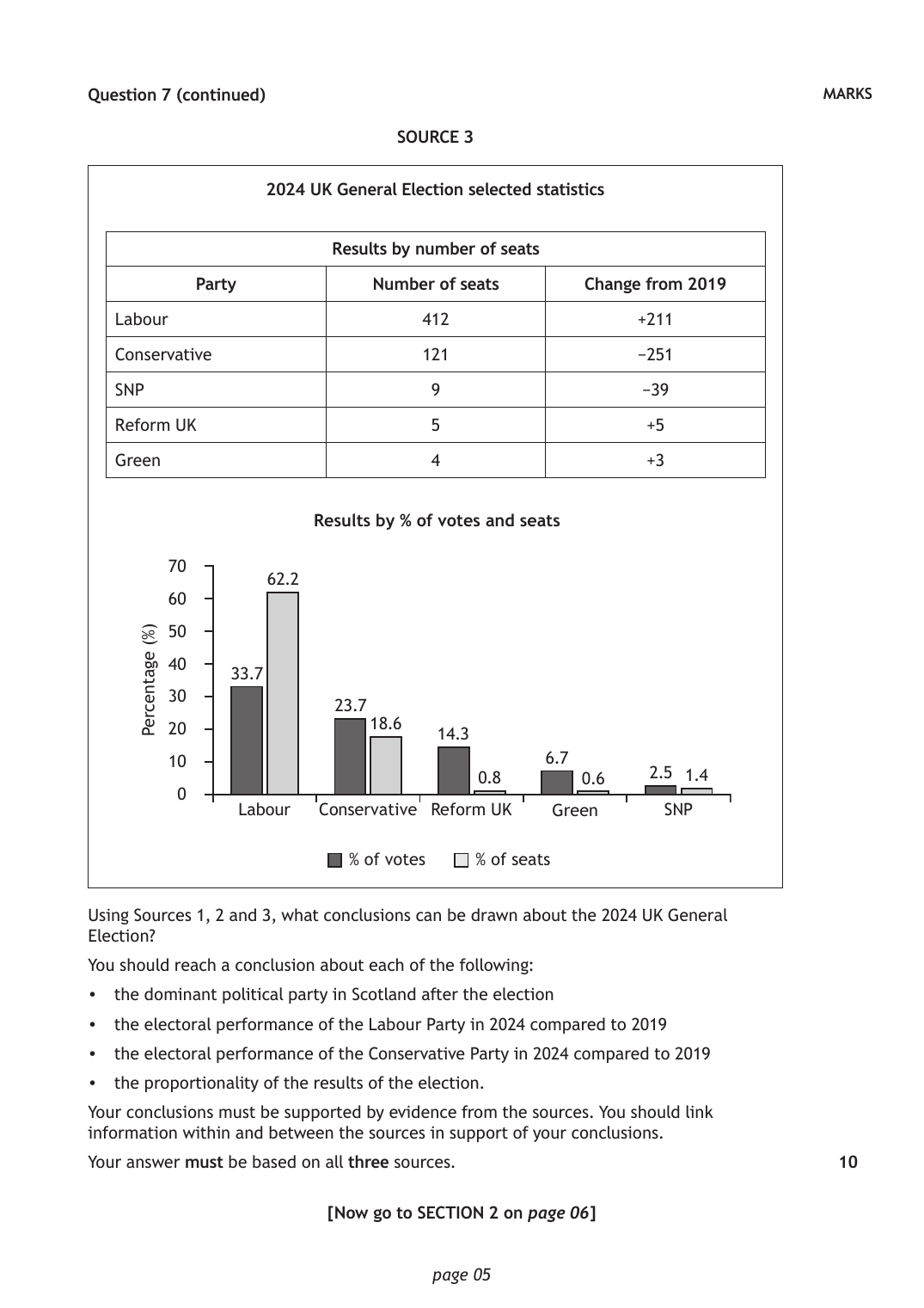
Using Sources 1, 2 and 3, what conclusions can be drawn about female representation in politics in Canada?

You should reach a conclusion about each of the following:

  • progress towards gender equality in the House of Commons
  • female representation in the Canadian Parliament compared to other countries
  • opinions on measures to increase female representation in the House of Commons
  • female representation in provincial and territorial legislatures.

Your conclusions must be supported by evidence from the sources. You should link information within and between the sources in support of your conclusions.

Your answer must be based on all three sources.

Sources (Source 1, Source 2, Source 3)
Source page 1 for this questionSource page 2 for this question
📝 Structure template — how to structure your answer

Conclusions · A source-based skills question

WFQ (words from the question)

  1. For EACH bullet point in the question, write the bullet point as a subheading, then:
  2. One conclusion that can be made about insert bullet point is insert valid conclusion.✓ 1 mark — valid conclusion
  3. Evidence to support this is shown in insert source which says/shows “insert evidence”.✓ 1 mark — evidence
  4. This clearly shows / strongly suggests insert valid conclusion — evaluative language earns the 3rd mark.✓ 1 mark — evaluative language

How it's marked

  • Conclusion + one piece of evidence = 2 marks. That is all you need for two of the three marks.
  • The 3rd mark does NOT come from a second piece of evidence linked to the same point — it comes from using evaluative terminology (e.g. “this clearly shows”, “the strongest evidence is”, “significantly”, “overwhelmingly”).
  • Comparison bullets (e.g. the UK compared with another country): you must give evidence about BOTH sides — but two pieces of evidence together still earn only ONE evidence mark, not two. You can still earn the 3rd mark with evaluative language, exactly as normal.
  • Up to 3 marks per bullet point; four conclusions (one per bullet point) are needed for full marks (10).
  • Tip: turn each bullet point into a question (e.g. “What is…?”, “What are…?”, “Which…?”, “How…?”) — the answer you give is your conclusion.
  • Conclusion + evidence = 2 marks. For the 3rd mark add evaluative language — a second quote linked to the same point does NOT earn it.
  • For a comparison bullet you must back BOTH sides with evidence — but that is still only one evidence mark, not two. The 3rd mark still comes from evaluative language.
✓ Reveal marking scheme
Max 10 marks

These are possible/exemplar answers from the marking instructions — other valid points can also gain marks.

How marks are awarded
  • The candidate is required to use a limited range of sources and draw valid conclusions from them, with supporting evidence.
  • Candidates should draw conclusions using the bullet points in the question.
  • For full marks, four conclusions must be given.
  • For full marks, candidates must refer to all sources in their answer. Award a maximum of 6 marks if only two sources are used and a maximum of 4 marks if only one source is used.

PROGRESS TOWARDS GENDER EQUALITY IN THE HOUSE OF COMMONS

  1. Conclusion — Women have made some progress in achieving gender equality in the House of Commons. (1 mark — valid conclusion)
  2. Conclusion — Women have made some progress in achieving gender equality in the House of Commons. Evidence — Source 1 states 'In the 2021 federal election, of the 338 members elected, 103 were women. Of those, 22 were elected for the first time. This represents an increase of five seats over the previous record of 98 women who were elected in 2019.' This links to Source 2 which highlights that between 2006 and 2021 the percentage of female representation rose by over 10%. (2 marks — valid conclusion with evidence)
  3. Conclusion — Women have made some progress in achieving gender equality in the House of Commons. Evidence — Source 1 states 'In the 2021 federal election, of the 338 members elected, 103 were women. Of those, 22 were elected for the first time. This represents an increase of five seats over the previous record of 98 women who were elected in 2019.' This is linked to Source 2 which highlights that between 2006 and 2021 the percentage of female representation rose by over 10%. This has only taken the representation to just over 30% in 15 years so suggests that they still have some way to go to achieve gender equality. (3 marks — valid conclusion with evidence and evaluative terminology)

FEMALE REPRESENTATION IN THE CANADIAN PARLIAMENT COMPARED TO OTHER COUNTRIES

  1. Conclusion — Canada has fewer women represented in Parliament compared to other countries. (1 mark — valid conclusion)
  2. Conclusion — Canada has fewer women represented in Parliament compared to other countries. Evidence — Source 1 states 'In terms of female representation in Parliament, Canada ranks 66th in the world.' This links to Source 3 which shows that Cuba and the UAE, at rankings two and five, are ranked far higher than Canada. (2 marks — valid conclusion with evidence)
  3. Conclusion — Canada has fewer women represented in Parliament compared to other countries. Evidence — Source 1 states 'In terms of female representation in Parliament, Canada ranks 66th in the world.' This links to Source 3 which shows that Cuba and the UAE, at rankings two and five, are ranked far higher than Canada. Furthermore, the table highlights that Canada is only ranked above two of the other selected countries, Estonia and Malta. (3 marks — valid conclusion with evidence and evaluative terminology)

OPINIONS ON MEASURES TO INCREASE FEMALE REPRESENTATION IN THE HOUSE OF COMMONS

  1. Conclusion — There is widespread support for the introduction of measures to increase female representation in the House of Commons. (1 mark — valid conclusion)
  2. Conclusion — There is widespread support for the introduction of measures to increase female representation in the House of Commons. Evidence — Source 1 highlights that 'Some Canadian political parties have pledged to include more female representation in government by introducing certain measures to increase both participation and representation. These measures have included all-woman shortlists, gender quotas and woman-only seats.' This is linked to Source 2 which highlights that 60% of the public either agree or strongly agree with the introduction of measures to improve female representation in the House of Commons. (2 marks conclusion — valid conclusion with evidence)
  3. Conclusion — There is widespread support for the introduction of measures to increase female representation in the House of Commons. Evidence — Source 1 highlights that 'Some Canadian political parties have pledged to include more female representation in government by introducing certain measures to increase both participation and representation. These measures have included all-woman shortlists, gender quotas and woman-only seats.' This is linked to Source 2 which highlights that 60%, a clear majority, of the public either agree or strongly agree with the introduction of measures to improve female representation in the House of Commons. (3 marks — valid conclusion with evidence and evaluative terminology)

FEMALE REPRESENTATION IN PROVINCIAL AND TERRITORIAL LEGISLATURES

  1. Conclusion — Gender inequality still exists in most provincial and territorial legislatures. (1 mark — valid conclusion)
  2. Conclusion — Gender inequality still exists in most provincial and territorial legislatures. Evidence — Source 1 states 'Provincial and territorial legislatures in Canada face similar issues in achieving gender equality between men and women. By the end of 2024, women represented 35.3% (273 out of 772) of all provincial and territorial legislators across Canada as a whole.' This is linked to Source 3 which highlights that of the seven provinces/territories shown, only one has achieved gender equality between males and females — Northwest Territories. The other six have less than 50% females with two having significantly low numbers of women — Newfoundland having less than 1/4 women and Alberta less than 1/3. (3 marks — valid conclusion with evidence and evaluative terminology)
Source: 2025 N5 History · X849/75/11 · Q21Question paper (PDF, p.15) ↗Marking instructions (PDF, p.43) ↗
Conclusions10 marks2024Q21International Issues

Study Sources 1, 2 and 3 and then answer the question which follows.

Using Sources 1, 2 and 3, what conclusions can be drawn about life in the United Arab Emirates (UAE)?

You should reach a conclusion about each of the following:

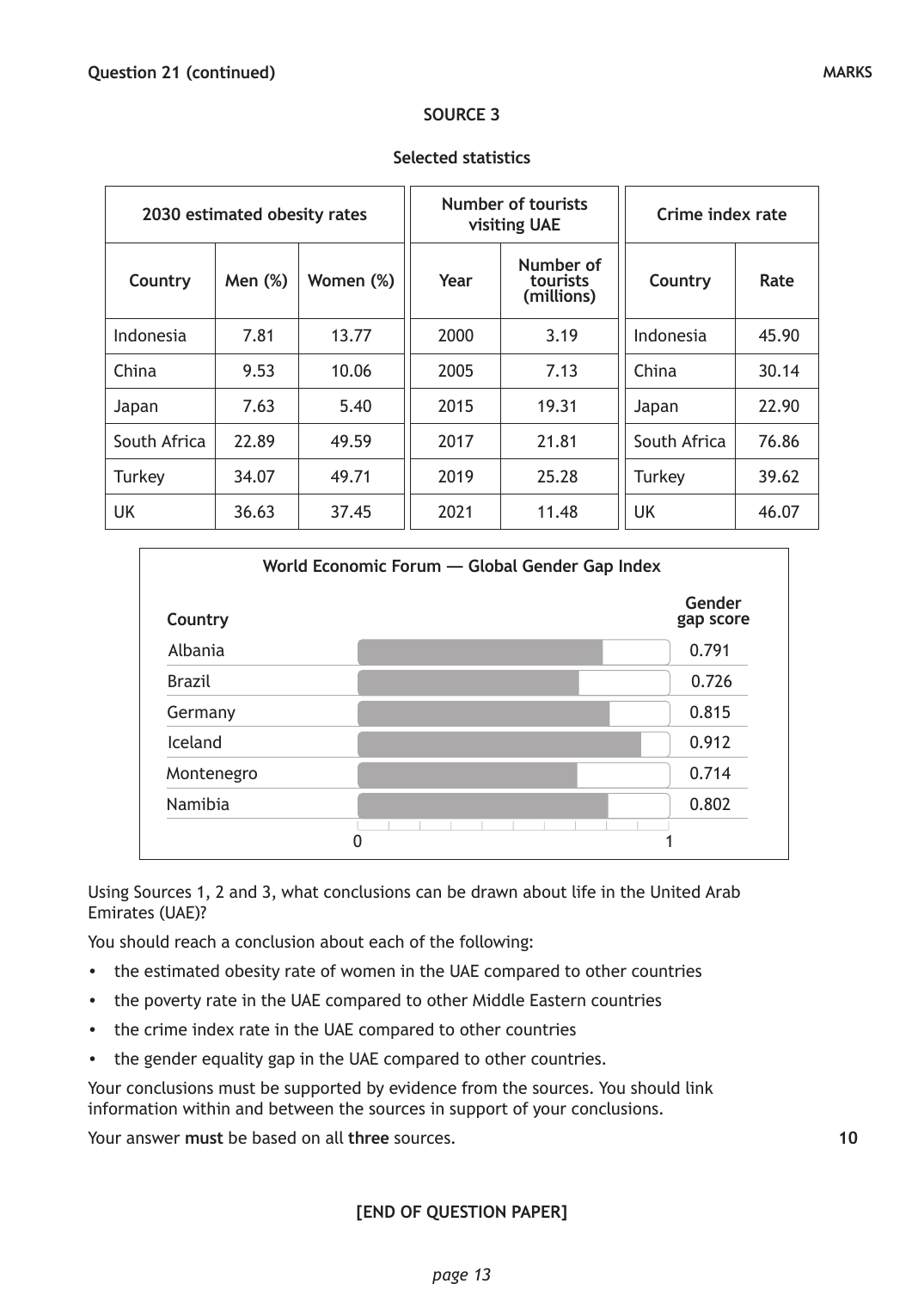
  • the estimated obesity rate of women in the UAE compared to other countries
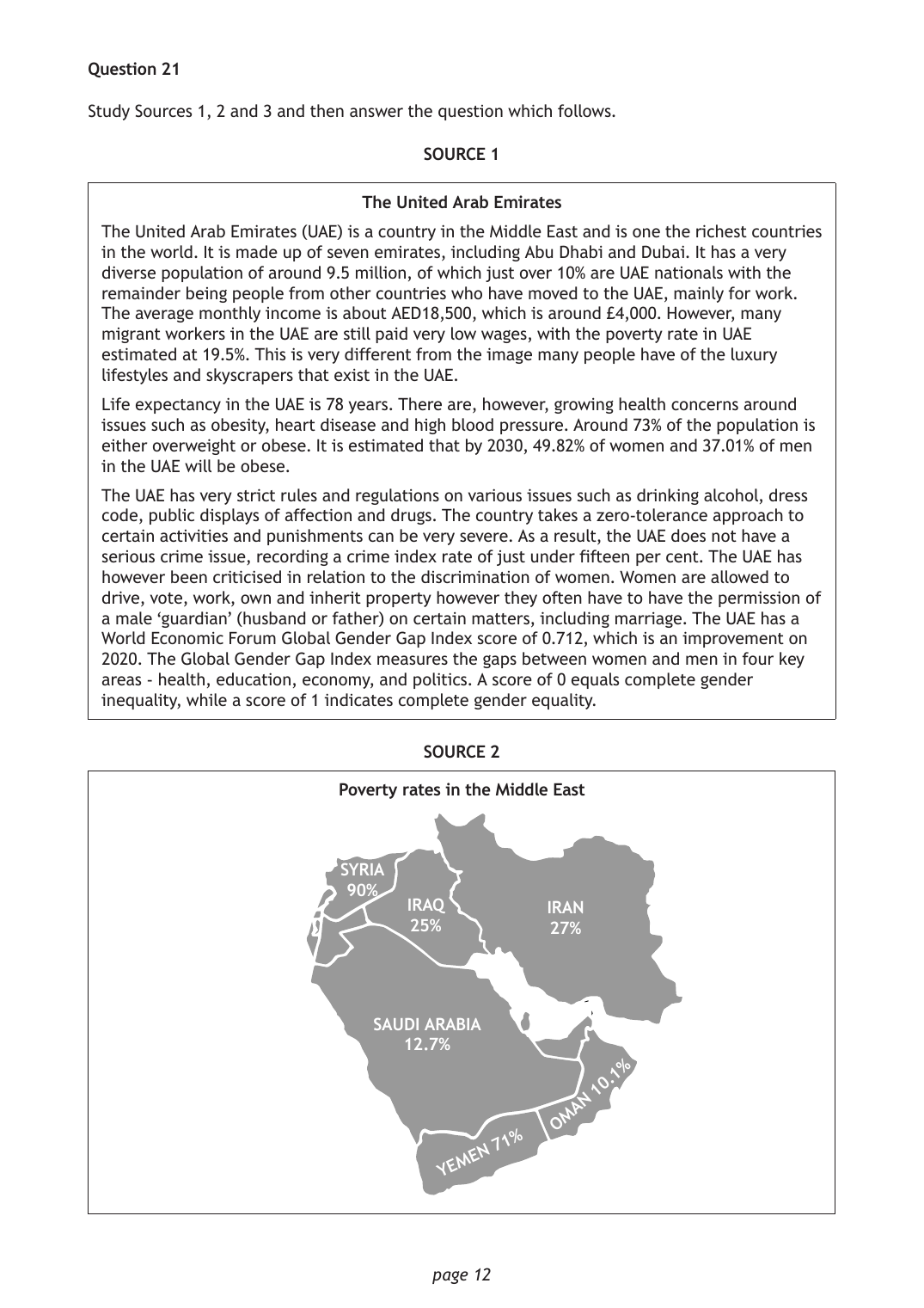
  • the poverty rate in the UAE compared to other Middle Eastern countries
  • the crime index rate in the UAE compared to other countries
  • the gender equality gap in the UAE compared to other countries.

Your conclusions must be supported by evidence from the sources. You should link information within and between the sources in support of your conclusions.

Your answer must be based on all three sources.

Sources (Source 1, Source 2, Source 3)

Source page 1 for this questionSource page 2 for this question
📝 Structure template — how to structure your answer

Conclusions · A source-based skills question

WFQ (words from the question)

  1. For EACH bullet point in the question, write the bullet point as a subheading, then:
  2. One conclusion that can be made about insert bullet point is insert valid conclusion.✓ 1 mark — valid conclusion
  3. Evidence to support this is shown in insert source which says/shows “insert evidence”.✓ 1 mark — evidence
  4. This clearly shows / strongly suggests insert valid conclusion — evaluative language earns the 3rd mark.✓ 1 mark — evaluative language

How it's marked

  • Conclusion + one piece of evidence = 2 marks. That is all you need for two of the three marks.
  • The 3rd mark does NOT come from a second piece of evidence linked to the same point — it comes from using evaluative terminology (e.g. “this clearly shows”, “the strongest evidence is”, “significantly”, “overwhelmingly”).
  • Comparison bullets (e.g. the UK compared with another country): you must give evidence about BOTH sides — but two pieces of evidence together still earn only ONE evidence mark, not two. You can still earn the 3rd mark with evaluative language, exactly as normal.
  • Up to 3 marks per bullet point; four conclusions (one per bullet point) are needed for full marks (10).
  • Tip: turn each bullet point into a question (e.g. “What is…?”, “What are…?”, “Which…?”, “How…?”) — the answer you give is your conclusion.
  • Conclusion + evidence = 2 marks. For the 3rd mark add evaluative language — a second quote linked to the same point does NOT earn it.
  • For a comparison bullet you must back BOTH sides with evidence — but that is still only one evidence mark, not two. The 3rd mark still comes from evaluative language.
✓ Reveal marking scheme
Max 10 marks

These are possible/exemplar answers from the marking instructions — other valid points can also gain marks.

How marks are awarded
  • The candidate is required to use a limited range of sources and draw valid conclusions from them, with supporting evidence.
  • Candidates should draw conclusions using the bullet points in the question.
  • For full marks, four developed conclusions must be given.
  • For full marks, candidates must refer to all sources in their answer. Award a maximum of 6 marks if only two sources are used and a maximum of 4 marks if only one source is used.

THE ESTIMATED OBESITY RATE OF WOMEN IN THE UAE COMPARED TO OTHER COUNTRIES

  1. Women in the UAE have a higher rate of estimated obesity than the other countries listed. (1 mark — valid conclusion)
  2. Women in the UAE have a higher rate of estimated obesity than the other countries listed. In Source 1, it states that by 2030 the obesity rate of women in the UAE will be 49.82% and Source 3 shows that other countries obesity rates are lower, with some significantly lower, such as Japan at 5.40%, China at 10.06% and Indonesia at 13.77%. (3 marks — valid conclusion with evidence from two sources and evaluative terminology)
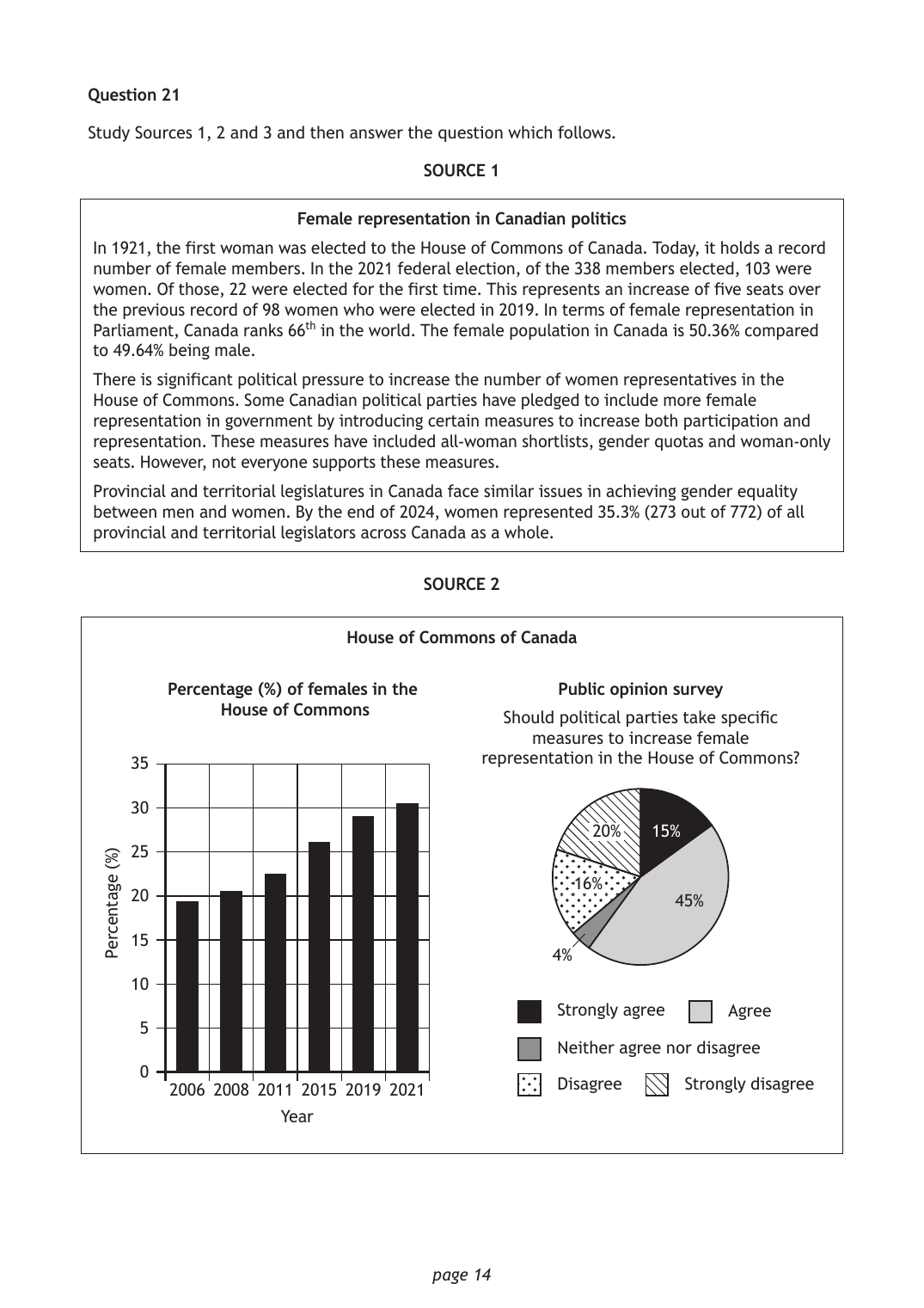
THE POVERTY RATES IN THE UAE COMPARED TO OTHER MIDDLE EASTERN COUNTRIES

  1. The poverty rate is lower in the UAE than most other Middle Eastern countries. (1 mark — valid conclusion)
  2. The poverty rate is lower in the UAE than most other Middle Eastern countries. In Source 1 it states that the poverty rate in the UAE is estimated at 19.5% and in Source 2 it shows that Syria, for example, has a poverty rate of 90% and Yemen has a poverty rate of 71%. (2 marks — valid conclusion with evidence)
  3. The poverty rate is lower in the UAE than most other Middle Eastern countries. In Source 1 it states that the poverty rate in the UAE is estimated at 19.5% and in Source 2 it shows that Syria, for example, has a poverty rate of 90% and Yemen has a poverty rate of 71%. This highlights that the poverty rate in Syria is more than four times higher than it is in the UAE. (3 marks — valid conclusion with evidence from two sources and evaluative terminology)
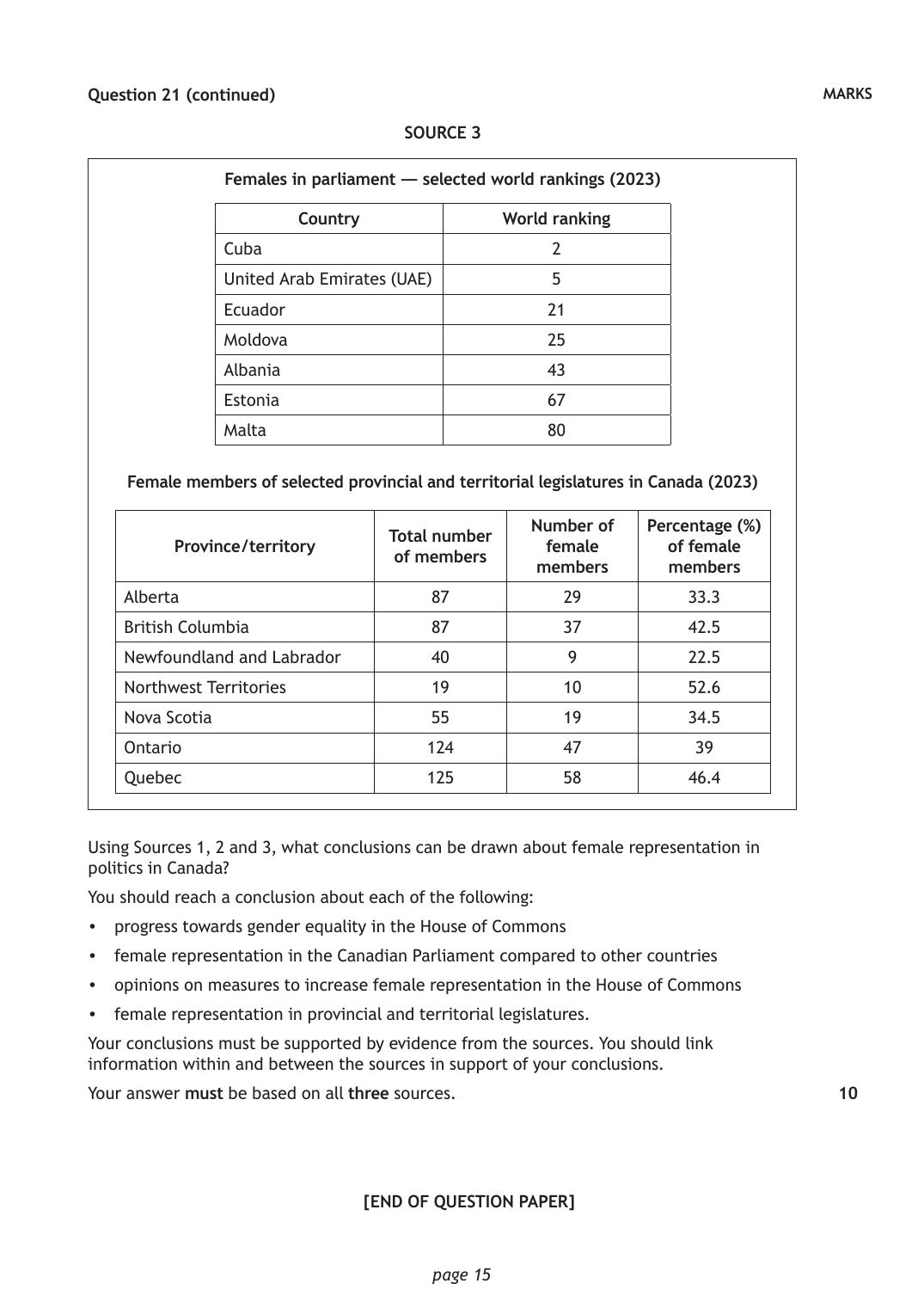
THE CRIME INDEX RATE IN THE UAE COMPARED TO OTHER COUNTRIES

  1. The crime index rate in the UAE is lower than the other selected countries. (1 mark — valid conclusion)
  2. The crime index rate in the UAE is lower than all the other countries shown. In Source 1 it states that the UAE has a crime index rate of just under fifteen per cent and Source 3 shows us that this is lower than other countries with, for example, South Africa having a rate of 76.86 and the UK a rate of 46.07. (2 marks — valid conclusion with evidence)

THE GENDER EQUALITY GAP IN THE UAE COMPARED TO OTHER COUNTRIES

  1. The gender equality gap in the UAE is bigger in comparison to other countries. (1 mark — valid conclusion)
  2. The gender equality gap in the UAE is bigger in comparison to other countries. In Source 1 it states that the UAE has a gender gap score of 0.712 while Source 3 shows that every other country has a better gender gap score, such as Iceland with a score of 0.912. (2 marks — valid conclusion with evidence)
  3. The gender equality gap in the UAE is bigger in comparison to other countries. In Source 1 it states that the UAE has a gender gap score of 0.712 while Source 3 shows that every other country has a better gender gap score, such as Iceland with a score of 0.912. Even the closest of all the countries shown, Montenegro (0.714), still has a better gender gap score than the UAE. (3 marks — valid conclusion with evidence from two sources and evaluative terminology)
Source: 2024 N5 History · X849/75/11 · Q21Question paper (PDF, p.12) ↗Marking instructions (PDF, p.35) ↗
Conclusions10 marks2023Q14Social Issues in the United Kingdom

Study Sources 1, 2 and 3 and then answer the question which follows.

Using Sources 1, 2 and 3, what conclusions can be drawn about the impact of COVID-19 on prisons?

You should reach a conclusion about each of the following:

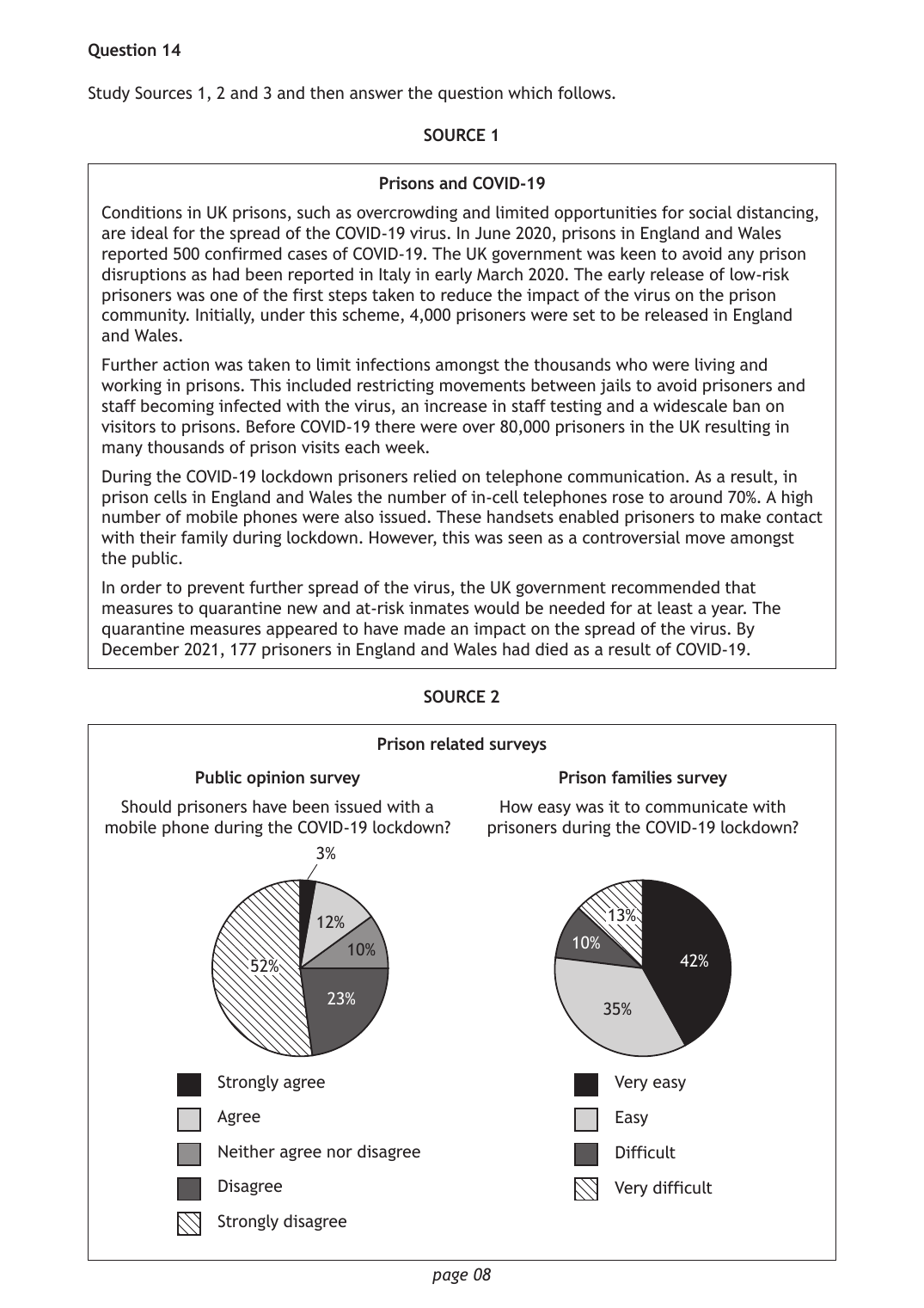
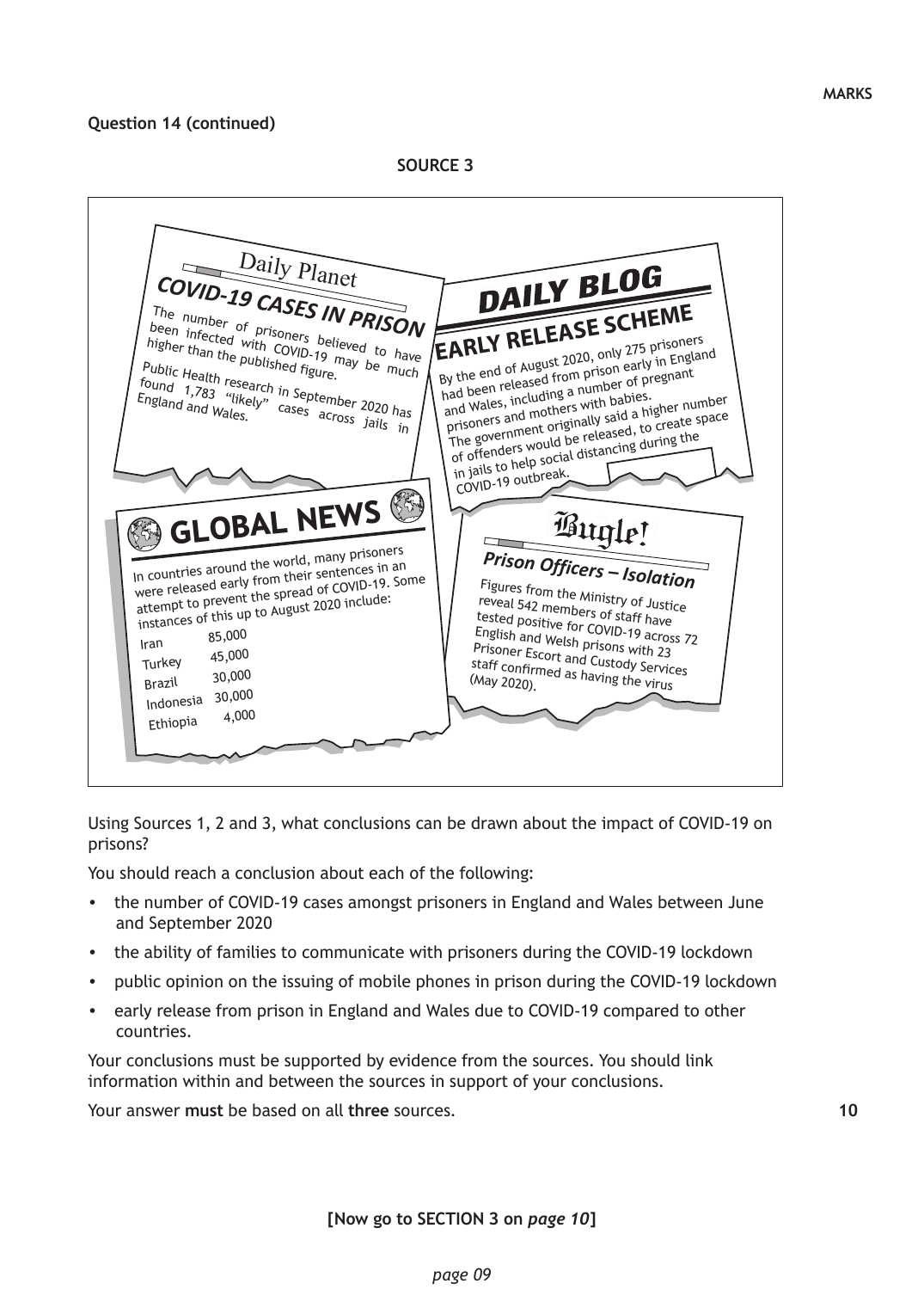
  • the number of COVID-19 cases amongst prisoners in England and Wales between June and September 2020
  • the ability of families to communicate with prisoners during the COVID-19 lockdown
  • public opinion on the issuing of mobile phones in prison during the COVID-19 lockdown
  • early release from prison in England and Wales due to COVID-19 compared to other countries.

Your conclusions must be supported by evidence from the sources. You should link information within and between the sources in support of your conclusions.

Your answer must be based on all three sources.

Sources (Source 1, Source 2, Source 3)

Source page 1 for this questionSource page 2 for this question
📝 Structure template — how to structure your answer

Conclusions · A source-based skills question

WFQ (words from the question)

  1. For EACH bullet point in the question, write the bullet point as a subheading, then:
  2. One conclusion that can be made about insert bullet point is insert valid conclusion.✓ 1 mark — valid conclusion
  3. Evidence to support this is shown in insert source which says/shows “insert evidence”.✓ 1 mark — evidence
  4. This clearly shows / strongly suggests insert valid conclusion — evaluative language earns the 3rd mark.✓ 1 mark — evaluative language

How it's marked

  • Conclusion + one piece of evidence = 2 marks. That is all you need for two of the three marks.
  • The 3rd mark does NOT come from a second piece of evidence linked to the same point — it comes from using evaluative terminology (e.g. “this clearly shows”, “the strongest evidence is”, “significantly”, “overwhelmingly”).
  • Comparison bullets (e.g. the UK compared with another country): you must give evidence about BOTH sides — but two pieces of evidence together still earn only ONE evidence mark, not two. You can still earn the 3rd mark with evaluative language, exactly as normal.
  • Up to 3 marks per bullet point; four conclusions (one per bullet point) are needed for full marks (10).
  • Tip: turn each bullet point into a question (e.g. “What is…?”, “What are…?”, “Which…?”, “How…?”) — the answer you give is your conclusion.
  • Conclusion + evidence = 2 marks. For the 3rd mark add evaluative language — a second quote linked to the same point does NOT earn it.
  • For a comparison bullet you must back BOTH sides with evidence — but that is still only one evidence mark, not two. The 3rd mark still comes from evaluative language.
✓ Reveal marking scheme
Max 10 marks

These are possible/exemplar answers from the marking instructions — other valid points can also gain marks.

How marks are awarded
  • The candidate is required to use a limited range of sources and draw valid conclusions from them, with supporting evidence.
  • Candidates should draw conclusions using the bullet points in the question.
  • For full marks, four conclusions must be given.
  • For full marks, candidates must refer to all sources in their answer. Award a maximum of 6 marks if only two sources are used and a maximum of 4 marks if only one source is used.

THE NUMBER OF COVID-19 CASES AMONGST PRISONERS IN ENGLAND AND WALES BETWEEN JUNE AND SEPTEMBER 2020

  1. Conclusion: none Evidence: Source 1 states that there were 500 confirmed cases in June 2020 and Source 3 states there were 1,783 likely cases in September 2020. (1 mark — correct identification of information)
  2. Conclusion: There was an increase in the number of prisoners with COVID-19 between June and September 2020. (1 mark — valid conclusion)
  3. Conclusion: There was an increase in the number of prisoners with COVID-19 between June and September 2020. Evidence: Source 1 states that there were 500 confirmed cases in June 2020 and Source 3 states there were 1,783 likely cases in September 2020. (2 marks — valid conclusion with evidence)
  4. Conclusion: There was an increase in the number of prisoners with COVID-19 between June and September 2020. Evidence: Source 1 states that there were 500 confirmed cases in June 2020 and Source 3 states there were 1,783 likely cases in September 2020. This shows that the numbers had increased by more than three times. (3 marks — valid conclusion with evidence and evaluative terminology)
THE ABILITY OF FAMILIES TO COMMUNICATE WITH PRISONERS DURING THE COVID-19 LOCKDOWN

  1. Conclusion: Families found it very easy to communicate with prisoners during COVID-19. (1 mark — valid conclusion)
  2. Conclusion: Families found it very easy to communicate with prisoners during COVID-19. Evidence: Source 2 shows that 77% of those surveyed said it was easy or very easy to communicate with prisoners during COVID-19. This is supported by Source 1 which highlights that around 70% of cells in England and Wales now had in-cell telephones and a high number of mobile phones were issued. (2 marks — valid conclusion and two pieces of evidence, however no evaluative terminology)
  3. Conclusion: Families found it very easy to communicate with prisoners during COVID-19. Evidence: Source 2 shows that 77% of those surveyed said it was easy or very easy to communicate with prisoners during COVID-19. This is supported by Source 1 which highlights that around 70% of cells in England and Wales now had in-cell telephones and a high number of mobile phones were issued. This helps explain why the vast majority of families, almost 80%, found it easy to communicate. (3 marks — valid conclusion with evidence and evaluative terminology)
PUBLIC OPINION ON THE ISSUING OF MOBILE PHONES IN PRISON DURING THE COVID-19 LOCKDOWN

  1. Conclusion: The public disagreed with the issuing of mobile phones in prison. (1 mark — valid conclusion)
  2. Conclusion: The public disagreed with the issuing of mobile phones in prison. Evidence: Source 2 shows that 75% of those surveyed, which is a significant majority, either disagreed or strongly disagreed with prisoners being issued with a mobile phone during lockdown. This links to Source 1 which highlights this was seen as a controversial move amongst the public. (3 marks — valid conclusion with evidence and evaluative terminology)
EARLY RELEASE FROM PRISON IN ENGLAND AND WALES DUE TO COVID-19 COMPARED TO OTHER COUNTRIES

  1. Conclusion: There were fewer prisoners released early in England and Wales in comparison to the other countries. (1 mark — valid conclusion)
  2. Conclusion: There were fewer prisoners released early in England and Wales in comparison to the other countries. Evidence: Source 3 highlights that only 275 prisoners were released in England and Wales by August 2020. Source 3, however, also shows that other countries took a much more extreme approach to early release, for example Iran released 85,000 prisoners with Turkey releasing 45,000 and both Indonesia and Brazil releasing 30,000 each. (3 marks — valid conclusion with evidence and evaluative terminology)
Source: 2023 N5 History · X849/75/11 · Q14Question paper (PDF, p.8) ↗Marking instructions (PDF, p.28) ↗
Conclusions10 marks2022Q7Democracy in Scotland and the UK

Study Sources 1, 2 and 3 and then answer the question which follows.

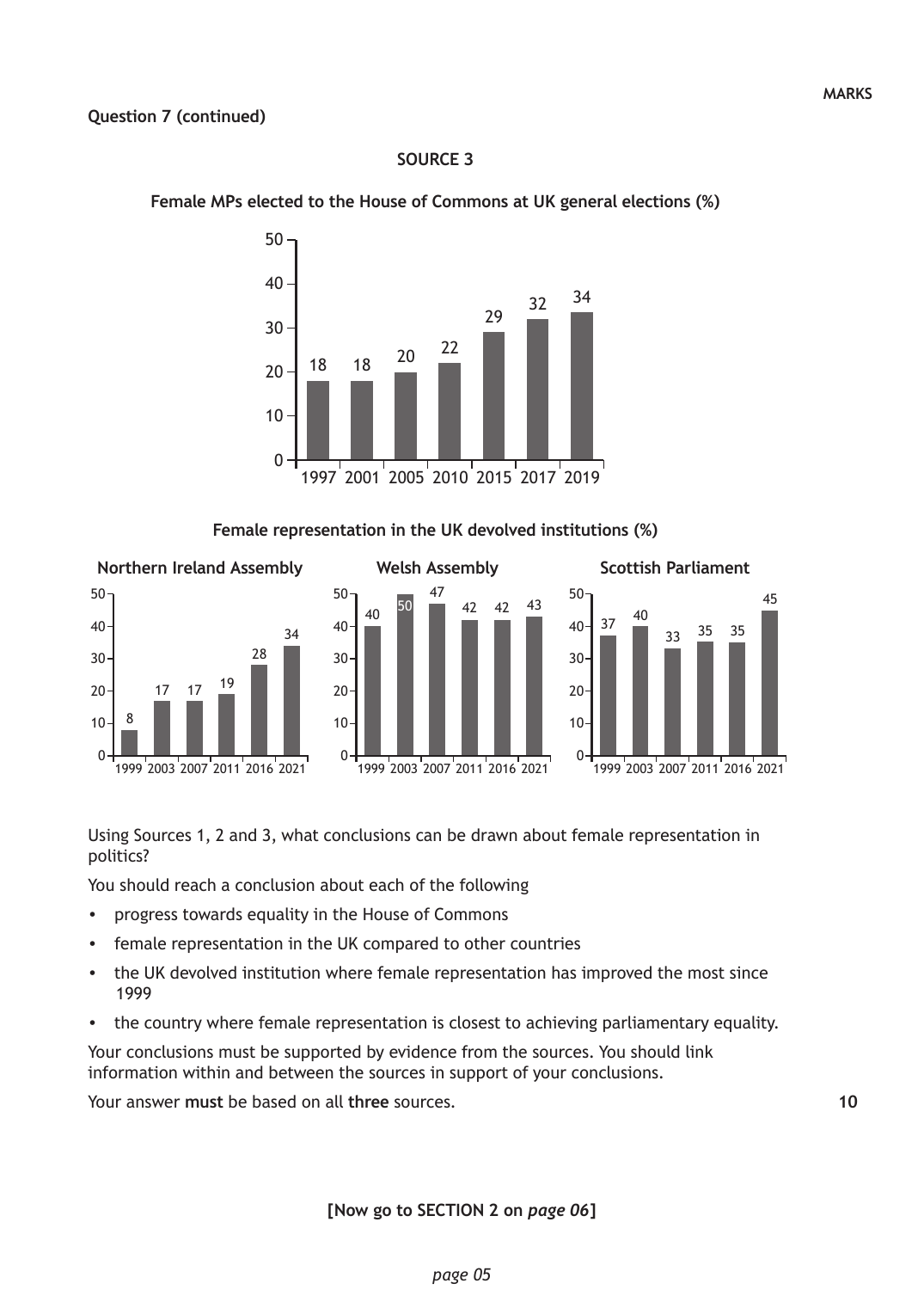
Using Sources 1, 2 and 3, what conclusions can be drawn about female representation in politics?

You should reach a conclusion about each of the following

  • progress towards equality in the House of Commons
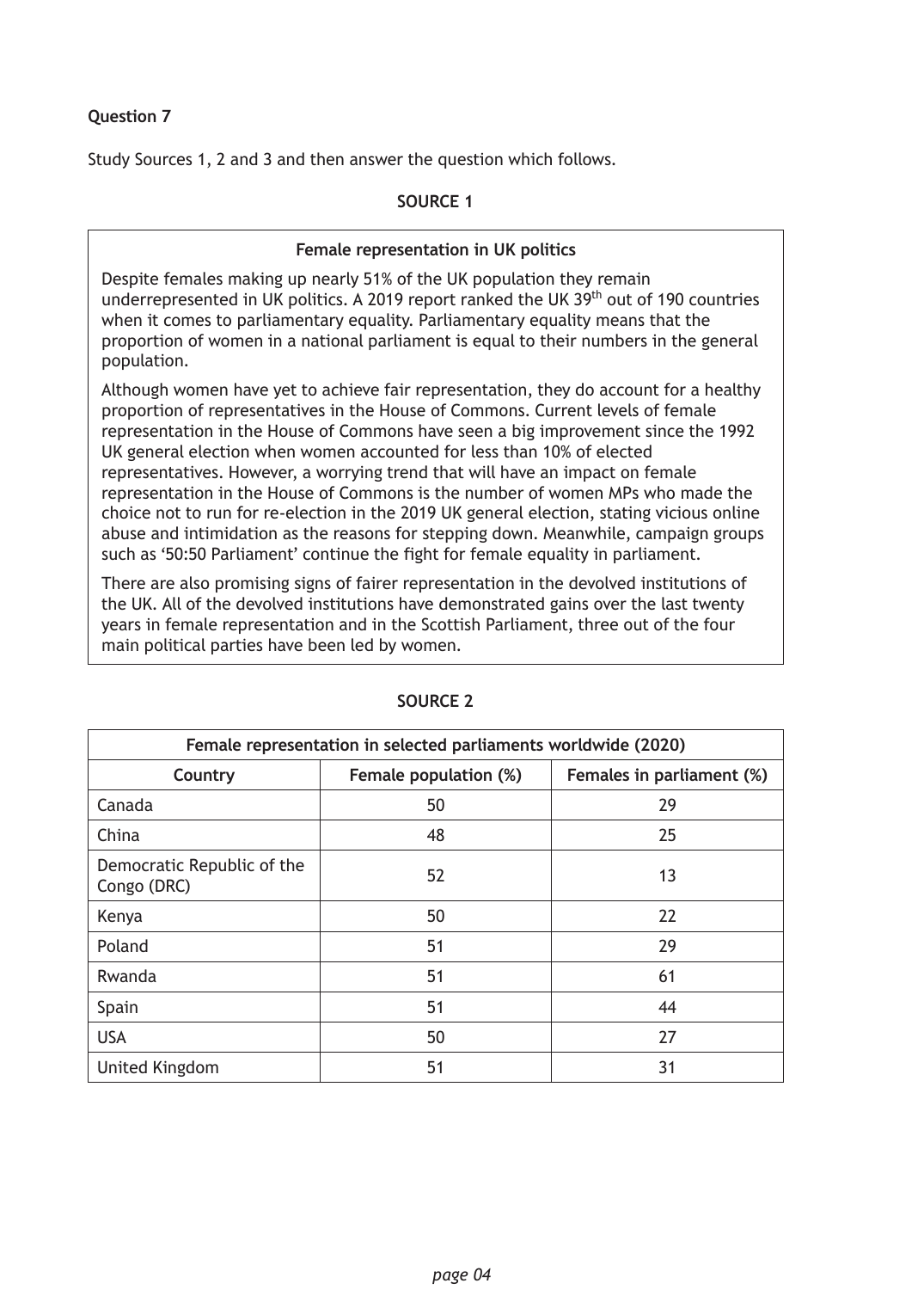
  • female representation in the UK compared to other countries
  • the UK devolved institution where female representation has improved the most since 1999
  • the country where female representation is closest to achieving parliamentary equality.

Your conclusions must be supported by evidence from the sources. You should link information within and between the sources in support of your conclusions.

Your answer must be based on all three sources.

Sources (Source 1, Source 2, Source 3)

Source page 1 for this questionSource page 2 for this question
📝 Structure template — how to structure your answer

Conclusions · A source-based skills question

WFQ (words from the question)

  1. For EACH bullet point in the question, write the bullet point as a subheading, then:
  2. One conclusion that can be made about insert bullet point is insert valid conclusion.✓ 1 mark — valid conclusion
  3. Evidence to support this is shown in insert source which says/shows “insert evidence”.✓ 1 mark — evidence
  4. This clearly shows / strongly suggests insert valid conclusion — evaluative language earns the 3rd mark.✓ 1 mark — evaluative language

How it's marked

  • Conclusion + one piece of evidence = 2 marks. That is all you need for two of the three marks.
  • The 3rd mark does NOT come from a second piece of evidence linked to the same point — it comes from using evaluative terminology (e.g. “this clearly shows”, “the strongest evidence is”, “significantly”, “overwhelmingly”).
  • Comparison bullets (e.g. the UK compared with another country): you must give evidence about BOTH sides — but two pieces of evidence together still earn only ONE evidence mark, not two. You can still earn the 3rd mark with evaluative language, exactly as normal.
  • Up to 3 marks per bullet point; four conclusions (one per bullet point) are needed for full marks (10).
  • Tip: turn each bullet point into a question (e.g. “What is…?”, “What are…?”, “Which…?”, “How…?”) — the answer you give is your conclusion.
  • Conclusion + evidence = 2 marks. For the 3rd mark add evaluative language — a second quote linked to the same point does NOT earn it.
  • For a comparison bullet you must back BOTH sides with evidence — but that is still only one evidence mark, not two. The 3rd mark still comes from evaluative language.
✓ Reveal marking scheme
Max 10 marks

These are possible/exemplar answers from the marking instructions — other valid points can also gain marks.

How marks are awarded
  • The candidate is required to use a limited range of sources and draw valid conclusions from them, with supporting evidence.
  • Candidates should draw conclusions using the bullet points in the question.
  • For full marks, four conclusions must be given.
  • For full marks, candidates must refer to all sources in their answer. Award a maximum of 6 marks if only two sources are used and a maximum of 4 marks if only one source is used.

PROGRESS TOWARDS EQUALITY IN THE HOUSE OF COMMONS

  1. Conclusion: Very good progress has been made towards equality in the House of Commons. (1 mark — valid conclusion)
  2. Conclusion: Very good progress has been made towards equality in the House of Commons. Evidence: In Source 1 it states that 'current levels of female representation in the House of Commons have seen a big improvement since the 1992 UK general election'. (2 marks — valid conclusion with evidence)
  3. Conclusion: Very good progress has been made towards equality in the House of Commons. Evidence: In Source 1 it states that 'current levels of female representation in the House of Commons have seen a big improvement since the 1992 UK general election'. This can be linked with Source 3 which shows a substantial increase of 16% of female MPs elected to the House of Commons between 1997 and 2019. (3 marks — valid conclusion with evidence and evaluative terminology)
FEMALE REPRESENTATION IN THE UK COMPARED TO OTHER COUNTRIES

  1. Conclusion: None. Evidence: In Source 1 it states that 'a 2019 report ranked the UK 39th out of 190 countries when it comes to parliamentary equality.' (1 mark — correct identification of information)
  2. Conclusion: Female representation in the UK is better than most other countries. Evidence: In Source 1 it states that 'a 2019 report ranks the UK 39th out of 190 countries when it comes to parliamentary equality.' (2 marks — valid conclusion with evidence)
  3. Conclusion: Female representation in the UK Parliament is better than most other countries. Evidence: In Source 1 it states that 'a 2019 report ranked the UK 39th out of 190 countries when it comes to parliamentary equality'. This can be linked to Source 2 which shows that the female representation in the UK Parliament is 31%. (2 marks — valid conclusion and two pieces of evidence, however no evaluative terminology)
THE UK DEVOLVED INSTITUTION WHERE FEMALE REPRESENTATION HAS IMPROVED THE MOST SINCE 1999

  1. Conclusion: The Northern Irish Assembly is the UK devolved institution where female representation has improved the most since 1999. (1 mark — valid conclusion)
  2. Conclusion: The Northern Irish Assembly is the UK devolved institution where female representation has improved the most since 1999. Evidence: Source 3 highlights that female representation in Northern Ireland has increased from 8% in 1999 to 34% in 2021. (2 marks — valid conclusion with evidence)
  3. Conclusion: The Northern Irish Assembly is the UK devolved institution where female representation has improved the most since 1999. Evidence: Source 3 highlights that in comparison to Scotland and Wales, Northern Ireland has made the greatest progress. Between 1999 and 2021 female representation rose dramatically by more than four times from 8% to 34% in comparison to Scotland and Wales where there was only a minor increase of 3% in the Welsh Assembly and 8% in the Scottish Parliament. (3 marks — valid conclusion with evidence and evaluative terminology)
THE COUNTRY WHERE FEMALE REPRESENTATION IS CLOSEST TO ACHIEVING PARLIAMENTARY EQUALITY

  1. Conclusion: Spain is the country where female representation is closest to achieving parliamentary equality. (1 mark — valid conclusion)
  2. Conclusion: Spain is the country where female representation is closest to achieving parliamentary equality. Evidence: In Source 2 it states that women account for 51% of the population and make up 44% of the Spanish parliament. (2 marks — valid conclusion with evidence)
  3. Conclusion: Spain is the country where female representation is closest to achieving parliamentary equality. Evidence: In Source 2 it states that women account for 51% of the population and make up 44% of the Spanish parliament. This can be linked to Source 1 which states that 'parliamentary equality means that the proportion of women in a national parliament is equal to their numbers in the general population'. While Spain's parliament does not have an exact proportion, falling 7% short, it does come closer than the other selected countries in Source 2. (3 marks — valid conclusion with evidence and evaluative terminology)
Conclusions10 marks2021Q14Social Issues in the United Kingdom

Study Sources 1, 2 and 3 and then answer the question which follows.

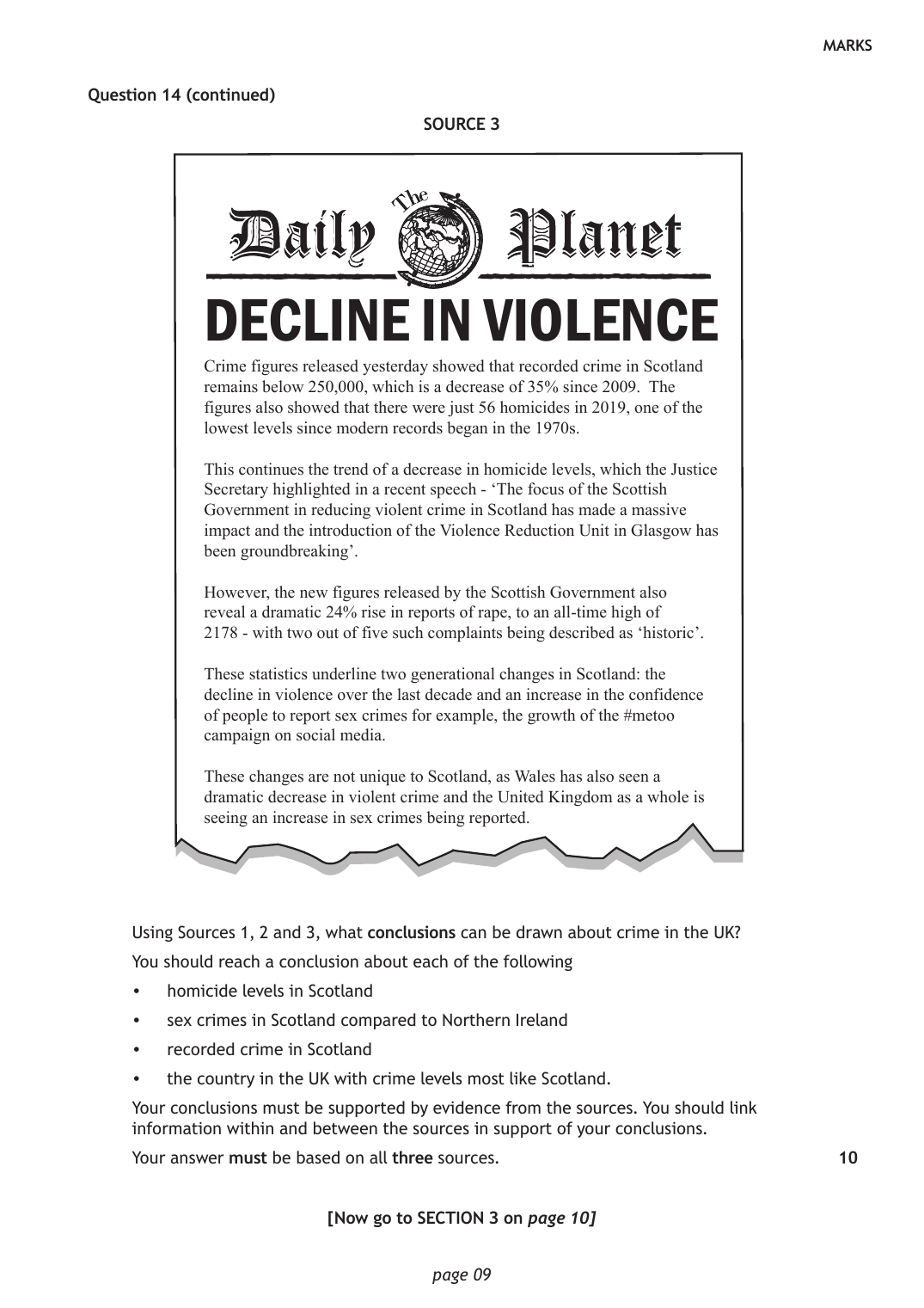
Using Sources 1, 2 and 3, what conclusions can be drawn about crime in the UK?

You should reach a conclusion about each of the following

  • homicide levels in Scotland
  • sex crimes in Scotland compared to Northern Ireland
  • recorded crime in Scotland
  • the country in the UK with crime levels most like Scotland.

Your conclusions must be supported by evidence from the sources. You should link information within and between the sources in support of your conclusions.

Your answer must be based on all three sources.

Sources (Source 1, Source 2, Source 3)

Source page 1 for this questionSource page 2 for this question
📝 Structure template — how to structure your answer

Conclusions · A source-based skills question

WFQ (words from the question)

  1. For EACH bullet point in the question, write the bullet point as a subheading, then:
  2. One conclusion that can be made about insert bullet point is insert valid conclusion.✓ 1 mark — valid conclusion
  3. Evidence to support this is shown in insert source which says/shows “insert evidence”.✓ 1 mark — evidence
  4. This clearly shows / strongly suggests insert valid conclusion — evaluative language earns the 3rd mark.✓ 1 mark — evaluative language

How it's marked

  • Conclusion + one piece of evidence = 2 marks. That is all you need for two of the three marks.
  • The 3rd mark does NOT come from a second piece of evidence linked to the same point — it comes from using evaluative terminology (e.g. “this clearly shows”, “the strongest evidence is”, “significantly”, “overwhelmingly”).
  • Comparison bullets (e.g. the UK compared with another country): you must give evidence about BOTH sides — but two pieces of evidence together still earn only ONE evidence mark, not two. You can still earn the 3rd mark with evaluative language, exactly as normal.
  • Up to 3 marks per bullet point; four conclusions (one per bullet point) are needed for full marks (10).
  • Tip: turn each bullet point into a question (e.g. “What is…?”, “What are…?”, “Which…?”, “How…?”) — the answer you give is your conclusion.
  • Conclusion + evidence = 2 marks. For the 3rd mark add evaluative language — a second quote linked to the same point does NOT earn it.
  • For a comparison bullet you must back BOTH sides with evidence — but that is still only one evidence mark, not two. The 3rd mark still comes from evaluative language.
✓ Reveal marking scheme
Max 10 marks

These are possible/exemplar answers from the marking instructions — other valid points can also gain marks.

How marks are awarded
  • The candidate is required to use a limited range of sources and draw valid conclusions from them, with supporting evidence.
  • Candidates should draw conclusions using the headings/bullet points in the question.
  • Candidates should be highly credited if they draw conclusions which show interaction between the sources.
  • For full marks, four developed conclusions must be given.

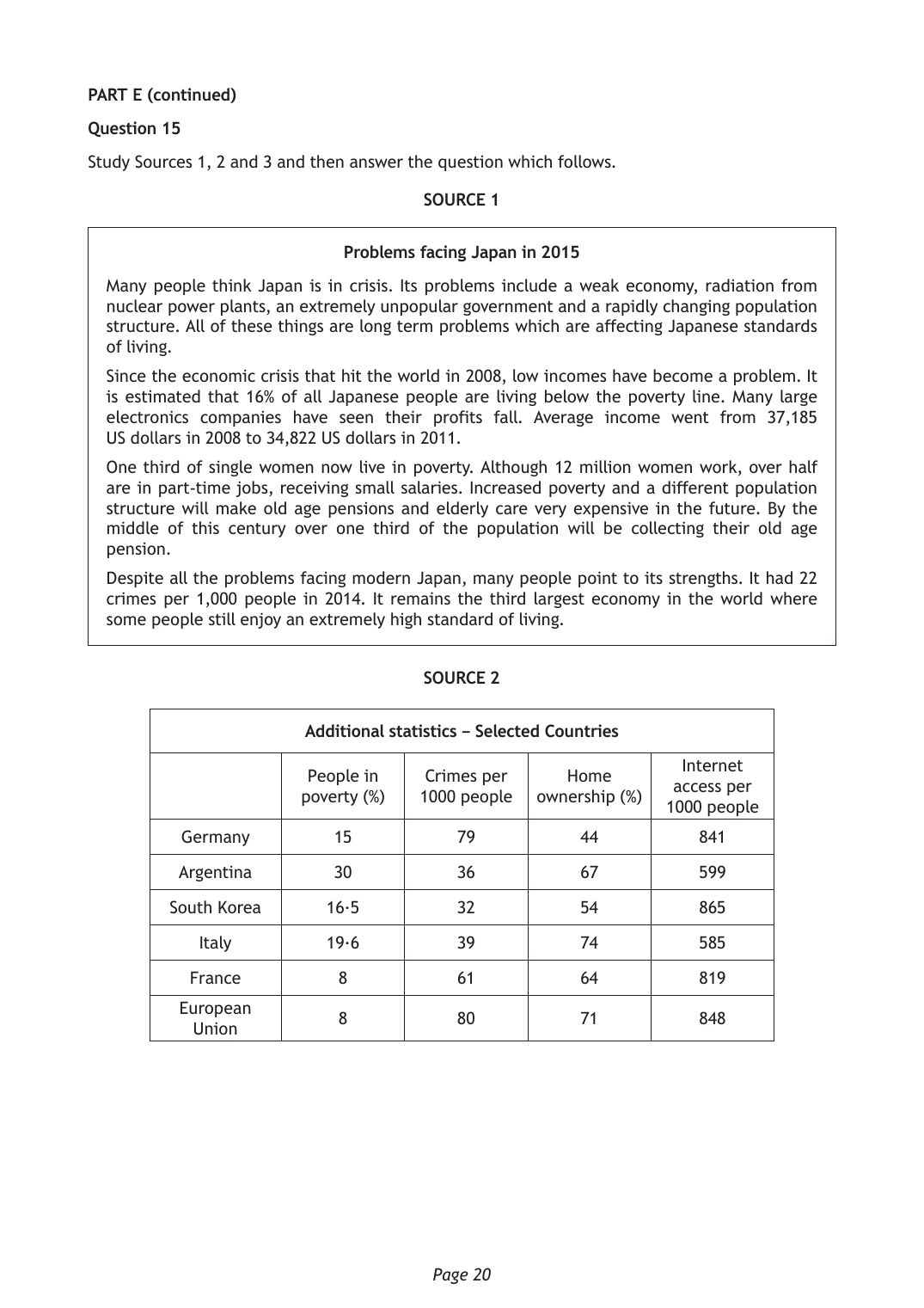
HOMICIDE LEVELS IN SCOTLAND

  1. Conclusion: Homicide levels in Scotland have decreased. (1 mark — valid conclusion)
  2. Conclusion: Homicide levels in Scotland have decreased. Evidence: This is supported by Source 3 which states ‘Crime figures released yesterday….in Scotland….showed that there were just 56 homicides in 2019, one of the lowest levels since modern records began in the 1970s’. (2 marks — valid conclusion with evidence)
  3. Conclusion: Homicide levels in Scotland have decreased. Evidence: This is supported by Source 3 which states ‘Crime figures released yesterday…..in Scotland…..showed that there were just 56 homicides in 2019, one of the lowest levels since modern records began in the 1970s.’ In 2016 there were 62 homicides in Scotland and every year since this number has decreased (Source 2). This shows a decrease of 6 homicides over three years. (3 marks — valid conclusion with evidence and evaluative terminology)
SEX CRIMES IN SCOTLAND COMPARED TO NORTHERN IRELAND

  1. Conclusion: There are more sex crimes in Scotland than in Northern Ireland. (1 mark — valid conclusion)
  2. Conclusion: There are more sex crimes in Scotland than in Northern Ireland. Evidence: Source 1 states Scotland has 10,822 sex crimes compared to 2,336 in Northern Ireland. (2 marks — valid conclusion with evidence)
  3. Conclusion: There are more sex crimes in Scotland than in Northern Ireland. Evidence: Source 1 states Scotland has 10,822 sex crimes, an increase of 10%, compared to 2,336 in Northern Ireland where sex crimes have not increased. This shows Scotland’s total is more than four times greater than Northern Ireland’s. (3 marks — valid conclusion with evidence and evaluative terminology)
RECORDED CRIME IN SCOTLAND

  1. Conclusion: None Evidence: ‘In 1991, over 500,000 crimes were recorded in Scotland, but in 2019 this was just under 250,000.’ (1 mark - correct identification of information)
  2. Conclusion: Recorded crime in Scotland has fallen over the years. Evidence: Source 1 states that ‘In 1991, over 500,000 crimes were recorded in Scotland, but in 2019 this was just under 250,000.’ (2 marks — valid conclusion with evidence)
  3. Conclusion: Recorded crime in Scotland has fallen over the years. Evidence: Source 1 states that ‘In 1991, over 500,000 crimes were recorded in Scotland, but in 2019 this was under 250,000.’ This is backed up in Source 3 where it states ‘crime figures released yesterday showed that recorded crime in Scotland remains below 250,000, which is a decrease of 35% since 2009’. This shows that recorded crime has more than halved since 1991. (3 marks — valid conclusion with evidence and evaluative terminology)
THE COUNTRY IN THE UK WITH CRIME LEVELS MOST LIKE SCOTLAND

  1. Conclusion: The country in the UK which has crime levels most like Scotland is Wales. (1 mark — valid conclusion)
  2. Conclusion: The country in the UK which has crime levels most like Scotland is Wales. Evidence: Source 1 shows that the figure for recorded crime in Scotland is 238,406 and for Wales is 219,111. (2 marks — valid conclusion with evidence)
  3. Conclusion: The country in the UK which has crime levels most like Scotland is Wales. Evidence: Source 1 shows that the figure for recorded crime in Scotland is 238,406 and for Wales is 219,111. Amongst UK countries, this is the figure which is closest to Scotland. This is also backed up in Source 3 where it states ‘These changes are not unique to Scotland as Wales has also seen a dramatic decrease in violent crime’. (3 marks — valid conclusion with evidence and evaluative terminology)
Source: 2021 N5 History · X849/75/11 · Q14Question paper (PDF, p.8) ↗Marking instructions (PDF, p.26) ↗
Conclusions10 marks2019Q7Democracy in Scotland and the UK

Study Sources 1, 2 and 3 and then answer the question which follows.

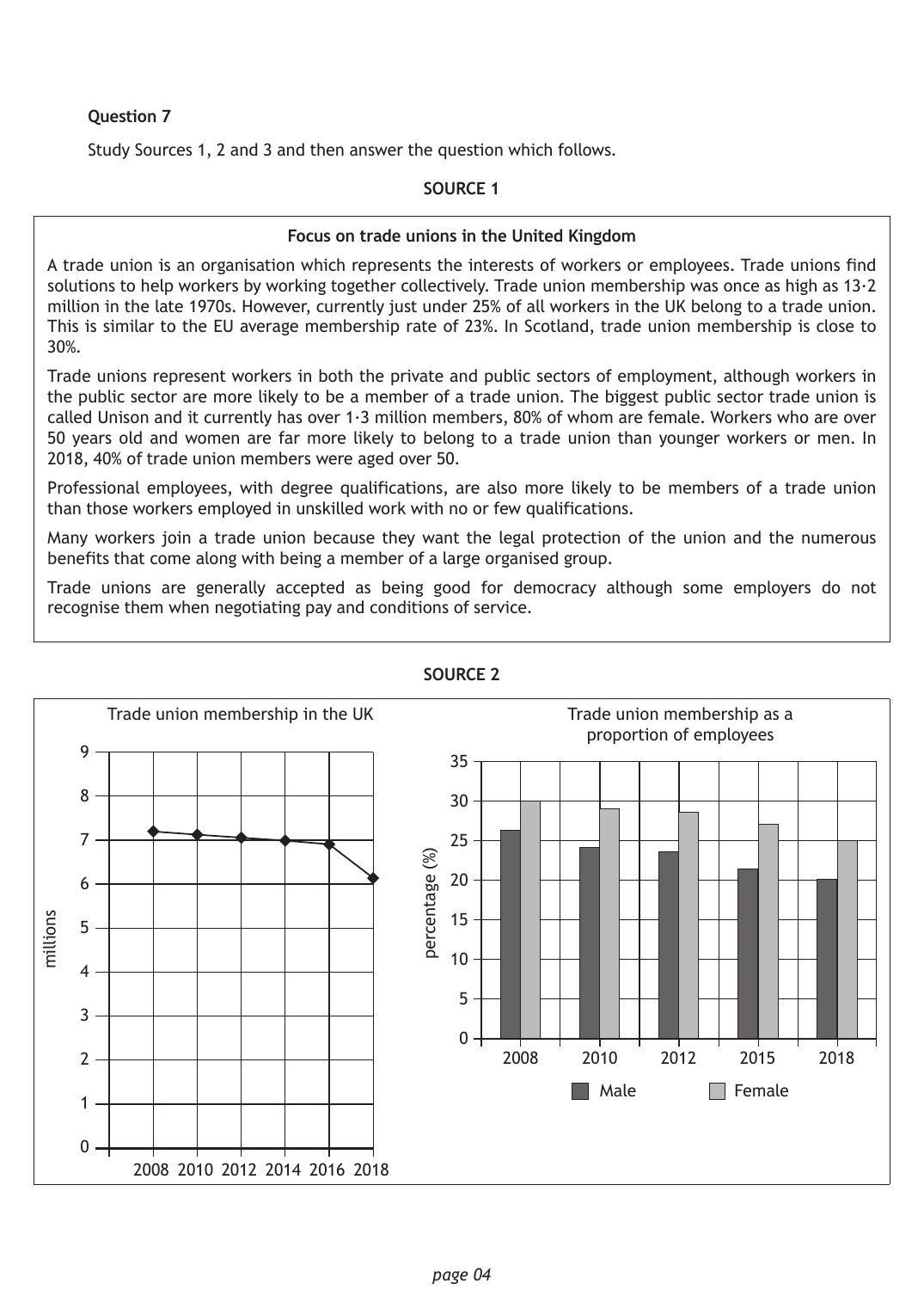
Using Sources 1, 2 and 3, what conclusions can be drawn about trade unions in the UK?

You should reach a conclusion about each of the following

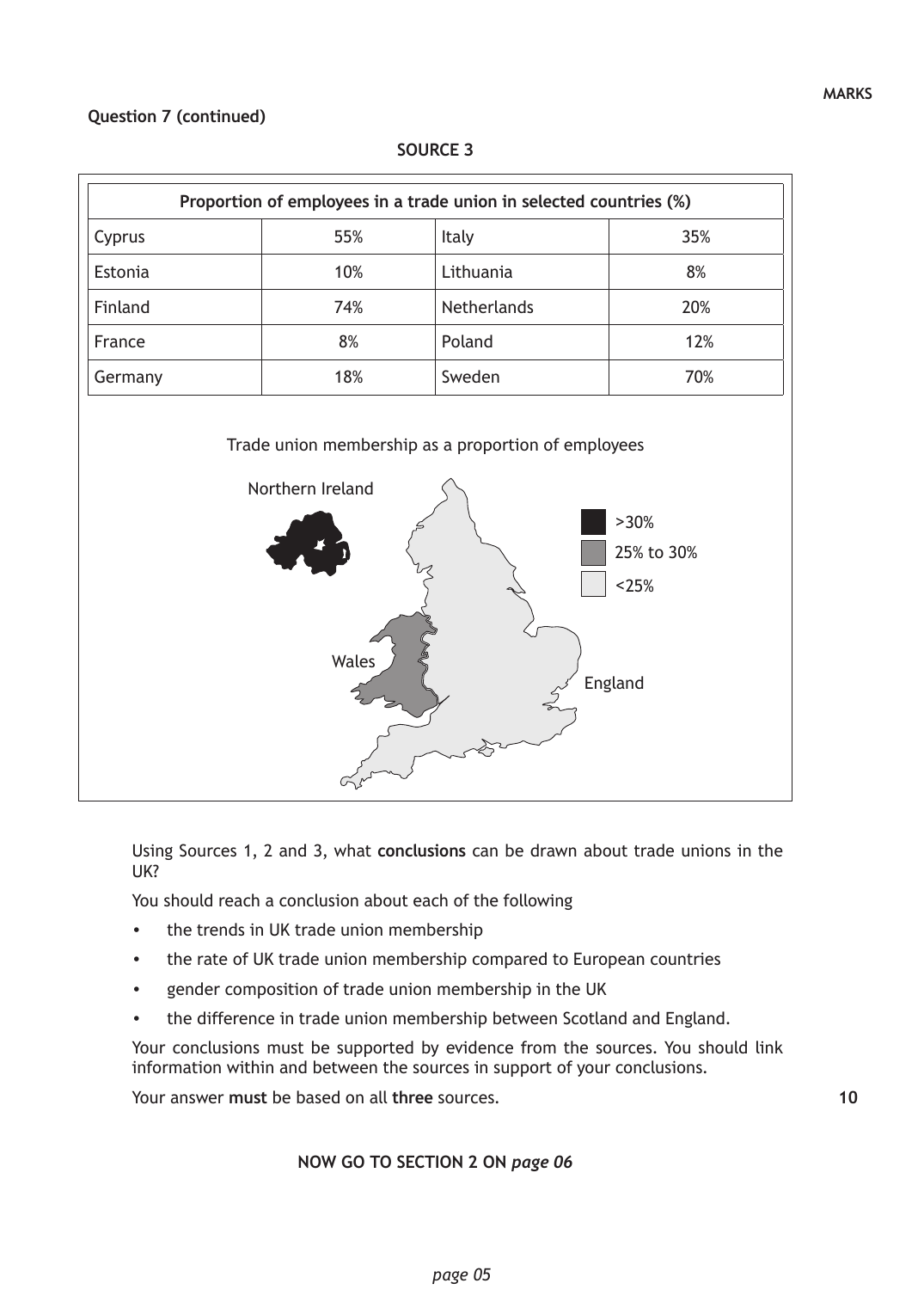
  • the trends in UK trade union membership
  • the rate of UK trade union membership compared to European countries
  • gender composition of trade union membership in the UK
  • the difference in trade union membership between Scotland and England.

Your conclusions must be supported by evidence from the sources. You should link information within and between the sources in support of your conclusions.

Your answer must be based on all three sources.

Sources (Source 1, Source 2, Source 3)

Source page 1 for this questionSource page 2 for this question
📝 Structure template — how to structure your answer

Conclusions · A source-based skills question

WFQ (words from the question)

  1. For EACH bullet point in the question, write the bullet point as a subheading, then:
  2. One conclusion that can be made about insert bullet point is insert valid conclusion.✓ 1 mark — valid conclusion
  3. Evidence to support this is shown in insert source which says/shows “insert evidence”.✓ 1 mark — evidence
  4. This clearly shows / strongly suggests insert valid conclusion — evaluative language earns the 3rd mark.✓ 1 mark — evaluative language

How it's marked

  • Conclusion + one piece of evidence = 2 marks. That is all you need for two of the three marks.
  • The 3rd mark does NOT come from a second piece of evidence linked to the same point — it comes from using evaluative terminology (e.g. “this clearly shows”, “the strongest evidence is”, “significantly”, “overwhelmingly”).
  • Comparison bullets (e.g. the UK compared with another country): you must give evidence about BOTH sides — but two pieces of evidence together still earn only ONE evidence mark, not two. You can still earn the 3rd mark with evaluative language, exactly as normal.
  • Up to 3 marks per bullet point; four conclusions (one per bullet point) are needed for full marks (10).
  • Tip: turn each bullet point into a question (e.g. “What is…?”, “What are…?”, “Which…?”, “How…?”) — the answer you give is your conclusion.
  • Conclusion + evidence = 2 marks. For the 3rd mark add evaluative language — a second quote linked to the same point does NOT earn it.
  • For a comparison bullet you must back BOTH sides with evidence — but that is still only one evidence mark, not two. The 3rd mark still comes from evaluative language.
✓ Reveal marking scheme
Max 10 marks

These are possible/exemplar answers from the marking instructions — other valid points can also gain marks.

How marks are awarded
  • The candidate is required to use a limited range of sources and draw valid conclusions from them, with supporting evidence.
  • Candidates should draw conclusions using the headings/bullet points in the question.
  • Candidates should be highly credited if they draw conclusions which show interaction between the sources.
  • For full marks, four developed conclusions must be given.

THE TRENDS IN UK TRADE UNION MEMBERSHIP

  1. Conclusion: Trade union membership in the UK has decreased. (1 mark — valid conclusion)
  2. Conclusion: Trade union membership in the UK has decreased. Evidence: In Source 2 it shows that in 2008, trade union membership was just over 7 million but by 2018 it had fallen to just over 6 million. (2 marks — conclusion and evidence from one source)
  3. Conclusion: Trade union membership in the UK has decreased. Evidence: In Source 2 it shows that in 2008 trade union membership was just over 7 million but by 2018 it had fallen to just over 6 million. This can be linked to Source 1 that states that trade union membership was once as high as 13·2 million, meaning that membership has more than halved in total since the late 1970s. (3 marks — conclusion and evidence from two sources with evaluative terminology)
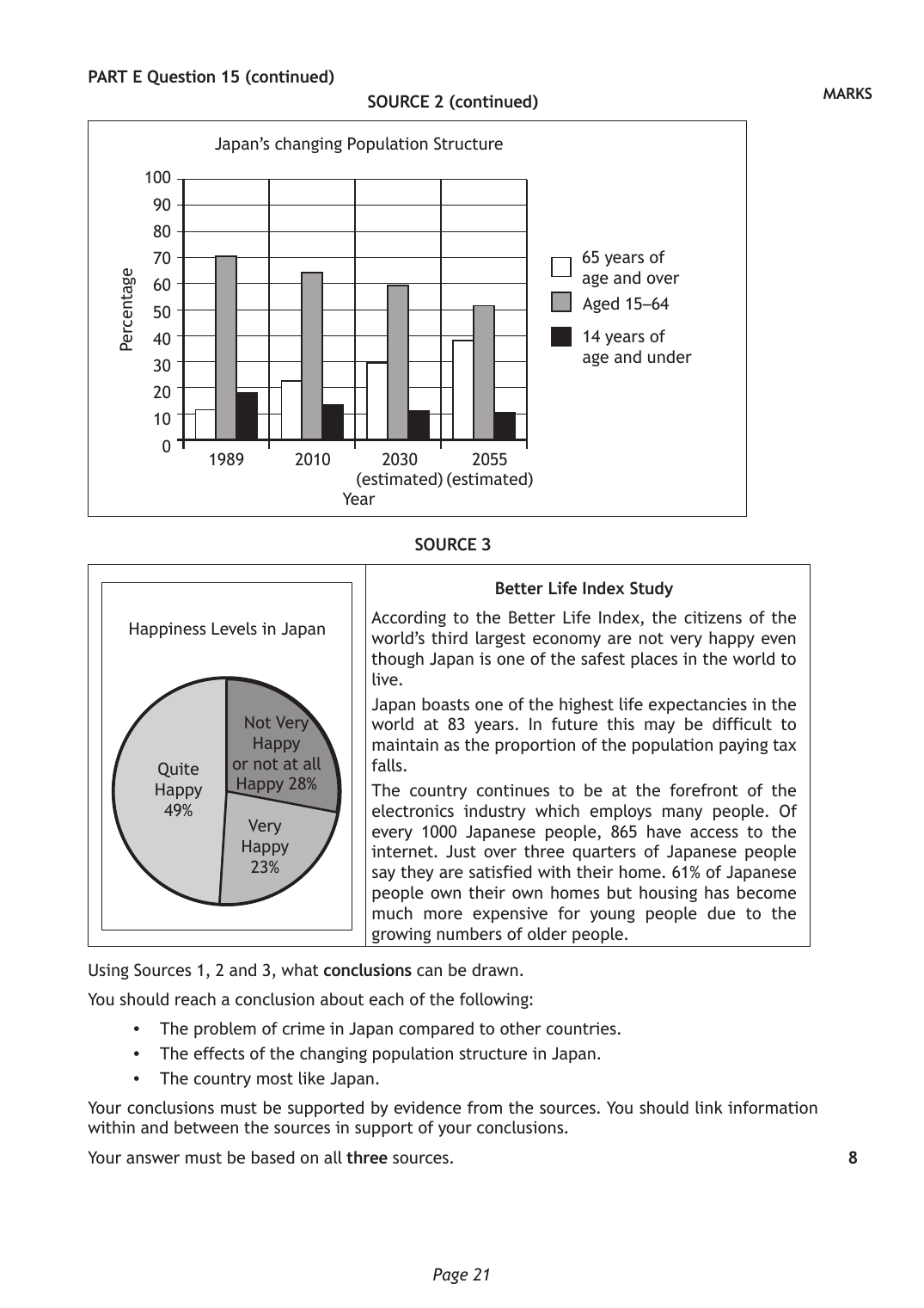
THE RATE OF UK TRADE UNION MEMBERSHIP COMPARED TO EUROPEAN COUNTRIES

  1. Conclusion: Trade union membership in the UK is higher than many other European countries. (1 mark — valid conclusion)
  2. Conclusion: Trade union membership in the UK is higher than many other European countries. Evidence: In Source 1 it shows that just under 25% of all workers in the UK are members of trade unions. According to Source 3, this is higher than many other European countries such as Germany, Poland, France and Lithuania. (2 marks — conclusion and evidence from two sources)
  3. Conclusion: Trade union membership in the UK is higher than many other European countries. Evidence: In Source 1 it shows that just under 25% of all workers in the UK are members of trade unions. According to Source 3, this is higher than many other European countries such as Germany, France and Lithuania. France has only 8% of employees in trade unions, this is around 17% lower than the UK which is a significant difference. (3 marks — conclusion and evidence from two sources with evaluative terminology)
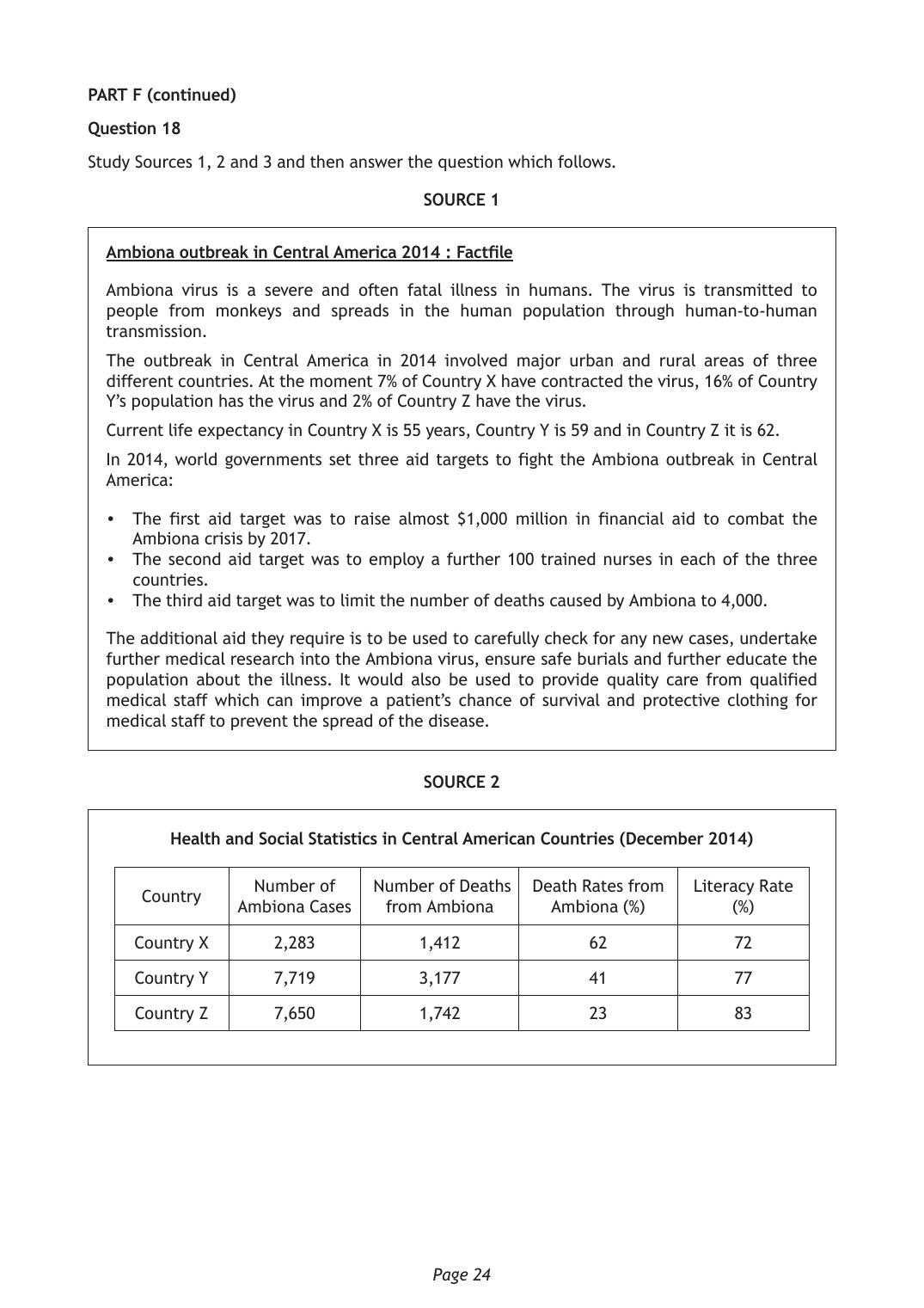
GENDER COMPOSITION OF TRADE UNION MEMBERSHIP IN THE UK

  1. Conclusion: Women are more likely than men to belong to a trade union in the UK. (1 mark — valid conclusion)
  2. Conclusion: Women are more likely than men to belong to a trade union in the UK. Evidence: In Source 1 it states that women are more likely to belong to a trade union then men and in some trade unions, such as Unison, women account for the majority of members. (2 marks — conclusion and evidence from one source)
  3. Conclusion: Women are more likely than men to belong to a trade union in the UK. Evidence: In Source 1 it states that women are more likely to belong to a trade union then men and in some trade unions, such as Unison, women account for the majority of members. This can be supported by Source 2 that shows female membership in the last ten years is consistently higher than male membership. For example, in 2018, 25% of women belonged to a trade union which was 5% higher than the rate for male membership. (3 marks — conclusion and information from two sources with evaluative terminology)
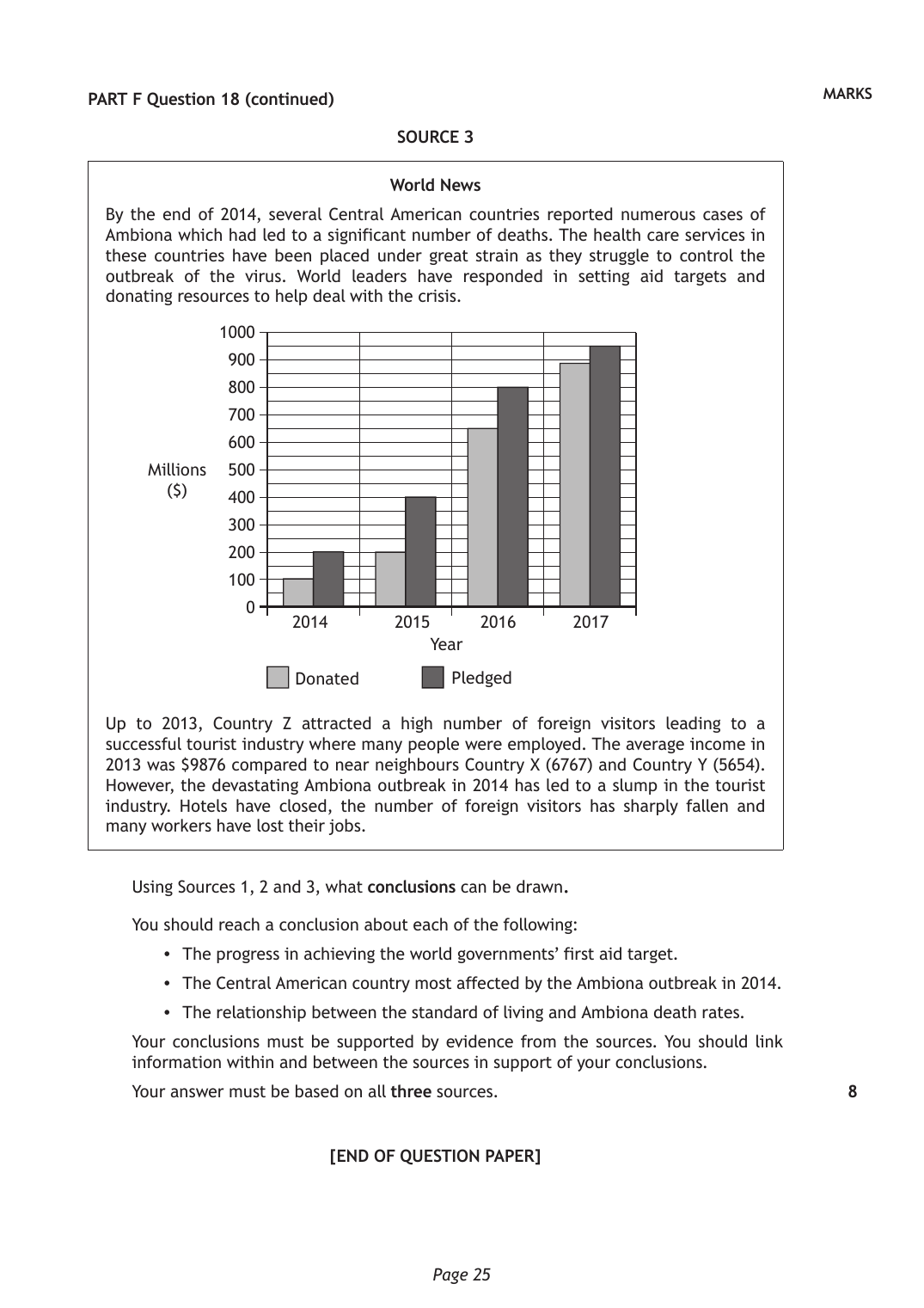
THE DIFFERENCE IN TRADE UNION MEMBERSHIP BETWEEN SCOTLAND AND ENGLAND

  1. Conclusion: Trade union membership is higher in Scotland than in England. (1 mark — valid conclusion)
  2. Conclusion: Trade union membership is higher in Scotland than in England. Evidence: Source 1 states trade union membership in Scotland is close to 30% but Source 3 shows England's trade union membership rate is less than 25%. (2 marks — conclusion and evidence from two sources)
  3. Conclusion: Trade union membership is higher in Scotland than in England. Evidence: Source 1 states trade union membership in Scotland is close to 30% but Source 3 shows England's trade union membership rate is less than 25%. This shows that employees in England are less likely to belong to a trade union than employees in Scotland. (3 marks — conclusion and information from two sources with evaluative terminology)
Conclusions8 marks2019 specimenQ3⏳ Older formatDemocracy in Scotland and the United Kingdom

Study Sources 1, 2 and 3 below, then attempt the question which follows.

Using Sources 1, 2 and 3 above, what conclusions can be drawn about committees in the Scottish Parliament?

You should reach a conclusion about each of the following:

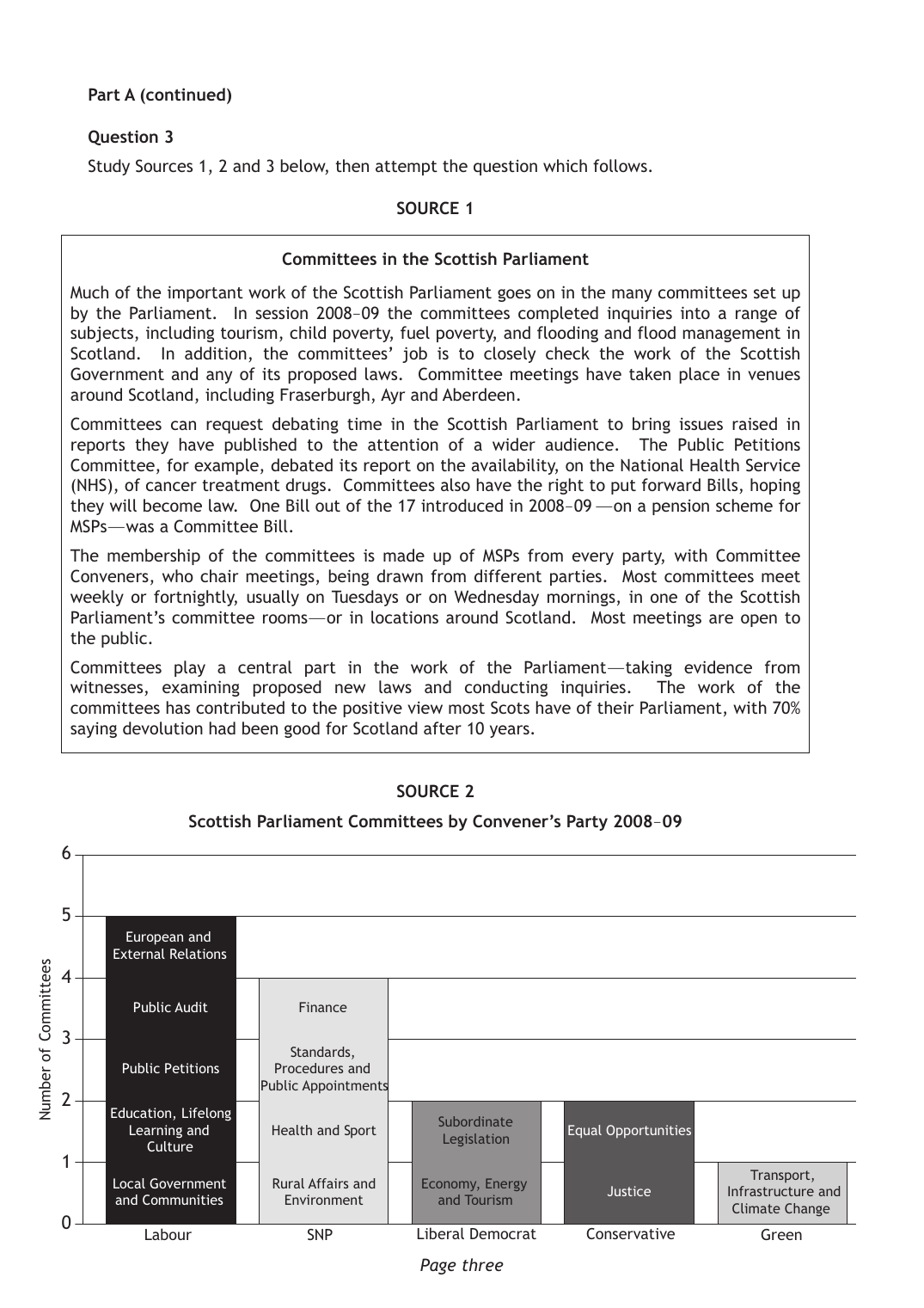
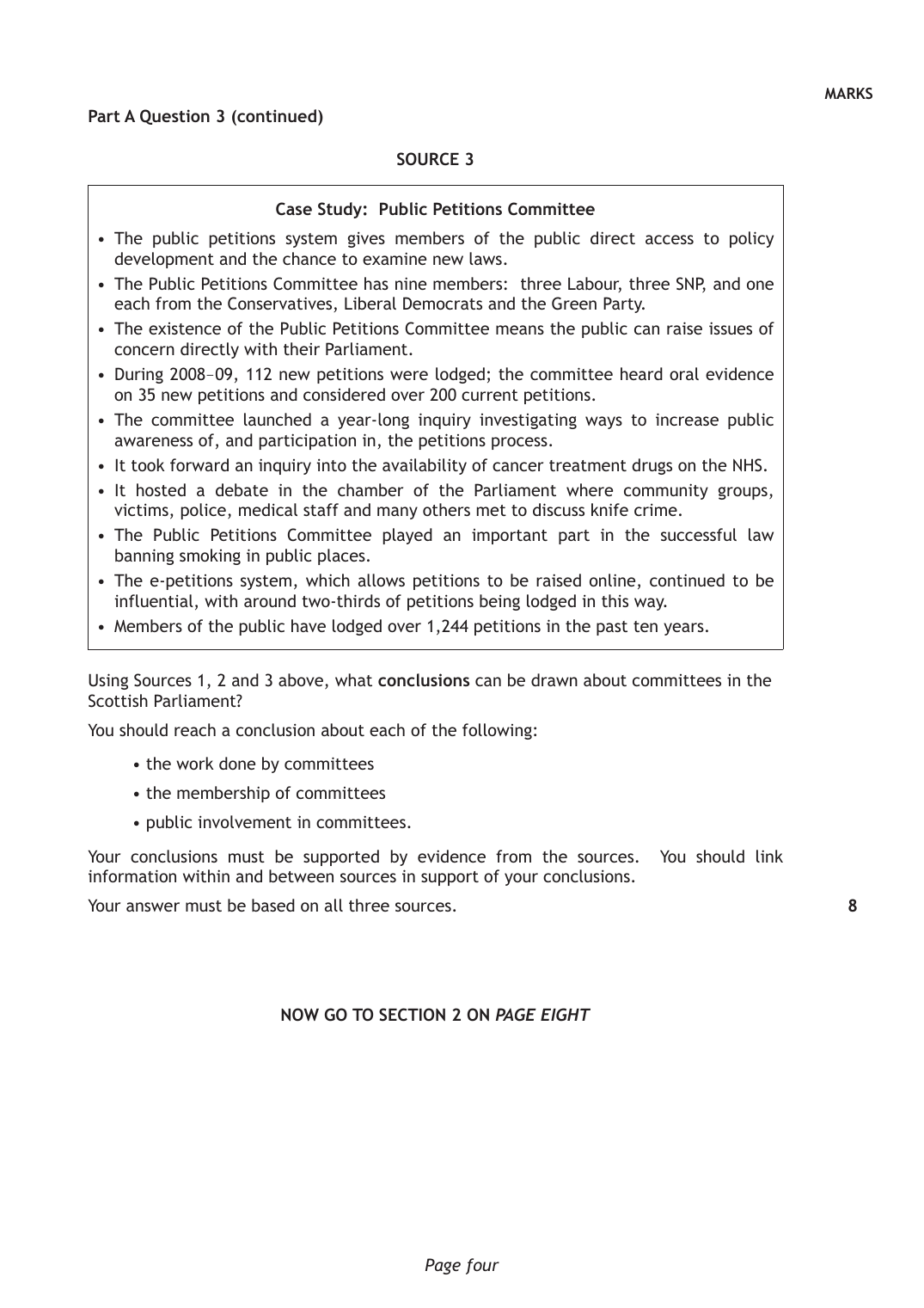
  • the work done by committees
  • the membership of committees
  • public involvement in committees.

Your conclusions must be supported by evidence from the sources. You should link information within and between sources in support of your conclusions.

Your answer must be based on all three sources.

Sources (Source 1, Source 2, Source 3)

Source page 1 for this questionSource page 2 for this question
📝 Structure template — how to structure your answer

Conclusions · A source-based skills question

WFQ (words from the question)

  1. For EACH bullet point in the question, write the bullet point as a subheading, then:
  2. One conclusion that can be made about insert bullet point is insert valid conclusion.✓ 1 mark — valid conclusion
  3. Evidence to support this is shown in insert source which says/shows “insert evidence”.✓ 1 mark — evidence
  4. This clearly shows / strongly suggests insert valid conclusion — evaluative language earns the 3rd mark.✓ 1 mark — evaluative language

How it's marked

  • Conclusion + one piece of evidence = 2 marks. That is all you need for two of the three marks.
  • The 3rd mark does NOT come from a second piece of evidence linked to the same point — it comes from using evaluative terminology (e.g. “this clearly shows”, “the strongest evidence is”, “significantly”, “overwhelmingly”).
  • Comparison bullets (e.g. the UK compared with another country): you must give evidence about BOTH sides — but two pieces of evidence together still earn only ONE evidence mark, not two. You can still earn the 3rd mark with evaluative language, exactly as normal.
  • Up to 3 marks per bullet point; four conclusions (one per bullet point) are needed for full marks (10).
  • Tip: turn each bullet point into a question (e.g. “What is…?”, “What are…?”, “Which…?”, “How…?”) — the answer you give is your conclusion.
  • Conclusion + evidence = 2 marks. For the 3rd mark add evaluative language — a second quote linked to the same point does NOT earn it.
  • For a comparison bullet you must back BOTH sides with evidence — but that is still only one evidence mark, not two. The 3rd mark still comes from evaluative language.
✓ Reveal marking scheme
Max 8 marks

These are possible/exemplar answers from the marking instructions — other valid points can also gain marks.

How marks are awarded
  • The candidate is required to use a limited range of sources and draw valid conclusions from them, with supporting evidence.
  • Candidates should draw conclusions using the headings/bullet points in the question.
  • Candidates should be highly credited if they draw conclusions which show interaction between the sources. Answers which merely repeat the source material without making judgements or drawing conclusions should be awarded zero marks.
  • For full marks, three developed conclusions must be given.

The work done by committees

  1. Much of the important work of the Parliament is done in committees (Source 1). Committees on public audit, finance, justice etc (Source 2). Hosted debates on knife crime (Source 3). [1 mark awarded overall—no conclusion reached or judgement made. A series of relevant points arranged under a correct heading.]
  2. Much of the important work of the Parliament done in committees (Source 1).
  3. Completed inquiries into a range of subjects (Source 1).
  4. Role of scrutinising the work of the Government and legislation (Source 1) link to paragraph 4 (Source 1).
  5. Can request debating time (Source 1) link with (Source 3) debate on cancer treatment drugs.
  6. Can introduce legislation—but only one in 2008–09 (Source 1).
  7. Source 2 indicates the range of areas of interest of Committees, eg Finance, Public Petitions, Justice (Source 2).
  8. 2008-09 Public Petition Committee—112 new petitions lodged; considered over 200 petitions (Source 3).
  9. Inquiry into availability of cancer treatment drugs (Source 3) link with (Source 1).
  10. Hosted debates on knife crime (Source 3).
  11. Possible conclusion—committees do a lot of work and play an important role in the work of the Scottish Parliament.

The membership of committees

  1. The membership of the committees is made up of MSPs from every party. This is supported by evidence from Source 3 which says The Public Petitions Committee has 9 members; Labour 3, SNP 3, and one each from the Conservatives, Liberal Democrats and the Green Party. [2 marks. Conclusion given but taken from Source 1—supported by accurate and relevant evidence from Source 3.]
  2. MSPs from every party are members of the committees (Source 1).
  3. Committee Convenors, who chair meetings, drawn from different parties (Source 1) link with Source 2.
  4. Conveners drawn from Conservative, Labour, SNP, Liberal Democrats and Greens (Source 2).
  5. The Public Petitions Committee has 9 members; Labour 3, SNP 3, and one each from the Conservatives, Liberal Democrats and the Green Party (Source 3).
  6. Possible conclusion—all parties play a role in the Committees.

Public involvement in committees

  1. Members of the public are able to get involved in politics through the committee system. [original conclusion] This conclusion is supported by evidence from Source 1 which says that committee meetings have been held around Scotland in places such as Fraserburgh, Ayr and Aberdeen. This is further supported in Source 3 which says that the Public Petitions Committee system gives members of the public direct access to policy development and also that members of the public have lodged over 1,244 petitions in the last 10 years. [3 marks awarded]
  2. Committee meetings have taken place in venues around Scotland, including Fraserburgh, Ayr and Aberdeen (Source 1).
  3. Most committees meet weekly or fortnightly in one of the Scottish Parliament’s committee rooms—or in locations around Scotland (Source 1).
  4. Most meetings are open to the public (Source 1).
  5. The public petitions system provides members of the public with direct access to the policy development and scrutiny process (Source 3).
  6. The existence of the Public Petitions Committee means that petitioners can raise issues of concern directly with their Parliament (Source 3).
  7. The committee launched a year-long inquiry investigating ways to increase public awareness of, and participation in, the petitions process (Source 3).
  8. The e-petitions system, which allows petitions to be raised online, continued to be influential, with around two-thirds of petitions being lodged in this form (Source 3).
  9. 1,244 petitions have been lodged by members of the public over 10 years (Source 3).
  10. Possible conclusion—the committees are open to the public and the public can participate in a variety of ways.
Source: 2019 specimen N5 History · X849/75/11 · Q3Question paper (PDF, p.3) ↗Marking instructions (PDF, p.26) ↗
Conclusions8 marks2019 specimenQ3⏳ Older formatDemocracy in Scotland and the United Kingdom

Study Sources 1, 2 and 3 below, then attempt the question which follows.

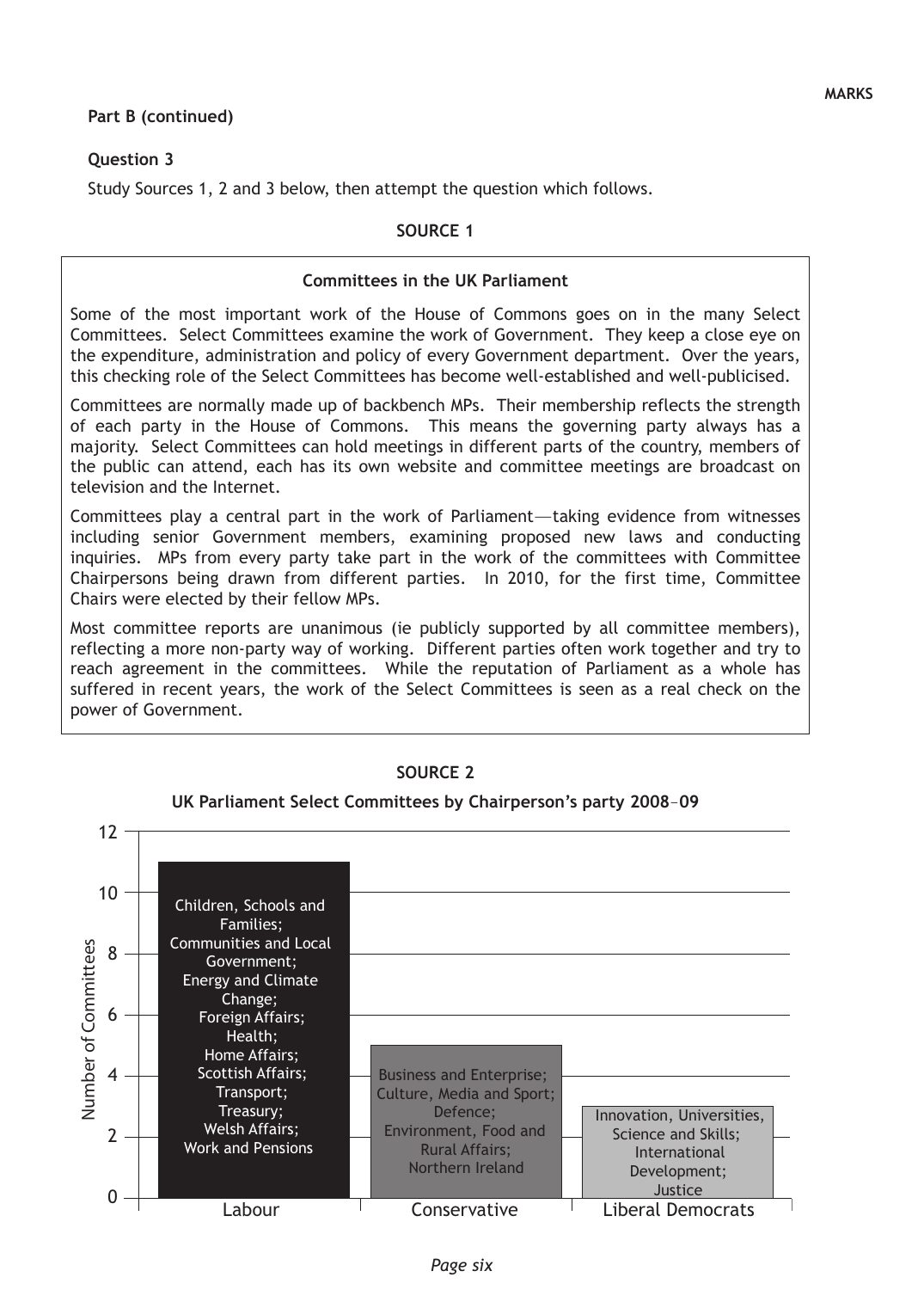
Using Sources 1, 2 and 3 above, what conclusions can be drawn about committees in the UK Parliament?

You should reach a conclusion about each of the following:

  • the work done by committees
  • the membership of committees
  • public involvement in committees.

Your conclusions must be supported by evidence from the sources. You should link information within and between sources in support of your conclusions.

Sources (Source 1, Source 2, Source 3)

Source page 1 for this questionSource page 2 for this question
📝 Structure template — how to structure your answer

Conclusions · A source-based skills question

WFQ (words from the question)

  1. For EACH bullet point in the question, write the bullet point as a subheading, then:
  2. One conclusion that can be made about insert bullet point is insert valid conclusion.✓ 1 mark — valid conclusion
  3. Evidence to support this is shown in insert source which says/shows “insert evidence”.✓ 1 mark — evidence
  4. This clearly shows / strongly suggests insert valid conclusion — evaluative language earns the 3rd mark.✓ 1 mark — evaluative language

How it's marked

  • Conclusion + one piece of evidence = 2 marks. That is all you need for two of the three marks.
  • The 3rd mark does NOT come from a second piece of evidence linked to the same point — it comes from using evaluative terminology (e.g. “this clearly shows”, “the strongest evidence is”, “significantly”, “overwhelmingly”).
  • Comparison bullets (e.g. the UK compared with another country): you must give evidence about BOTH sides — but two pieces of evidence together still earn only ONE evidence mark, not two. You can still earn the 3rd mark with evaluative language, exactly as normal.
  • Up to 3 marks per bullet point; four conclusions (one per bullet point) are needed for full marks (10).
  • Tip: turn each bullet point into a question (e.g. “What is…?”, “What are…?”, “Which…?”, “How…?”) — the answer you give is your conclusion.
  • Conclusion + evidence = 2 marks. For the 3rd mark add evaluative language — a second quote linked to the same point does NOT earn it.
  • For a comparison bullet you must back BOTH sides with evidence — but that is still only one evidence mark, not two. The 3rd mark still comes from evaluative language.
✓ Reveal marking scheme
Max 8 marks

These are possible/exemplar answers from the marking instructions — other valid points can also gain marks.

How marks are awarded
  • The candidate is required to use a limited range of sources and draw valid conclusions from them, with supporting evidence.
  • Candidates should draw conclusions using the headings/bullet points in the question.
  • Candidates should be highly credited if they draw conclusions which show interaction between the sources. Answers which merely repeat the source material without making judgements or drawing conclusions should be awarded zero marks.
  • For full marks, three developed conclusions must be given.

The work done by committees

  1. Much of the important work of the Parliament done in select committees (Source 1). There are Select Committees on lots of issues (Source 2). Select Committees have the power to investigate what they want. (Source 3). [1 mark awarded overall—no conclusion reached or judgement made. A series of relevant points arranged under a correct heading.]
  2. Some of the most important work of Parliament goes on in the many Select Committees (Source 1).
  3. Role is to “examine the expenditure, administration and policy of the principal Government departments” (Source 1).
  4. Over the years, the scrutiny role of the Select Committees has become well-established and well-publicised (Source 1).
  5. Committees play a central part in the work of the Parliament—taking evidence from witnesses including senior Government members, scrutinising legislation and conducting inquiries (Source 1).
  6. Source 2 indicates the range of areas of interest of Committees, eg Defence, Foreign Affairs, Treasury (Source 2).
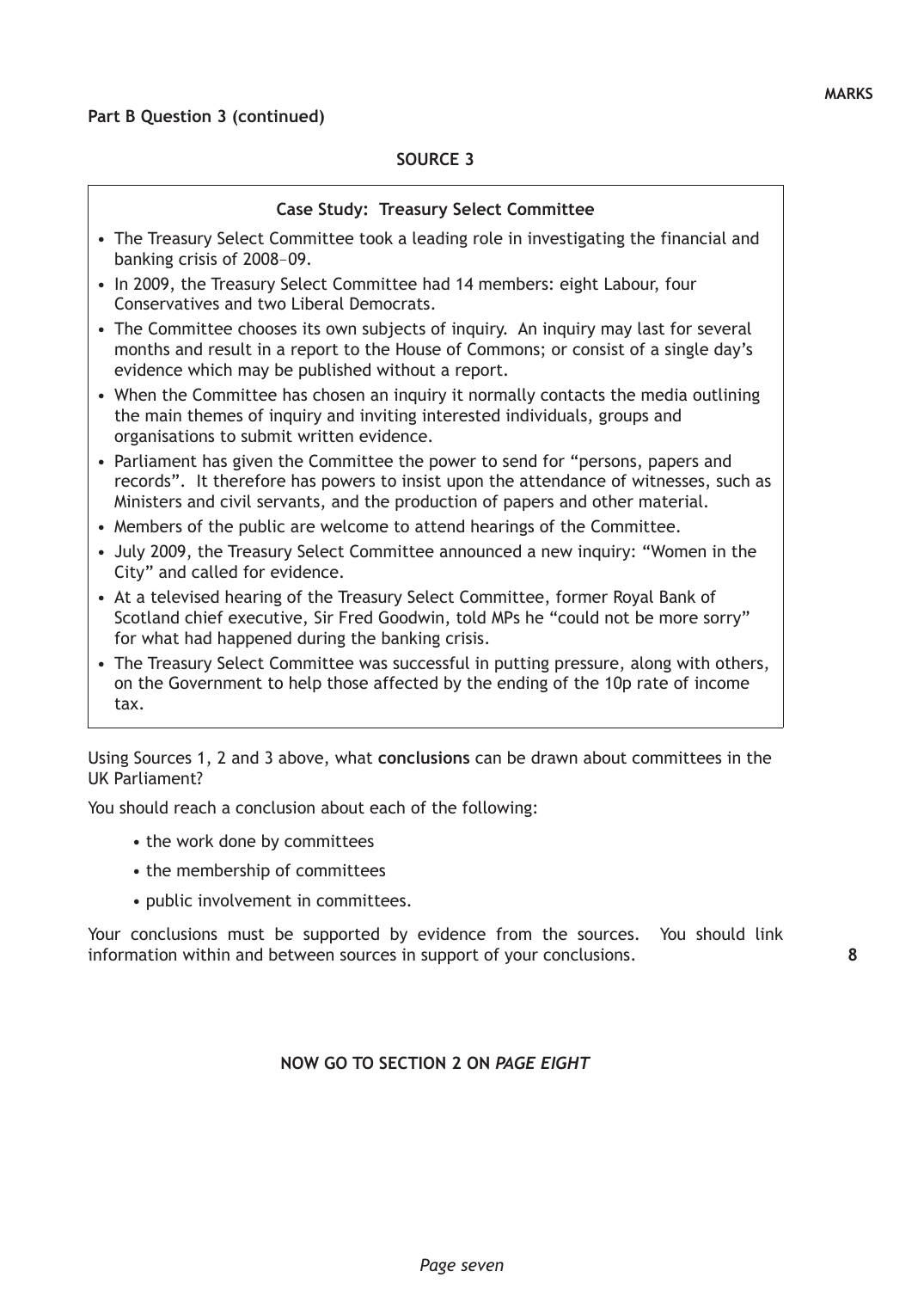
  7. The Treasury Select Committee took a leading role in investigating the financial and banking crisis of 2008–09 (Source 3).
  8. The Committee chooses its own subjects of inquiry.
  9. Parliament has given the Committee the power to send for “persons, papers and records”. It therefore has powers to insist upon the attendance of witnesses, such as ministers and civil servants, and the production of papers and other material (Source 3).
  10. Possible conclusion—Committees do a lot of work and play an important role in the work of the UK Parliament.

The membership of committees

  1. The membership of the committees is made up of backbench MPs from every party. This is supported by evidence from Source 3 which says The Treasury Select Committee has 8 Labour members and two Liberal democrats. [2 marks. Conclusion given but taken from Source 1—supported by accurate and relevant evidence from Source 3.]
  2. Committees normally consist of backbench members (Source 1).
  3. Membership reflects the composition of the parties in the House of Commons as a whole. This means the governing party always has a majority (Source 1).
  4. Most committee reports are unanimous, reflecting a more non-party way of working. Different parties often work together and try to reach agreement in the committees (Source 1).
  5. MPs from every party take part in the work of the committees with Committee Chairs being drawn from different parties (Source 1).
  6. Chairs drawn from three parties, ie Labour, Conservative and Liberal Democrats (Source 2).
  7. The Treasury Select Committee has 14 members; Labour 8, Conservatives 4, Liberal Democrats 2 (Source 3).
  8. Possible conclusion—Committees are made up of all parties although governing party (Labour in 2008–09) has biggest role.

Public involvement in committees

  1. Members of the public have several opportunities to get involved in politics through the select committee system. [original conclusion] This conclusion is supported by evidence from Source 1 which says that committee meetings have been held in different parts of the country with the public attending. The public are welcome to attend and can also feel involved through television coverage, internet broadcast and the website. The public have been involved in recent Select Committee investigations, eg Fred Goodwin and the 10p tax issue. (Source 3)
  2. Select Committees can hold meetings in different parts of the country (Source 1).
  3. Members of the public can attend (Source 1).
  4. Each has its own website and committee meetings are broadcast on television and the Internet (Source 1).
  5. Members of the public are welcome to attend hearings of the committee (Source 3).
  6. At a televised hearing of the Treasury Select Committee, former Royal Bank of Scotland chief executive Sir Fred Goodwin told MPs he “could not be more sorry” for what had happened during the banking crisis (Source 3).
  7. Possible conclusion—public does have some access to work of committees.
Source: 2019 specimen N5 History · X849/75/11 · Q3Question paper (PDF, p.6) ↗Marking instructions (PDF, p.32) ↗
Conclusions10 marks2018Q21International Issues

Study Sources 1, 2 and 3 then answer the question which follows.

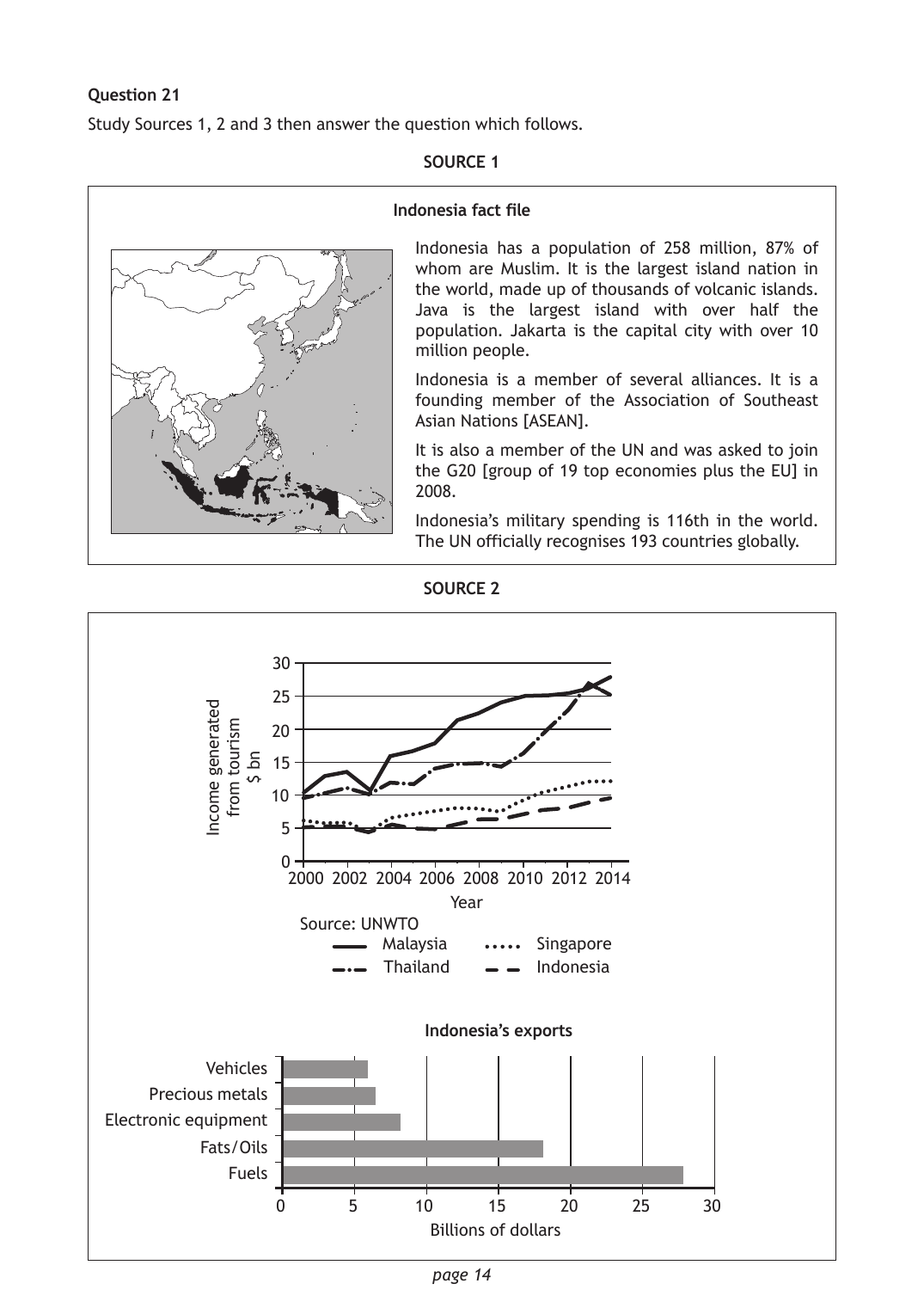
Using Sources 1, 2 and 3, what conclusions can be drawn about the influence of Indonesia?

You should reach a conclusion about each of the following:

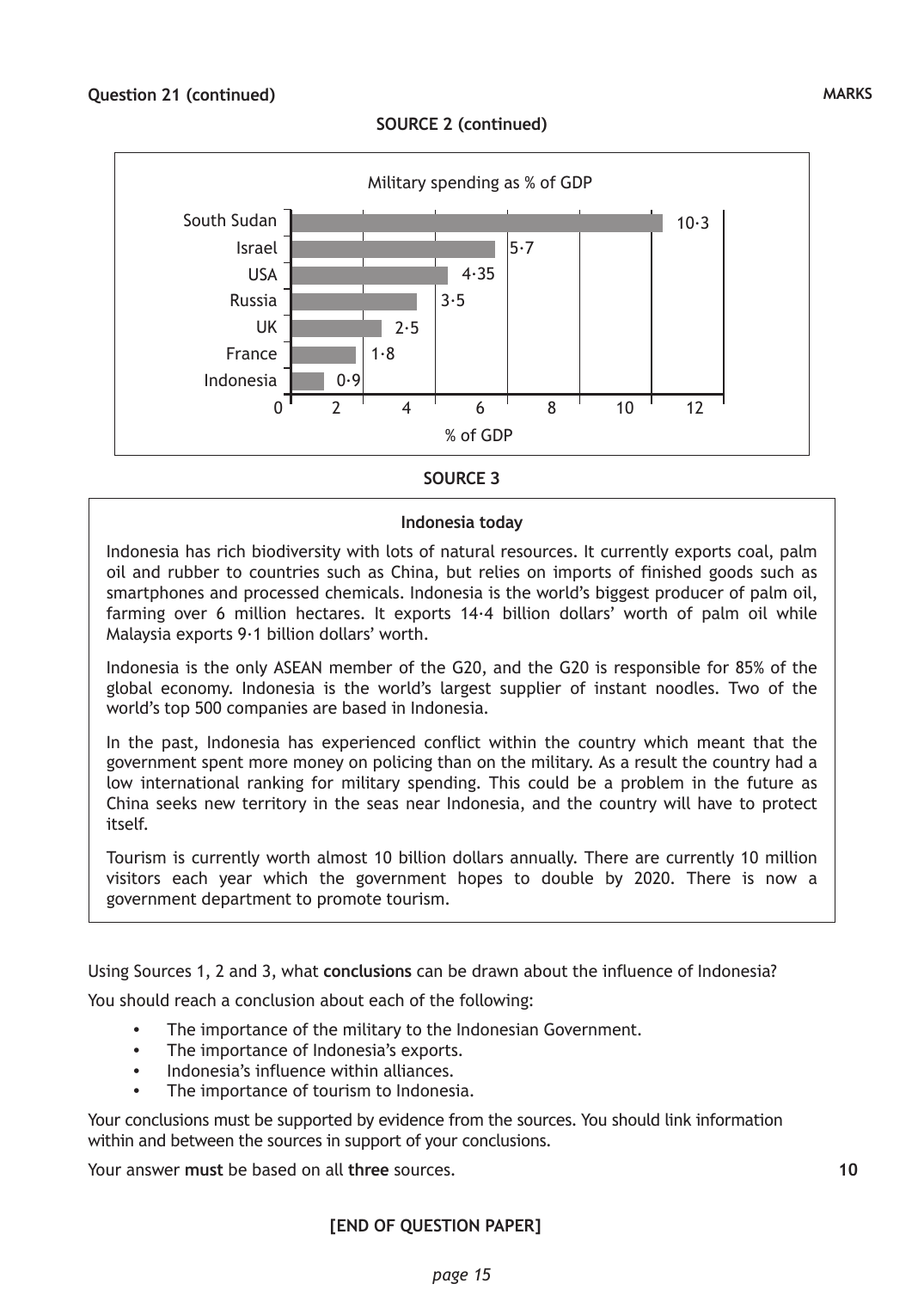
  • The importance of the military to the Indonesian Government.
  • The importance of Indonesia's exports.
  • Indonesia's influence within alliances.
  • The importance of tourism to Indonesia.

Your conclusions must be supported by evidence from the sources. You should link information within and between the sources in support of your conclusions.

Your answer must be based on all three sources.

Sources (Source 1, Source 2, Source 3)

Source page 1 for this questionSource page 2 for this question
📝 Structure template — how to structure your answer

Conclusions · A source-based skills question

WFQ (words from the question)

  1. For EACH bullet point in the question, write the bullet point as a subheading, then:
  2. One conclusion that can be made about insert bullet point is insert valid conclusion.✓ 1 mark — valid conclusion
  3. Evidence to support this is shown in insert source which says/shows “insert evidence”.✓ 1 mark — evidence
  4. This clearly shows / strongly suggests insert valid conclusion — evaluative language earns the 3rd mark.✓ 1 mark — evaluative language

How it's marked

  • Conclusion + one piece of evidence = 2 marks. That is all you need for two of the three marks.
  • The 3rd mark does NOT come from a second piece of evidence linked to the same point — it comes from using evaluative terminology (e.g. “this clearly shows”, “the strongest evidence is”, “significantly”, “overwhelmingly”).
  • Comparison bullets (e.g. the UK compared with another country): you must give evidence about BOTH sides — but two pieces of evidence together still earn only ONE evidence mark, not two. You can still earn the 3rd mark with evaluative language, exactly as normal.
  • Up to 3 marks per bullet point; four conclusions (one per bullet point) are needed for full marks (10).
  • Tip: turn each bullet point into a question (e.g. “What is…?”, “What are…?”, “Which…?”, “How…?”) — the answer you give is your conclusion.
  • Conclusion + evidence = 2 marks. For the 3rd mark add evaluative language — a second quote linked to the same point does NOT earn it.
  • For a comparison bullet you must back BOTH sides with evidence — but that is still only one evidence mark, not two. The 3rd mark still comes from evaluative language.
✓ Reveal marking scheme
Max 10 marks

These are possible/exemplar answers from the marking instructions — other valid points can also gain marks.

How marks are awarded
  • The candidate is required to use a limited range of sources and draw valid conclusions from them, with supporting evidence.
  • Candidates should draw conclusions using the headings/bullet points in the question.
  • Candidates should be highly credited if they draw conclusions which show interaction between the sources.
  • For full marks, four developed conclusions must be given.

THE IMPORTANCE OF THE MILITARY TO THE INDONESIAN GOVERNMENT

  1. Conclusion: The military are not seen as important to the Indonesian Government. (1 mark - valid conclusion)
  2. Conclusion: The military are not seen as important to the Indonesian Government. Evidence: This is supported by Source 1 which shows Indonesia is ranked 116th in the world for military spending. (2 marks - conclusion and evidence from one source)
  3. Conclusion: The military are not seen as important to the Indonesian Government. Evidence: This is supported by Source 1 which shows Indonesia is ranked 116th in the world for military spending and further by Source 2 where South Sudan spends far more of its GDP on the military (10·3% of its GDP) compared to only 0·9% of Indonesia's GDP. (3 marks - conclusion and information from two sources with evaluative terminology)
THE IMPORTANCE OF INDONESIA'S EXPORTS

  1. Conclusion: Indonesia has some very important exports. (1 mark - valid conclusion)
  2. Conclusion: Indonesia has some very important exports. Evidence: Source 3 states that Indonesia is the world's biggest producer of palm oil, farming over 6 million hectares. (2 marks - conclusion and evidence from one source)
  3. Conclusion: Indonesia has some very important exports. Evidence: Source 3 states that Indonesia is the world's biggest producer of palm oil, farming over 6 million hectares, it exports 14·4 billion dollars worth of palm oil compared to Malaysia which only exports 9·1 billion dollars worth. This is over 5 billion dollars more. (3 marks - conclusion and two pieces of evidence from one source and evaluation)

INDONESIA'S INFLUENCE WITHIN ALLIANCES

  1. Conclusion: Indonesia is very influential within alliances. (1 mark - valid conclusion)
  2. Conclusion: Indonesia is very influential within alliances. Evidence: Source 1 shows that Indonesia is a member of several important alliances such as the G20 and the UN. (2 marks - conclusion and evidence from one source)
  3. Conclusion: Indonesia is very influential within alliances. Evidence: Source 1 shows that Indonesia is a member of several important alliances such as the G20 and the UN. Indonesia is the only ASEAN member of the G20 according to Source 3, which gives it more influence than other Asian countries. (3 marks - conclusion and information from two sources)

THE IMPORTANCE OF TOURISM TO INDONESIA

  1. Conclusion: Tourism is very important to Indonesia. (1 mark - valid conclusion)
  2. Conclusion: Tourism is very important to Indonesia. Evidence: Source 2 shows that tourism brings in almost 10 billion dollars to the economy. (2 marks - conclusion and evidence from one source)
  3. Conclusion: Tourism is very important to Indonesia. Evidence: Source 2 shows that tourism brings in almost 10 billion dollars to the economy. This links to Source 3 which states the government has also set up a department to promote tourism which is significant as it must view it as important. (3 marks - conclusion and information from two sources with evaluation)
Source: 2018 N5 History · X849/75/11 · Q21Question paper (PDF, p.14) ↗Marking instructions (PDF, p.36) ↗
Conclusions8 marks2017Q3⏳ Older formatDemocracy in Scotland and the UK

Study Sources 1, 2 and 3 and then answer the question which follows.

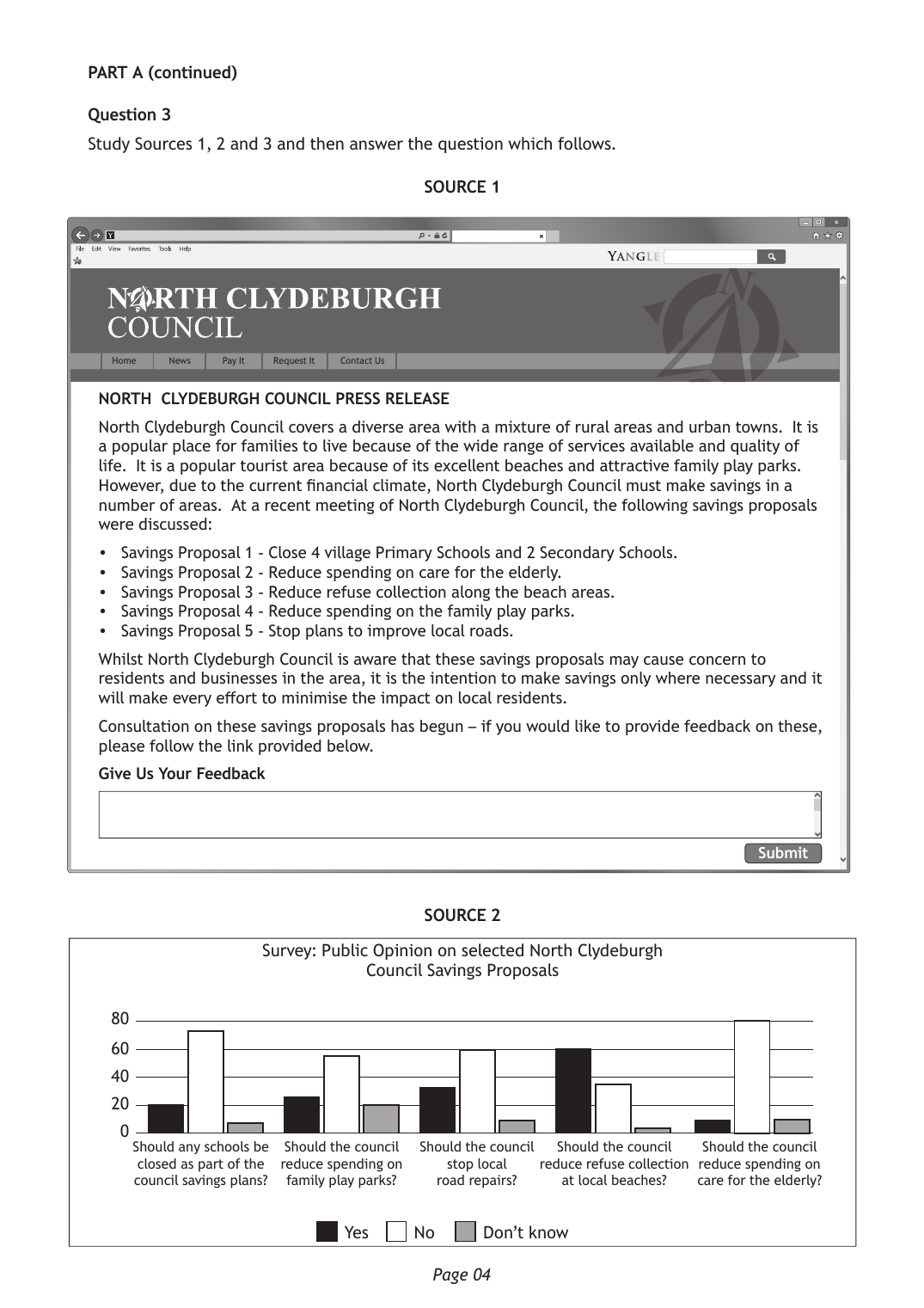
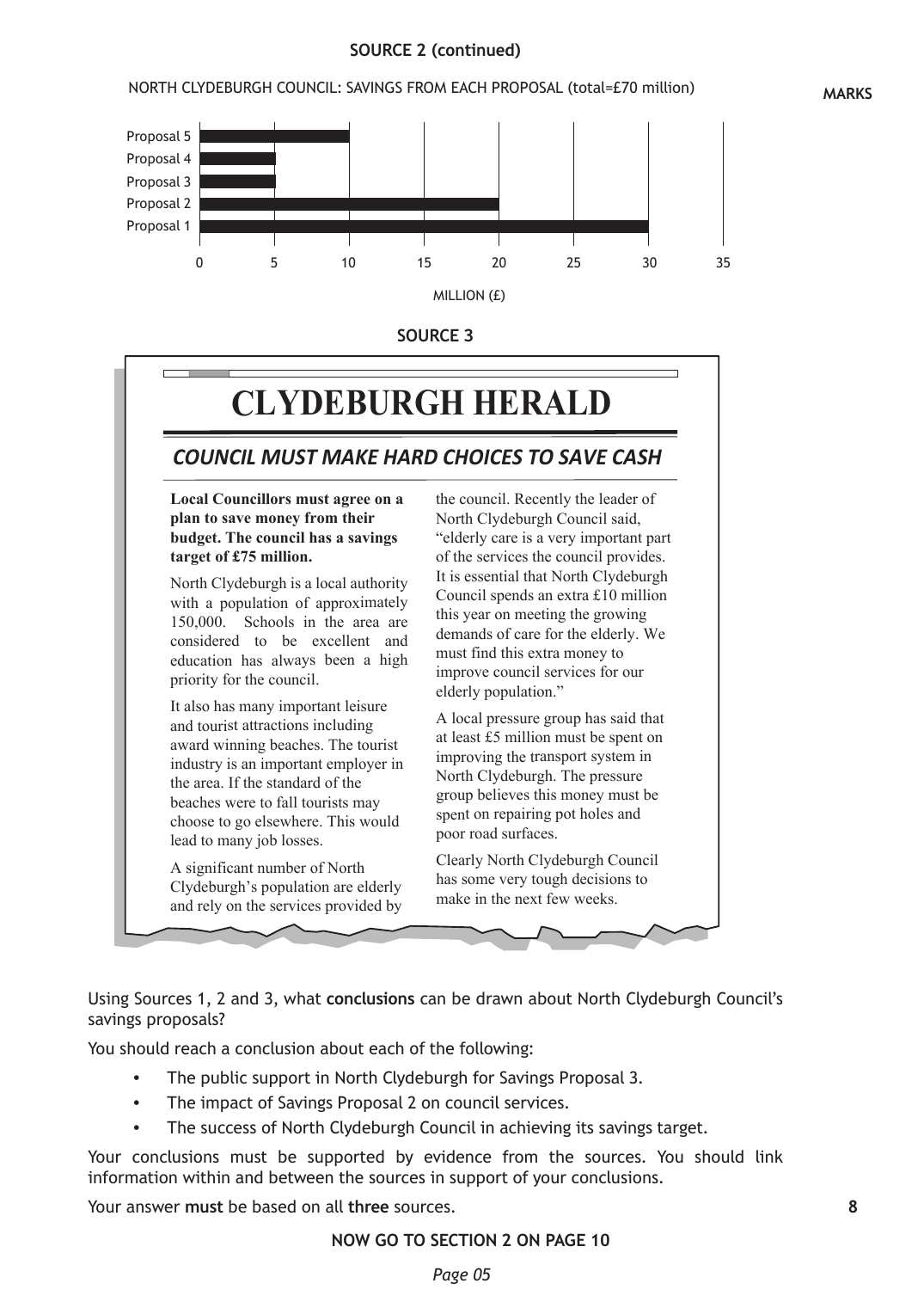
Using Sources 1, 2 and 3, what conclusions can be drawn about North Clydeburgh Council’s savings proposals?

You should reach a conclusion about each of the following:

  • The public support in North Clydeburgh for Savings Proposal 3.
  • The impact of Savings Proposal 2 on council services.
  • The success of North Clydeburgh Council in achieving its savings target.

Your conclusions must be supported by evidence from the sources. You should link information within and between the sources in support of your conclusions.

Your answer must be based on all three sources.

Sources (Source 1, Source 2, Source 3)

Source page 1 for this questionSource page 2 for this question
📝 Structure template — how to structure your answer

Conclusions · A source-based skills question

WFQ (words from the question)

  1. For EACH bullet point in the question, write the bullet point as a subheading, then:
  2. One conclusion that can be made about insert bullet point is insert valid conclusion.✓ 1 mark — valid conclusion
  3. Evidence to support this is shown in insert source which says/shows “insert evidence”.✓ 1 mark — evidence
  4. This clearly shows / strongly suggests insert valid conclusion — evaluative language earns the 3rd mark.✓ 1 mark — evaluative language

How it's marked

  • Conclusion + one piece of evidence = 2 marks. That is all you need for two of the three marks.
  • The 3rd mark does NOT come from a second piece of evidence linked to the same point — it comes from using evaluative terminology (e.g. “this clearly shows”, “the strongest evidence is”, “significantly”, “overwhelmingly”).
  • Comparison bullets (e.g. the UK compared with another country): you must give evidence about BOTH sides — but two pieces of evidence together still earn only ONE evidence mark, not two. You can still earn the 3rd mark with evaluative language, exactly as normal.
  • Up to 3 marks per bullet point; four conclusions (one per bullet point) are needed for full marks (10).
  • Tip: turn each bullet point into a question (e.g. “What is…?”, “What are…?”, “Which…?”, “How…?”) — the answer you give is your conclusion.
  • Conclusion + evidence = 2 marks. For the 3rd mark add evaluative language — a second quote linked to the same point does NOT earn it.
  • For a comparison bullet you must back BOTH sides with evidence — but that is still only one evidence mark, not two. The 3rd mark still comes from evaluative language.
✓ Reveal marking scheme
Max 8 marks

These are possible/exemplar answers from the marking instructions — other valid points can also gain marks.

How marks are awarded
  • The candidate is required to use a limited range of sources and draw valid conclusions from them, with supporting evidence.

Public support in North Clydeburgh for Savings Proposal 3

  1. Conclusion – There is support for Savings Proposal 3 in North Clydeburgh. (1 mark – valid conclusion)
  2. Conclusion – People in North Clydeburgh support Savings Proposal 3. For example, in a survey of public opinion on North Clydeburgh’s savings proposals 60% said yes. (source 2). (2 marks – conclusion and evidence from one source)
  3. Conclusion – Savings Proposal 3 would be the most popular option for people in North Clydeburgh. Savings Proposal 3 is for the council to reduce refuse collection along the beach areas (source 3). The public opinion survey on North Clydeburgh Council’s saving proposals show that a majority of people in North Clydeburgh, 60%, said they supported reducing refuse collection at local beaches, all of the other options only had support of 30% or less (source 2). (3 marks – conclusion and information from two sources with evaluative terminology)
The impact on council services of Savings Proposal 2

  1. Conclusion – Savings Proposal 2 will mean the council can’t improve the care services for the elderly. (1 mark – valid conclusion)
  2. Conclusion – Savings Proposal 2 will mean the council can’t improve the care services for the elderly. For example, spending on elderly services will be reduced by £20 million (source 3). (2 marks – conclusion and evidence from one source)
  3. Conclusion – Savings Proposal 2 will mean North Clydeburgh Council will be unable to improve the care services for the elderly. Savings Proposal 2 wants to reduce spending on care for the elderly by £20 million (source 3) however the leader of North Clydeburgh Council recently said they have to spend more money on services for the elderly, according to the leader an extra £10 million was needed to be spent on improving elderly care (source 1). Savings proposal 2 will mean they will not have enough money to make the improvements. (3 marks – conclusion and information from two sources)

How successfully will North Clydeburgh Council’s Savings proposals achieve their savings target

  1. Conclusion – North Cydeburgh Council’s saving proposals will not achieve their savings target. (1 mark – valid conclusion)
  2. Conclusion – North Cydeburgh Council’s saving proposals will not achieve their savings target. The proposals will only save the council £70 million (source 3). (2 marks – conclusion and evidence from one source)
  3. Conclusion – North Clydeburgh Council’s saving proposals will not achieve their savings target. North Clydeburgh Council has a savings target of £75 million (source 1) however the chart shows that the savings from all of the proposals will only achieve a saving of £70 million (source 3). This is £5 million less than their overall target and this means their target will not be met. (3 marks – conclusion and information from two sources with evaluative terminology)
Source: 2017 N5 History · X749/75/11 · Q3Question paper (PDF, p.4) ↗Marking instructions (PDF, p.6) ↗
Conclusions8 marks2017Q6⏳ Older formatDemocracy in Scotland and the UK

Study Sources 1, 2 and 3 and then answer the question which follows.

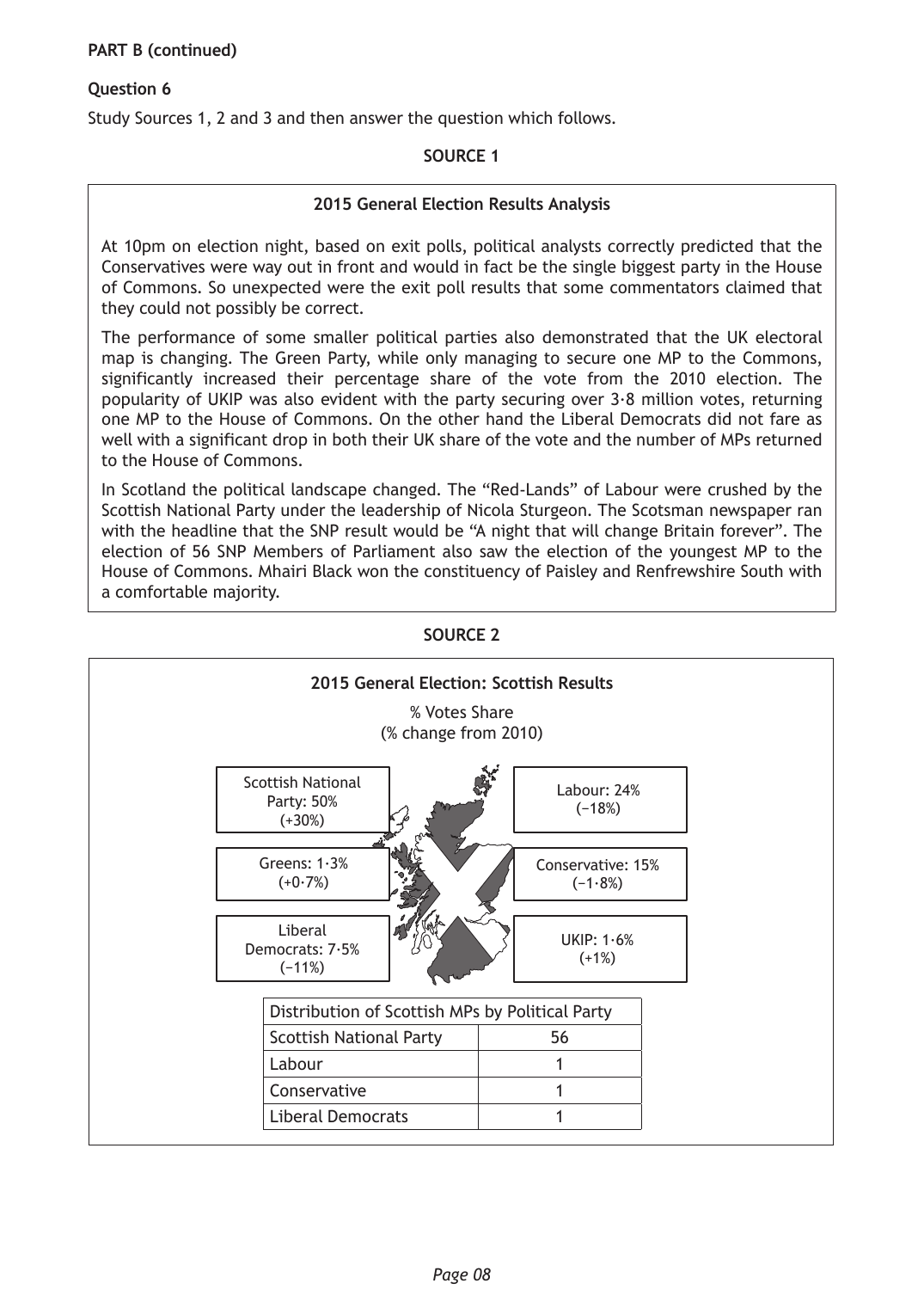
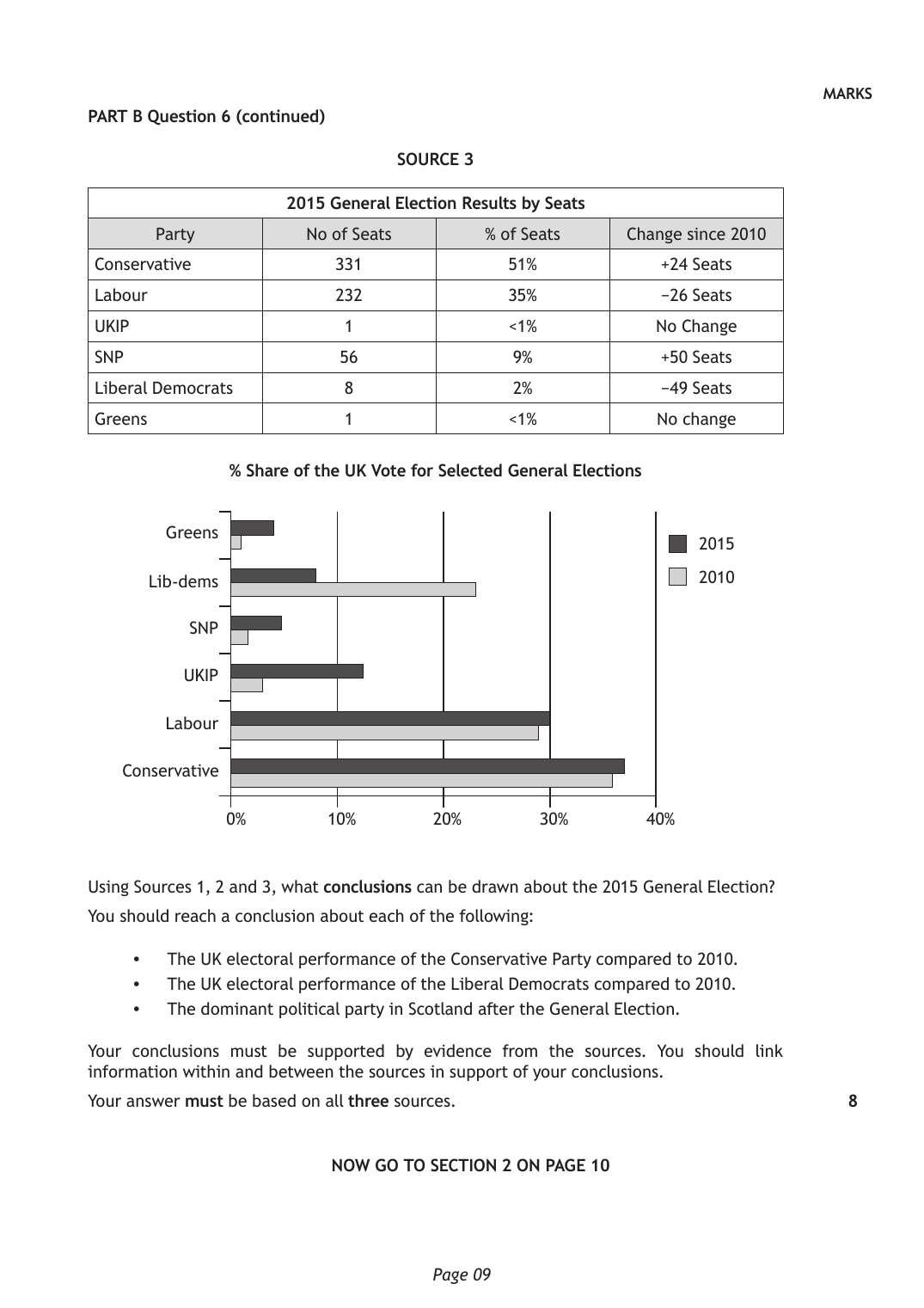
Using Sources 1, 2 and 3, what conclusions can be drawn about the 2015 General Election?

You should reach a conclusion about each of the following:

  • The UK electoral performance of the Conservative Party compared to 2010.
  • The UK electoral performance of the Liberal Democrats compared to 2010.
  • The dominant political party in Scotland after the General Election.

Your conclusions must be supported by evidence from the sources. You should link information within and between the sources in support of your conclusions.

Your answer must be based on all three sources.

Sources (Source 1, Source 2, Source 3)

Source page 1 for this questionSource page 2 for this question
📝 Structure template — how to structure your answer

Conclusions · A source-based skills question

WFQ (words from the question)

  1. For EACH bullet point in the question, write the bullet point as a subheading, then:
  2. One conclusion that can be made about insert bullet point is insert valid conclusion.✓ 1 mark — valid conclusion
  3. Evidence to support this is shown in insert source which says/shows “insert evidence”.✓ 1 mark — evidence
  4. This clearly shows / strongly suggests insert valid conclusion — evaluative language earns the 3rd mark.✓ 1 mark — evaluative language

How it's marked

  • Conclusion + one piece of evidence = 2 marks. That is all you need for two of the three marks.
  • The 3rd mark does NOT come from a second piece of evidence linked to the same point — it comes from using evaluative terminology (e.g. “this clearly shows”, “the strongest evidence is”, “significantly”, “overwhelmingly”).
  • Comparison bullets (e.g. the UK compared with another country): you must give evidence about BOTH sides — but two pieces of evidence together still earn only ONE evidence mark, not two. You can still earn the 3rd mark with evaluative language, exactly as normal.
  • Up to 3 marks per bullet point; four conclusions (one per bullet point) are needed for full marks (10).
  • Tip: turn each bullet point into a question (e.g. “What is…?”, “What are…?”, “Which…?”, “How…?”) — the answer you give is your conclusion.
  • Conclusion + evidence = 2 marks. For the 3rd mark add evaluative language — a second quote linked to the same point does NOT earn it.
  • For a comparison bullet you must back BOTH sides with evidence — but that is still only one evidence mark, not two. The 3rd mark still comes from evaluative language.
✓ Reveal marking scheme
Max 8 marks

These are possible/exemplar answers from the marking instructions — other valid points can also gain marks.

How marks are awarded
  • The candidate is required to use a limited range of sources and draw valid conclusions from them, with supporting evidence.

The UK electoral performance of the Conservative Party compared to 2010

  1. Conclusion – The Conservative Party performed better in the 2015 General Election than 2010. (1 mark – valid conclusion)
  2. Conclusion – The Conservative Party performed better in the 2015 General Election than 2010. In source 1 it states that the exit polls correctly predicted they would be the biggest single party in the House of Commons. (2 marks – valid conclusion and evidence from one source)
  3. Conclusion – The Conservative Party performed better in the 2015 General Election than 2010. In source 1 it stated that the exit polls correctly predicted they would be the biggest single party in the House of Commons. This can be linked to source 2 which tells us the Conservative gained the share of the UK vote, 37% which was an increase from 2010. (3 marks – valid conclusion and evidence from two sources)

The UK electoral performance of the Liberal Democrats compared to 2010

  1. Conclusion – The Liberal Democrats performed very poorly in 2015 compared to their 2010 result. (1 mark – valid conclusion)
  2. Conclusion – The Liberal Democrats performed very poorly in 2015 compared to their 2010 result. In source 1 it states that the Liberal Democrats saw a significant drop in both their UK share of the vote and in the number of MPs returned to the House of Commons. (2 marks – valid conclusion and evidence from one source)
  3. Conclusion – The Liberal Democrats performed very poorly in 2015 compared to their 2010 result. In source 1 it states that the Liberal Democrats saw a significant drop in both their UK share of the vote and in the number of MPs returned to the House of Commons. This can be supported by source 2 that shows that the seats won by the Liberal Democrats fell by 49, which means they only managed to get 8 MPs elected compared to their 57 MPs in 2010. (3 marks – valid conclusion and evidence from two sources)

The dominant political party in Scotland after the General Election.

  1. Conclusion - The Scottish National Party (SNP) was the dominant political party in Scotland after the 2015 general election. (1 mark – valid conclusion)
  2. Conclusion - The Scottish National Party (SNP) was the dominant political party in Scotland after the 2015 General Election. In source 1 it states that Labour was crushed by the Scottish National Party under the leadership of Nicola Sturgeon with 56 MPs elected to the House of Commons. (2 marks – valid conclusion and evidence from one source)
  3. Conclusion - The Scottish National Party (SNP) was the dominant political party in Scotland after the 2015 General Election. In source 1 it states that Labour was crushed by the Scottish National Party under the leadership of Nicola Sturgeon with 56 MPs elected to the House of Commons. This can be linked to source 3 that clearly shows that the SNP won 50% of the vote in Scotland which was an increase of 30% since the 2010 general election. (3 marks – valid conclusion and evidence from two sources)
Conclusions8 marks2016Q15⏳ Older formatInternational Issues

Study Sources 1, 2 and 3 and then answer the question which follows.

Using Sources 1, 2 and 3, what conclusions can be drawn.

You should reach a conclusion about each of the following:

  • The problem of crime in Japan compared to other countries.
  • The effects of the changing population structure in Japan.
  • The country most like Japan.

Your conclusions must be supported by evidence from the sources. You should link information within and between the sources in support of your conclusions.

Your answer must be based on all three sources.

Sources (Source 1, Source 2, Source 3)

Source page 1 for this questionSource page 2 for this question
📝 Structure template — how to structure your answer

Conclusions · A source-based skills question

WFQ (words from the question)

  1. For EACH bullet point in the question, write the bullet point as a subheading, then:
  2. One conclusion that can be made about insert bullet point is insert valid conclusion.✓ 1 mark — valid conclusion
  3. Evidence to support this is shown in insert source which says/shows “insert evidence”.✓ 1 mark — evidence
  4. This clearly shows / strongly suggests insert valid conclusion — evaluative language earns the 3rd mark.✓ 1 mark — evaluative language

How it's marked

  • Conclusion + one piece of evidence = 2 marks. That is all you need for two of the three marks.
  • The 3rd mark does NOT come from a second piece of evidence linked to the same point — it comes from using evaluative terminology (e.g. “this clearly shows”, “the strongest evidence is”, “significantly”, “overwhelmingly”).
  • Comparison bullets (e.g. the UK compared with another country): you must give evidence about BOTH sides — but two pieces of evidence together still earn only ONE evidence mark, not two. You can still earn the 3rd mark with evaluative language, exactly as normal.
  • Up to 3 marks per bullet point; four conclusions (one per bullet point) are needed for full marks (10).
  • Tip: turn each bullet point into a question (e.g. “What is…?”, “What are…?”, “Which…?”, “How…?”) — the answer you give is your conclusion.
  • Conclusion + evidence = 2 marks. For the 3rd mark add evaluative language — a second quote linked to the same point does NOT earn it.
  • For a comparison bullet you must back BOTH sides with evidence — but that is still only one evidence mark, not two. The 3rd mark still comes from evaluative language.
✓ Reveal marking scheme
Max 8 marks

These are possible/exemplar answers from the marking instructions — other valid points can also gain marks.

How marks are awarded
  • The candidate is required to use a limited range of sources and draw valid conclusions from them, with supporting evidence

The problem of Crime in Japan compared to other countries

  1. Conclusion: Compared to many other countries there are relatively low levels of crime in Japan. [1 mark for a valid conclusion]
  2. Conclusion: Compared to many other countries there are relatively low levels of crime in Japan. Evidence - It is one of the safest places in the world to live (S3) [2 marks for a valid conclusion with supporting evidence]
  3. Conclusion: Compared to many other countries there are relatively low levels of crime in Japan. Evidence - Japan had 22 crimes per 1000 people in 2014 (S1), which is only about one quarter of the EU figure of 80 and lower than all the countries mentioned (S2). [3 marks - valid conclusion with evidence from two sources and synthesis]

The effects of the changing population structure in Japan

  1. Conclusion: As the elderly population increases so do social and economic problems in Japan. [1 mark for a valid conclusion]
  2. Conclusion: As the elderly population increases so do social and economic problems in Japan. Evidence – Pensions will be very expensive in the future [2 marks for a valid conclusion with supporting evidence from source 1]
  3. Conclusion: As the elderly population increases so do social and economic problems in Japan. Evidence - Pensions will be very expensive in the future. As Source 1 shows the elderly population will almost double in forty years but those paying tax (15-64 years) will fall to just over 50% of the population. [3 marks for a valid conclusion with supporting evidence from sources 1 and 3]
  4. Also credit reference to:
  5. Housing is getting expensive as a result of the aging population (S3) 61% own their home, lower than the EU, France, Italy and Argentina.
  6. Japan has a high life expectancy (S3) but this will be difficult to maintain as fewer will be paying tax (S3)
  7. A growing elderly population is listed as one of Japan's problems. (S1).

The country most like Japan

  1. Conclusion: South Korea is most like Japan [1 mark for a valid conclusion]
  2. Conclusion: South Korea is most like Japan Evidence – In south Korea the poverty rate is 16.5% and Japan is 16% (S1&2) [2 marks for a valid conclusion with supporting evidence]
  3. Conclusion: South Korea is most like Japan Evidence – In south Korea only 0·5% more people in poverty – this is the closest to Japan at 16% with crime rate in South Korea also being closest to that of Japan – 22 per 1000 in Japan and 32 per 1000 in South Korea [3 marks for valid conclusion with supporting evidence from sources 1 and 2]
  4. Internet users – 865 per 1000 in Japan and South Korea – highest of all the countries mentioned [S1 & 3]
Source: 2016 N5 History · X749/75/11 · Q15Question paper (PDF, p.21) ↗Marking instructions (PDF, p.24) ↗
Conclusions8 marks2016Q18⏳ Older formatInternational Issues

Study Sources 1, 2 and 3 and then answer the question which follows.

Using Sources 1, 2 and 3, what conclusions can be drawn.

You should reach a conclusion about each of the following:

  • The progress in achieving the world governments' first aid target.
  • The Central American country most affected by the Ambiona outbreak in 2014.
  • The relationship between the standard of living and Ambiona death rates.

Your conclusions must be supported by evidence from the sources. You should link information within and between the sources in support of your conclusions.

Your answer must be based on all three sources.

Sources (Source 1, Source 2, Source 3)

Source page 1 for this questionSource page 2 for this question
📝 Structure template — how to structure your answer

Conclusions · A source-based skills question

WFQ (words from the question)

  1. For EACH bullet point in the question, write the bullet point as a subheading, then:
  2. One conclusion that can be made about insert bullet point is insert valid conclusion.✓ 1 mark — valid conclusion
  3. Evidence to support this is shown in insert source which says/shows “insert evidence”.✓ 1 mark — evidence
  4. This clearly shows / strongly suggests insert valid conclusion — evaluative language earns the 3rd mark.✓ 1 mark — evaluative language

How it's marked

  • Conclusion + one piece of evidence = 2 marks. That is all you need for two of the three marks.
  • The 3rd mark does NOT come from a second piece of evidence linked to the same point — it comes from using evaluative terminology (e.g. “this clearly shows”, “the strongest evidence is”, “significantly”, “overwhelmingly”).
  • Comparison bullets (e.g. the UK compared with another country): you must give evidence about BOTH sides — but two pieces of evidence together still earn only ONE evidence mark, not two. You can still earn the 3rd mark with evaluative language, exactly as normal.
  • Up to 3 marks per bullet point; four conclusions (one per bullet point) are needed for full marks (10).
  • Tip: turn each bullet point into a question (e.g. “What is…?”, “What are…?”, “Which…?”, “How…?”) — the answer you give is your conclusion.
  • Conclusion + evidence = 2 marks. For the 3rd mark add evaluative language — a second quote linked to the same point does NOT earn it.
  • For a comparison bullet you must back BOTH sides with evidence — but that is still only one evidence mark, not two. The 3rd mark still comes from evaluative language.
✓ Reveal marking scheme
Max 8 marks

These are possible/exemplar answers from the marking instructions — other valid points can also gain marks.

How marks are awarded
  • The candidate is required to use a limited range of sources and draw valid conclusions from them, with supporting evidence.

The progress in achieving the world government's aid targets.

  1. Conclusion - There has been good progress in achieving the world government's financial aid target. [1 mark for valid conclusion]
  2. Evidence - In 2014 world government's requested almost $1 Billion in financial aid to combat the Ambiona crisis (S1) and by 2017 almost 900 million dollars will have been donated with 950 million dollars pledged (S3). [3 marks for valid conclusion with supporting evidence from sources 1 and 3]

The Central American country most affected by the Ambiona outbreak in 2014

  1. Conclusion – Country Y has been most affected by the Ambiona outbreak (1 mark for valid conclusion)
  2. Evidence – Source 2 highlights that it has the highest number of cases of Ambiona at 7719 and by far the highest number of deaths – 3177 – more than double that of country X and almost double that of country Z. This is linked to Source 1 which highlights that country Y has the highest proportion which has contracted the virus at 16%. [3 marks for valid conclusion with supporting evidence from sources 1 and 3]

The relationship between the standard of living and Ambiona death rates.

  1. Conclusion – The higher the standard of living the lower the death rate. [1 mark for valid conclusion]
  2. Evidence – Source 2 highlights that the country Z has the lowest death rate at 23% with the highest literacy rate at 83% and Source 3 supports this by showing that country Z has the highest average income of $9876 compared to country Y at $5654. [3 marks for valid conclusion with supporting evidence from sources 2 and 3]
Source: 2016 N5 History · X749/75/11 · Q18Question paper (PDF, p.25) ↗Marking instructions (PDF, p.29) ↗
Conclusions8 marks2015Q9⏳ Older formatSocial Issues in the United Kingdom

Study Sources 1, 2 and 3 and then answer the question which follows.

Using Sources 1, 2 and 3, what conclusions can be drawn about the issue of child poverty.

You should reach a conclusion about each of the following.

  • The impact of poverty on a child's life
  • The UK Government's progress towards meeting its targets for 2020
  • UK child poverty rates compared to other countries

Your conclusions must be supported by evidence from the sources. You should link information within and between the sources in support of your conclusions.

Your answer must be based on all three sources.

Sources (Source 1, Source 2, Source 3)

Source page 1 for this questionSource page 2 for this question
📝 Structure template — how to structure your answer

Conclusions · A source-based skills question

WFQ (words from the question)

  1. For EACH bullet point in the question, write the bullet point as a subheading, then:
  2. One conclusion that can be made about insert bullet point is insert valid conclusion.✓ 1 mark — valid conclusion
  3. Evidence to support this is shown in insert source which says/shows “insert evidence”.✓ 1 mark — evidence
  4. This clearly shows / strongly suggests insert valid conclusion — evaluative language earns the 3rd mark.✓ 1 mark — evaluative language

How it's marked

  • Conclusion + one piece of evidence = 2 marks. That is all you need for two of the three marks.
  • The 3rd mark does NOT come from a second piece of evidence linked to the same point — it comes from using evaluative terminology (e.g. “this clearly shows”, “the strongest evidence is”, “significantly”, “overwhelmingly”).
  • Comparison bullets (e.g. the UK compared with another country): you must give evidence about BOTH sides — but two pieces of evidence together still earn only ONE evidence mark, not two. You can still earn the 3rd mark with evaluative language, exactly as normal.
  • Up to 3 marks per bullet point; four conclusions (one per bullet point) are needed for full marks (10).
  • Tip: turn each bullet point into a question (e.g. “What is…?”, “What are…?”, “Which…?”, “How…?”) — the answer you give is your conclusion.
  • Conclusion + evidence = 2 marks. For the 3rd mark add evaluative language — a second quote linked to the same point does NOT earn it.
  • For a comparison bullet you must back BOTH sides with evidence — but that is still only one evidence mark, not two. The 3rd mark still comes from evaluative language.
✓ Reveal marking scheme
Max 8 marks

These are possible/exemplar answers from the marking instructions — other valid points can also gain marks.

How marks are awarded
  • The candidate is required to use a limited range of sources and draw valid conclusions from them, with supporting evidence.

The impact of poverty on a child's life

  1. Conclusion – Poverty can have a big impact on a child's health. [1 mark - valid conclusion]
  2. Poverty can have a big impact on a child's health. [Mark 1 – valid conclusion] For example, life expectancy for the poorest children is only 71 years [Source 2]. [2 marks - conclusion and evidence from one source]
  3. Conclusion – Poverty can have a big impact on many areas of a child's life [1 mark valid conclusion]. Children living in poverty find themselves socially excluded from everyday life [Source 1]. Sixty two percent of poor families cannot afford a week's holiday compared to only 6% of wealthy families [Source 2]. [3 marks - conclusion and information from two sources]
  4. Conclusion – Poverty can have a big impact on many areas of a child's health. [1 mark valid conclusion] This is backed up by figures which show life expectancy at birth is 71 years for poor children, compared to 82 years for wealthy children [Source 2]. This is a substantial difference of eleven years. [3 marks - conclusion and information from two sources with evaluative terminology]

The Government's progress towards meeting its targets for 2020

  1. Conclusion – The Government will make little progress in the next few years. [1 mark - valid conclusion]
  2. Conclusion – The Government has made little progress toward reducing child poverty in the UK [1 mark valid conclusion]. Source 2 shows us that both relative and absolute poverty will continue to increase. [2 marks - conclusion and evidence from one source]
  3. Conclusion – The Government will make little progress toward reducing child poverty in the UK [1 mark valid conclusion]. Currently, a quarter of children live in poverty in the UK [Source 1]. Government made a promise to reduce child poverty to 12% for relative poverty by 2020[Source 1] but Source 3 shows it will actually be 22%. [3 marks - conclusion and information from two sources]

UK Poverty rates compared to other Countries

  1. Conclusion – UK child poverty rates are higher than most other EU countries [1 mark valid conclusion].
  2. Conclusion - UK child poverty rates are higher than most other EU countries [1 mark valid conclusion]. Currently a quarter of children are living in poverty in the UK [Source 1], this is 4% higher than the EU average of 21% [Source 3]. [3 marks - conclusion and evidence from two sources].
  3. Conclusion - UK child poverty rates are among the highest in the EU [1 mark valid conclusion]. Only three EU countries have higher rates of child poverty than the UK, these are Romania, Spain and Italy which are all above the UKs rate of 25% [Source 3]. The UK is also above the EU average of 21% [Source 3]. [3 marks - conclusion and evidence from two sources]
  4. Any other valid reason that meets the criteria described in the general marking instructions for this kind of question (see column to left).
Conclusions8 marks2015Q12⏳ Older formatSocial Issues in the United Kingdom

Study Sources 1, 2 and 3 below and then answer the question which follows.

Using Sources 1, 2 and 3, what conclusions can be drawn about the law concerning social media.

You should reach a conclusion about each of the following:

  • The level of public awareness of the law concerning social media
  • Social media and the workplace
  • Crime associated with social media.

Your conclusions must be supported by evidence from the sources. You should link information within and between the sources in support of your conclusions.

Your answer must be based on all three sources.

Sources (Source 1, Source 2, Source 3)

Source page 1 for this questionSource page 2 for this question
📝 Structure template — how to structure your answer

Conclusions · A source-based skills question

WFQ (words from the question)

  1. For EACH bullet point in the question, write the bullet point as a subheading, then:
  2. One conclusion that can be made about insert bullet point is insert valid conclusion.✓ 1 mark — valid conclusion
  3. Evidence to support this is shown in insert source which says/shows “insert evidence”.✓ 1 mark — evidence
  4. This clearly shows / strongly suggests insert valid conclusion — evaluative language earns the 3rd mark.✓ 1 mark — evaluative language

How it's marked

  • Conclusion + one piece of evidence = 2 marks. That is all you need for two of the three marks.
  • The 3rd mark does NOT come from a second piece of evidence linked to the same point — it comes from using evaluative terminology (e.g. “this clearly shows”, “the strongest evidence is”, “significantly”, “overwhelmingly”).
  • Comparison bullets (e.g. the UK compared with another country): you must give evidence about BOTH sides — but two pieces of evidence together still earn only ONE evidence mark, not two. You can still earn the 3rd mark with evaluative language, exactly as normal.
  • Up to 3 marks per bullet point; four conclusions (one per bullet point) are needed for full marks (10).
  • Tip: turn each bullet point into a question (e.g. “What is…?”, “What are…?”, “Which…?”, “How…?”) — the answer you give is your conclusion.
  • Conclusion + evidence = 2 marks. For the 3rd mark add evaluative language — a second quote linked to the same point does NOT earn it.
  • For a comparison bullet you must back BOTH sides with evidence — but that is still only one evidence mark, not two. The 3rd mark still comes from evaluative language.
✓ Reveal marking scheme
Max 8 marks

These are possible/exemplar answers from the marking instructions — other valid points can also gain marks.

How marks are awarded
  • The candidate is required to use a limited range of sources and draw valid conclusions from them, with supporting evidence.

The level of public awareness of the law concerning social media

  1. Conclusion - A minority of people know about the law. [1 mark - valid conclusion]
  2. Conclusion - A minority of people know about the law [1 mark - valid conclusion]. This is supported by Source 1 which shows only 1 in 10 know about the law. [2 marks - conclusion and evidence from one source]
  3. Conclusion - A minority of people know about the law [1 mark - valid conclusion]. This is supported by Source 1 which shows only 1 in 10 know about the law and by Source 2 which tells us that 75% of people, a clear majority didn't know about the consequences of being offensive. [3 marks - conclusion and information from two sources with evaluative terminology]
  4. More than half of sixteen to eighteen year olds believed it was illegal for an employer to check social media [Source 1].

Social media and the workplace

  1. Conclusion - Employees now have more rules to follow about the use of social media. [1 mark - valid conclusion]
  2. Conclusion - Employees now have more rules to follow about the use of social media. [1 mark - valid conclusion] The Gleninch Council have issued a memo to its employees on the appropriate use of social media during work-time [Source 2]. [2 marks - conclusion and evidence from one source]
  3. Conclusion – A lot of working time is being lost due to the use of social media. [1 mark - valid conclusion] The Gleninch Council have issued a memo to its employees on the appropriate use of social media during work-time [Source 2]. This is obviously a problem judging by the increase in the number of hours lost through social media breaks from half an hour to two hours per day [Source 3]. [3 marks - conclusion and information from two sources]
  4. Social Media breaks are costing more than smoking breaks [Source 3].
  5. Social Media breaks have quadrupled since 2010 [Source 2].
  6. Companies now use Social Media to vet applicants [Source 1].
  7. The Gleninch Council may sack people for inappropriate use of Social Media [Source 2].

Crime associated with social media

  1. Conclusion - There has been an increase in prosecutions relating to social media. [1 mark - valid conclusion]
  2. Conclusion - There has been an increase in prosecutions relating to social media [1 mark - valid conclusion]. Source 3 shows a huge increase in successful prosecutions. [2 marks - conclusion and evidence from one source]
  3. Conclusion - Crime related to social media appears to have increased in recent years [1 mark - valid conclusion]. Source 2 shows an increase in the number of incidents reported to the police from 2347 to 2703. However, police have said that many of these (two thirds) petty online arguments [Source 1]. [3 marks - conclusion and information from two sources]
  4. More and more people are being prosecuted for their online activities [Source 1].
  5. Both the number of complaints to the police and of successful prosecutions have increased [Source 2].
  6. Any other valid reason that meets the criteria described in the general marking instructions for this kind of question (see column to left).
Source: 2015 N5 History · X749/75/11 · Q12Question paper (PDF, p.16) ↗Marking instructions (PDF, p.24) ↗
Conclusions8 marks2014Q3⏳ Older formatDemocracy in Scotland

Study Sources 1, 2 and 3 then attempt the question which follows.

Using Sources 1, 2 and 3 what conclusions can be drawn about recent Scottish Parliament elections?

You should reach a conclusion about each of the following.

  • The importance of trade union donations to the party election campaigns.
  • The link between a party's election spending and election success.
  • The link between election spending and voter awareness of election campaign methods.

Your conclusions must be supported by evidence from the sources. You should link information within and between the sources in support of your conclusions.

Your answer must be based on all three sources.

Sources (Source 1, Source 2, Source 3)

Source page 1 for this questionSource page 2 for this question
📝 Structure template — how to structure your answer

Conclusions · A source-based skills question

WFQ (words from the question)

  1. For EACH bullet point in the question, write the bullet point as a subheading, then:
  2. One conclusion that can be made about insert bullet point is insert valid conclusion.✓ 1 mark — valid conclusion
  3. Evidence to support this is shown in insert source which says/shows “insert evidence”.✓ 1 mark — evidence
  4. This clearly shows / strongly suggests insert valid conclusion — evaluative language earns the 3rd mark.✓ 1 mark — evaluative language

How it's marked

  • Conclusion + one piece of evidence = 2 marks. That is all you need for two of the three marks.
  • The 3rd mark does NOT come from a second piece of evidence linked to the same point — it comes from using evaluative terminology (e.g. “this clearly shows”, “the strongest evidence is”, “significantly”, “overwhelmingly”).
  • Comparison bullets (e.g. the UK compared with another country): you must give evidence about BOTH sides — but two pieces of evidence together still earn only ONE evidence mark, not two. You can still earn the 3rd mark with evaluative language, exactly as normal.
  • Up to 3 marks per bullet point; four conclusions (one per bullet point) are needed for full marks (10).
  • Tip: turn each bullet point into a question (e.g. “What is…?”, “What are…?”, “Which…?”, “How…?”) — the answer you give is your conclusion.
  • Conclusion + evidence = 2 marks. For the 3rd mark add evaluative language — a second quote linked to the same point does NOT earn it.
  • For a comparison bullet you must back BOTH sides with evidence — but that is still only one evidence mark, not two. The 3rd mark still comes from evaluative language.
✓ Reveal marking scheme
Max 8 marks

These are possible/exemplar answers from the marking instructions — other valid points can also gain marks.

How marks are awarded
  • The candidate is required to use a limited range of sources and draw valid conclusions from them, with supporting evidence.

The importance of Trade Union donations to party election campaigns.

  1. Conclusion – Trade Union contributions were not very important to political parties during the election in 2011. [1 mark for valid conclusion]
  2. Evidence – Trade Unions contributed 29% of the overall donations to political parties in 2011 compared to 41% from individuals [Source 3]
  3. The SNP and Conservatives rely more on wealthy business people and as such unions are not important to them [Source 1]
  4. Conclusion – They are much more important to Labour than the other parties [1 mark for valid conclusion]
  5. Evidence – 29% is almost a third of all party donations – Labour however is more reliant as over a third of their funding is from trade unions (36%). [Sources 1 and 3]

The link between a party's election spending and election success.

  1. Conclusion – The party which spends the most wins the election. [1 mark for a valid conclusion]
  2. Evidence – In 2007, SNP spent the most at c£3.5 million compared to Labour at £1 6 million [Source 2] and they won the election by 1 seat [Source 3]
  3. In 2011, SNP spent the most at c£2.6 million compared to Labour's £1.1 million [Source 2] and the SNP won 69 seats compared to 37 for Labour [Source 3].

The link between election spending and voter awareness of election campaign methods.

  1. Conclusion – There is a direct link between election spending and voter awareness of campaign methods. [1 mark for valid conclusion]
  2. Evidence – Spending on leaflets increased from £1.2 million to £1.4 million between 2007 and 2011 and awareness of leaflets increased from 89% to 93% of voters. [Source 1]
  3. Conclusion – Money spent on campaign methods means people are more aware of it. [1 mark for valid conclusion]
  4. Evidence – In 2011, the smallest sum (only £47,000) was spent on rallies and public meetings and only 2% of people attended these (this is the smallest number). [Source 1]
Source: 2014 N5 History · X749/75/11 · Q3Question paper (PDF, p.5) ↗Marking instructions (PDF, p.6) ↗
Conclusions8 marks2014Q3⏳ Older formatDemocracy in the United Kingdom

Study Sources 1, 2 and 3 then attempt the question which follows.

Using Sources 1, 2 and 3 what conclusions can be drawn about recent UK general elections?

You should reach a conclusion about each of the following.

  • The importance of trade union donations to the party election campaigns.
  • The link between a party's election spending and election success.
  • The link between election spending and voter awareness of election campaign methods.

Your conclusions must be supported by evidence from the sources. You should link information within and between the sources in support of your conclusions.

Your answer must be based on all three sources.

Sources (Source 1, Source 2, Source 3)

Source page 1 for this questionSource page 2 for this question
📝 Structure template — how to structure your answer

Conclusions · A source-based skills question

WFQ (words from the question)

  1. For EACH bullet point in the question, write the bullet point as a subheading, then:
  2. One conclusion that can be made about insert bullet point is insert valid conclusion.✓ 1 mark — valid conclusion
  3. Evidence to support this is shown in insert source which says/shows “insert evidence”.✓ 1 mark — evidence
  4. This clearly shows / strongly suggests insert valid conclusion — evaluative language earns the 3rd mark.✓ 1 mark — evaluative language

How it's marked

  • Conclusion + one piece of evidence = 2 marks. That is all you need for two of the three marks.
  • The 3rd mark does NOT come from a second piece of evidence linked to the same point — it comes from using evaluative terminology (e.g. “this clearly shows”, “the strongest evidence is”, “significantly”, “overwhelmingly”).
  • Comparison bullets (e.g. the UK compared with another country): you must give evidence about BOTH sides — but two pieces of evidence together still earn only ONE evidence mark, not two. You can still earn the 3rd mark with evaluative language, exactly as normal.
  • Up to 3 marks per bullet point; four conclusions (one per bullet point) are needed for full marks (10).
  • Tip: turn each bullet point into a question (e.g. “What is…?”, “What are…?”, “Which…?”, “How…?”) — the answer you give is your conclusion.
  • Conclusion + evidence = 2 marks. For the 3rd mark add evaluative language — a second quote linked to the same point does NOT earn it.
  • For a comparison bullet you must back BOTH sides with evidence — but that is still only one evidence mark, not two. The 3rd mark still comes from evaluative language.
✓ Reveal marking scheme
Max 8 marks

These are possible/exemplar answers from the marking instructions — other valid points can also gain marks.

How marks are awarded
  • The candidate is required to use a limited range of sources and draw valid conclusions from them, with supporting evidence.

The importance of trade union donations to party election campaigns.

  1. Conclusion – trade union contributions were not very important to political parties during the election in 2010.
  2. Evidence – Trade unions contributed 16% of the overall donations to political parties in 2010 compared to 47% from individuals [Source 3]
  3. The Labour Party received 36% of their funding from Unions but this is less than half so not that important [Source 1]
  4. The Conservatives rely on wealthy business people so Unions are not important to them [Source 1]
  5. Conclusion – trade unions are more important to Labour than the other parties. [1 mark valid conclusion]
  6. Evidence – 16% of all party donations [Source 3]
  7. Labour however is more reliant as over a third of their funding is from trade unions (36%) [Source 1]

The link between a party's election spending and election success.

  1. Conclusion – The party which spends the most wins the election. [1 mark valid conclusion]
  2. Evidence – In 2005 Labour spent the most at c£18 million compared to Conservatives at £17 million [Source 2] and they won the election by 158 seats [Source 3]
  3. In 2010 Conservatives spent the most at c£16 million compared to Labour's £8 million [Source 2] and the Conservatives won 307 seats compared to 258 for Labour [Source 3].

The link between election spending and voter awareness of election campaign methods.

  1. Conclusion – As election spending on campaign methods decreases so does voter awareness of these methods [1 mark valid conclusion]
  2. Evidence – In 2005, £15 million was spent on billboard advertising and this fell to £9 million in 2010 [Source 1]
  3. Awareness of billboard advertising fell from 62% in 2005 to 48% in 2010. [Source 1]
  4. Conclusion – More money spent on a campaign method means people are more aware of it eg leaflets [1 mark valid conclusion]
  5. Evidence – In 2010, most money (£12.3 million) was spent on leaflets and 93% of people had received leaflets. [Source 1]
  6. Only 1.7 million was spent on public meetings and only 2% of people attended one in 2010 [Source 1]