Study Sources 1, 2 and 3 and then answer the question which follows.
Using Sources 1, 2 and 3, give reasons to support and oppose the view of Lily Robertson.
There should be a referendum on whether Australia becomes a republic.
In your answer you must:
- give evidence from the sources that supports Lily Robertson's view
AND
- give evidence from the sources that opposes Lily Robertson's view.
Your answer must be based on all three sources.
Sources (Source 1, Source 2, Source 3)
📝 Structure template — how to structure your answer
Support or oppose · A source-based skills question
WFQ (words from the question)
- I can support the view of insert name that “insert view” because Source 1 says “insert evidence”.✓ up to 3 marks
- Source 2 also supports the view when it says “insert evidence”.✓ up to 3 marks
- Source 3 also supports the view when it says “insert evidence”.✓ up to 3 marks
- I can oppose the view of insert name that “insert view” because Source 1 says “insert evidence”.✓ up to 3 marks
- Source 2 also opposes the view when it says “insert evidence”.✓ up to 3 marks
- Source 3 also opposes the view when it says “insert evidence”.✓ up to 3 marks
How it's marked
- Up to 3 marks for each developed point using accurate source evidence.
- Maximum 6 marks if you only support OR only oppose.
- For full marks you must use all sources and give evidence that supports AND opposes the view.
- Do as many support / oppose points as you like (e.g. 8 support + 2 oppose)…
- …but you MUST have evidence for BOTH support and oppose to reach full marks.
✓ Reveal marking scheme
These are possible/exemplar answers from the marking instructions — other valid points can also gain marks.
How marks are awarded
- The candidate is required to evaluate a limited range of sources, to support and oppose a point of view.
- In order to achieve full marks candidates must show evidence that supports the view and show evidence that does not support the view.
- An answer which deals with only one side of the explanation should be awarded a maximum of 6 marks.
- For full marks, candidates must refer to all sources in their answer. Award a maximum of 6 marks if only two sources are used and a maximum of 4 marks if only one source is used.
Evidence to support Lily Robertson's view that there should be a referendum on whether Australia becomes a republic:
- Source 1 states 'They argue it is unfair to have a head of state who is not elected or an Australian citizen.' (1 mark — accurate use of Source 1 but minimal development)
- Source 1 states 'They argue it is unfair to have a head of state who is not elected or an Australian citizen' which links to Source 3 where Shane says, 'We should be able to choose an Australian citizen instead of having a British King or Queen as the unelected head of state.' (2 marks — accurate use of Sources 1 and 3 linking two pieces of evidence)
Credit reference to aspects of the following:
- Source 1 states 'He is not elected or appointed — he is the King and therefore head of state by birthright. Some Australians dislike this because King Charles III is British and lives in the UK.'
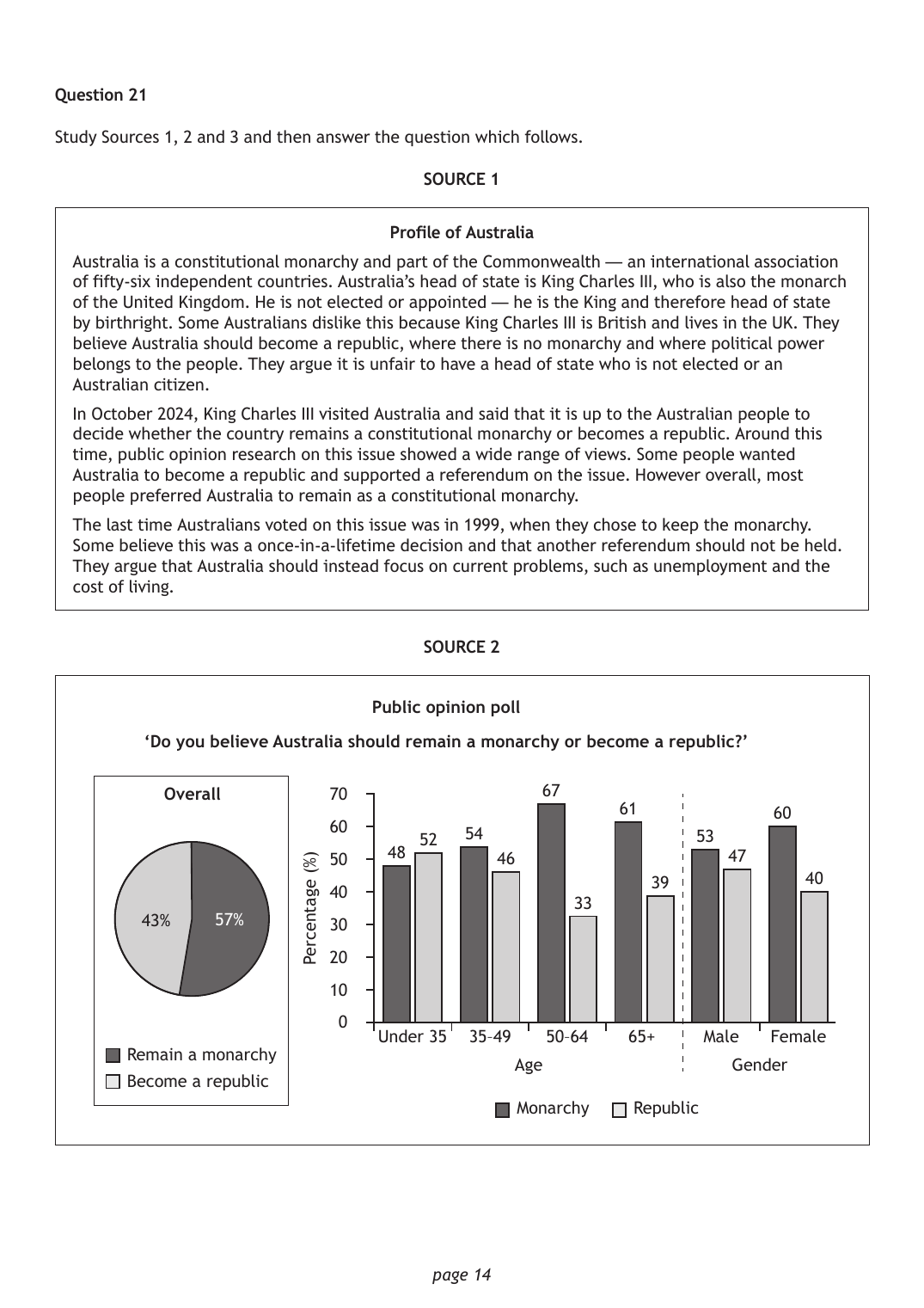
- Source 1 says that 'public opinion research on this issue showed a wide range of views. Some people wanted Australia to become a republic and supported a referendum on the issue.'
- Source 2 shows that those aged under 35 support Australia becoming a republic — 52% to 48%
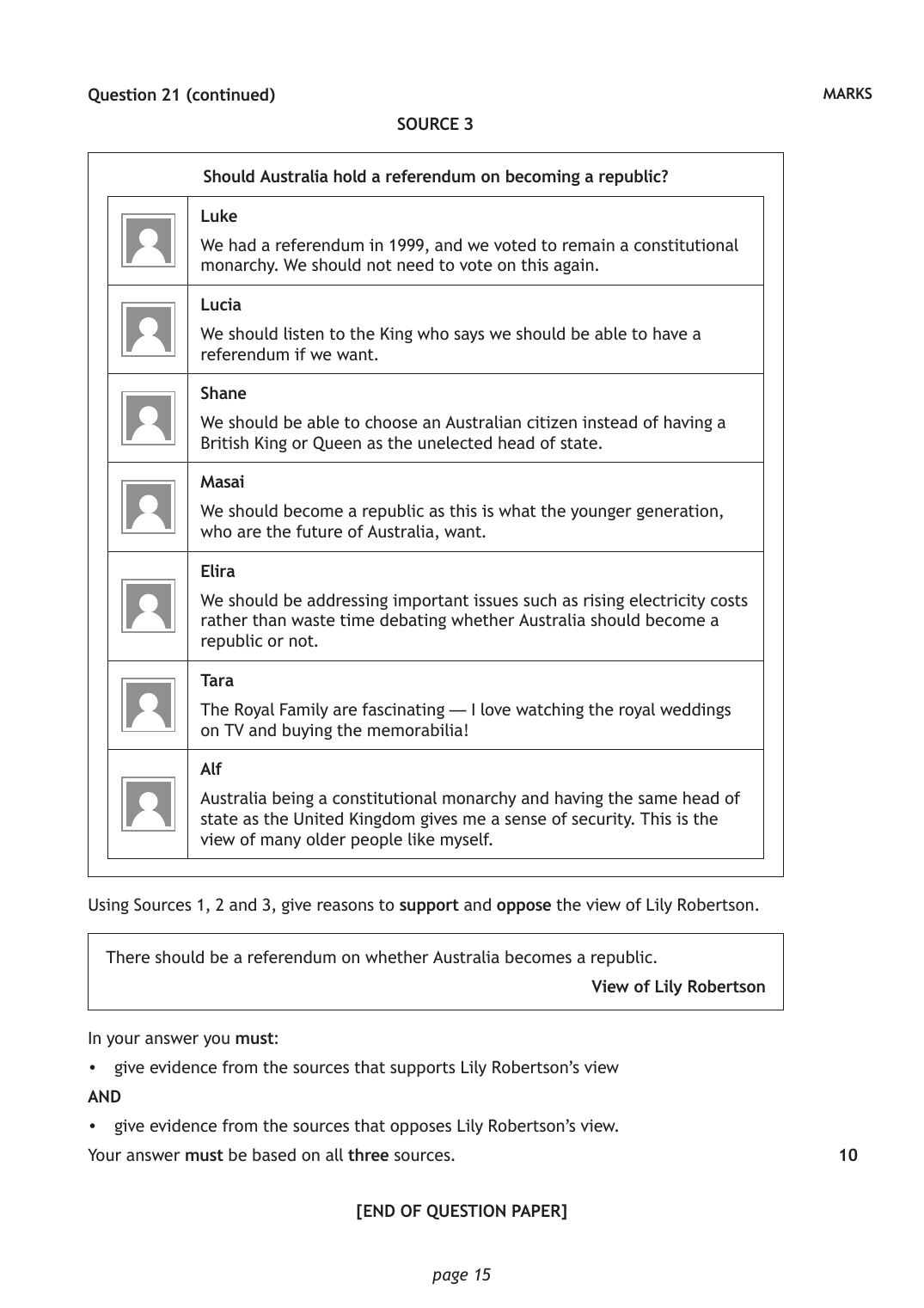
- Lucia in Source 3 states 'We should listen to the King who says we should be able to have a referendum if we want'
- Masai in Source 3 states 'We should become a republic as this is what the younger generation, who are the future of Australia, want.'
Evidence to oppose Lily Robertson's view that there should be a referendum on whether Australia becomes a republic:
- Source 1 states 'most people preferred Australia to remain as a constitutional monarchy.' (1 mark — accurate use of Source 1 but minimal development)
- Source 1 states 'most people preferred Australia to remain as a constitutional monarchy' which links with Source 2 where the pie chart shows that 57% of those who were surveyed said they believe Australia should remain a monarchy. (2 marks — accurate use of Source 1 and Source 3 linking two pieces of evidence)
Credit reference to aspects of the following:
- Source 1 states 'The last time Australians voted on this issue was in 1999, when they chose to keep the monarchy. Some believe this was a once-in-a-lifetime decision and that another referendum should not be held.'
- Source 1 says that 'They argue that Australia should instead focus on current problems, such as unemployment and the cost of living.'
- Source 2 shows that men, women, and those aged 35-49, 50-64 and 65+ are in favour of Australia remaining as a monarchy
- in Source 3 Luke states 'We had a referendum in 1999, and we voted to remain a constitutional monarchy. We should not need to vote on this again'
- in Source 3 Elira states 'We should be addressing important issues such as rising electricity costs rather than waste time debating whether Australia should become a republic or not.'
- Alf in Source 3 says 'Australia being a constitutional monarchy and having the same head of state as the United Kingdom gives me a sense of security. This is the view of many older people like myself.'