Revise Nat 5
← All years & topics

National 5 Modern Studies

2017 exam paper

Every question from the 2017 paper. Refine by section, topic or question type.

Filter
Section
Topic
Type
View

Showing 18 of 18 questions

Describe, in detail4 marks2017Q1⏳ Older formatDemocracy in Scotland

People in Scotland have many political rights.

Describe, in detail, two political rights that people in Scotland have.

WFQ = words from the question — reuse in every point.

📝 Structure template — how to structure your answer

Describe, in detail · A knowledge (KU) question · use PEE

Remember PEE

  • Point — make your point
  • Explanation — develop it
  • Example — a specific, recent example

WFQ (words from the question)

  1. One words from the question is insert point.✓ 1 mark — Point
  2. This means that … (explain your point).✓ 1 mark — Explanation
  3. For example, … (give a specific, recent example).✓ 1 mark — Example
  4. Then repeat with a second point — two developed points are needed for full marks.

How it's marked

  • 1 mark for an accurate but undeveloped point (P).
  • +1 mark for developing/explaining it (E).
  • +1 mark for a specific example (E). Up to 3 marks per description; two descriptions needed for full marks.
  • The example is where learners most often drop the mark — always add “For example, …”.
✓ Reveal marking scheme
Max 4 marks

These are possible/exemplar answers from the marking instructions — other valid points can also gain marks.

How marks are awarded
  • Award up to 3 marks for a single description, depending on quality, level of detail, relevance, accuracy and exemplification. At least two descriptions are necessary for full marks.

Possible approaches to answering the question

  1. People in Scotland have the right to vote in elections. (1 mark – accurate but undeveloped point)
  2. People in Scotland have the right to vote in elections such as the Scottish Parliament elections. (2 marks – accurate with development)
  3. People in Scotland have the right to vote in elections such as the Scottish Parliament elections. For example, the last Scottish Parliament election was held in May 2016 when the SNP won 63 seats, allowing them to form the government. (3 marks – accurate point with development and exemplification)

Credit reference to aspects of the following

  1. Right to free speech
  2. Right to protest
  3. Right to join a group (pressure group, trade union or political party)
  4. Right to lobby a representative
  5. Right to organise/sign a petition.
Source: 2017 N5 History · X749/75/11 · Q1Question paper (PDF, p.2) ↗Marking instructions (PDF, p.4) ↗
Explain, in detail8 marks2017Q2⏳ Older formatDemocracy in Scotland

Some political parties’ election campaigns are successful during Scottish Parliament elections.

Explain, in detail, the reasons why some political parties’ election campaigns are successful during Scottish Parliament elections. You should give a maximum of three reasons in your answer.

WFQ = words from the question — reuse in every point.

📝 Structure template — how to structure your answer

Explain, in detail · A knowledge (KU) question · use PEE (+ analysis)

Remember PEE

  • Point — give your reason
  • Explanation — “this means that…”
  • Example — a specific, recent example

WFQ (words from the question)

  1. One reason words from the question is insert point.✓ 1 mark — Point
  2. This means that … (explain the reason).✓ 1 mark — Explanation
  3. For example, … (give a specific, recent example).✓ 1 mark — Example
  4. This is important because … (analysis — how it links to other factors).✓ 1 mark — Analysis
  5. Then repeat with a second reason — a maximum of two explanations are credited.

How it's marked

  • 1 mark for an accurate but undeveloped reason (P).
  • +1 for explanation (E), +1 for a specific example (E), +1 for analysis. Up to 4 marks per explanation.
  • A maximum of two explanations are credited.
  • Build each reason: Point → Explanation → Example → Analysis.
✓ Reveal marking scheme
Max 8 marks

These are possible/exemplar answers from the marking instructions — other valid points can also gain marks.

How marks are awarded
  • Award up to 4 marks for a single explanation, depending on quality, level of detail, relevance, accuracy, exemplification and answers which show the interaction of various factors.

Possible approaches to answering the question

  1. Some political parties’ election campaigns are successful because of their use of social media. (1 mark accurate but undeveloped)
  2. Some political parties’ election campaigns are successful because of their use of social media. This allows them to reach a large number of voters and tell them about their policies. (2 marks accurate with development)
  3. Some political parties’ election campaigns are successful because of their use of social media. This allows them to reach a large number of voters and tell them about their policies. Most political parties now have Facebook and Twitter pages. For example, the SNP has over 150,000 followers on Twitter. (4 marks accurate with development and exemplification)

Credit reference to aspects of the following

  1. Party membership
  2. Party funding
  3. Use of other media, eg television, radio
  4. Support of the printed press
  5. Party image
  6. Party leader
  7. Constituency party activists.
  8. Credit reference to aspects of unsuccessful political parties’ election campaigns, where appropriate.
Source: 2017 N5 History · X749/75/11 · Q2Question paper (PDF, p.2) ↗Marking instructions (PDF, p.5) ↗
Conclusions8 marks2017Q3⏳ Older formatDemocracy in Scotland and the UK

Study Sources 1, 2 and 3 and then answer the question which follows.

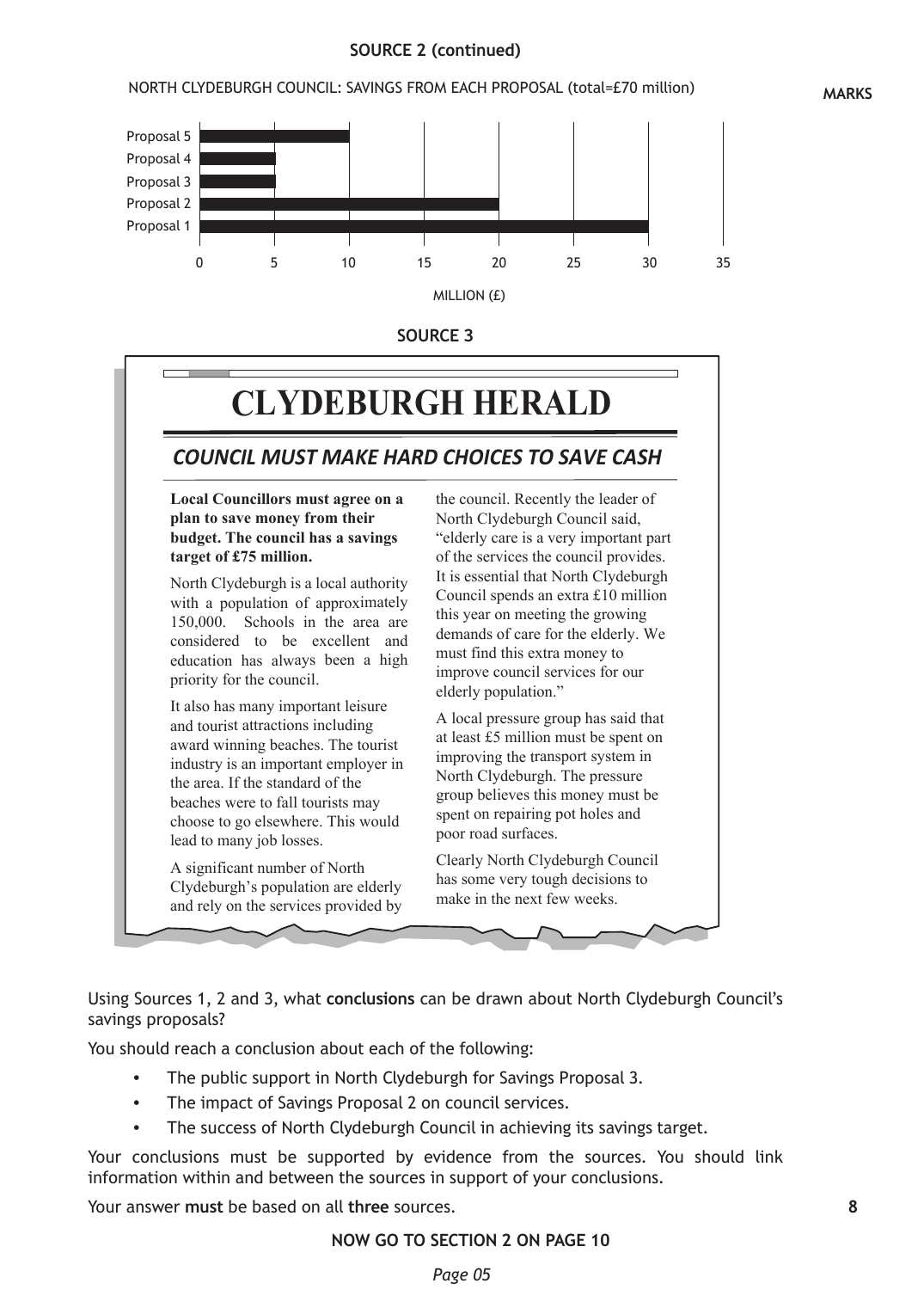
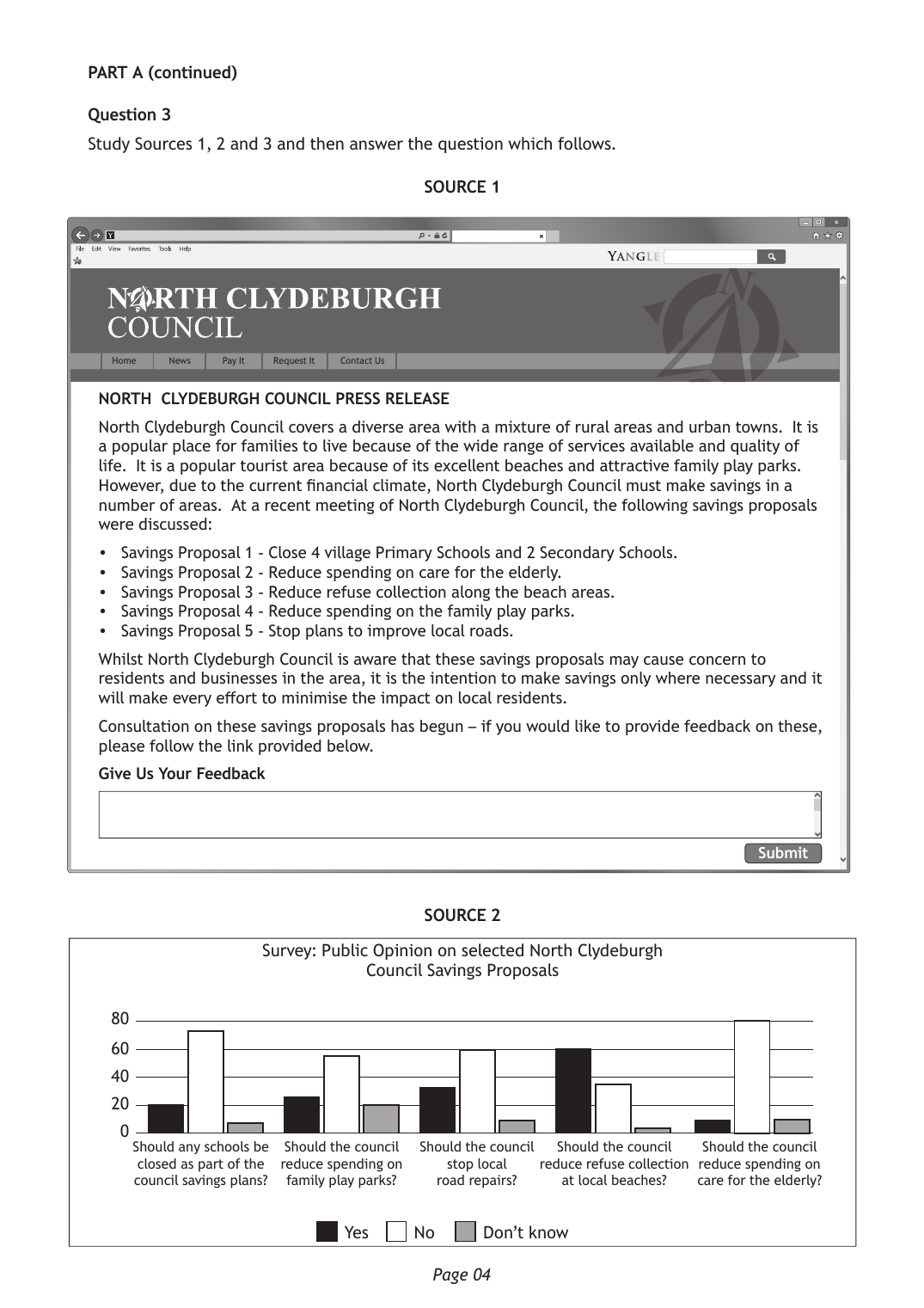
Using Sources 1, 2 and 3, what conclusions can be drawn about North Clydeburgh Council’s savings proposals?

You should reach a conclusion about each of the following:

  • The public support in North Clydeburgh for Savings Proposal 3.
  • The impact of Savings Proposal 2 on council services.
  • The success of North Clydeburgh Council in achieving its savings target.

Your conclusions must be supported by evidence from the sources. You should link information within and between the sources in support of your conclusions.

Your answer must be based on all three sources.

Sources (Source 1, Source 2, Source 3)

Source page 1 for this questionSource page 2 for this question
📝 Structure template — how to structure your answer

Conclusions · A source-based skills question

WFQ (words from the question)

  1. For EACH bullet point in the question, write the bullet point as a subheading, then:
  2. One conclusion that can be made about insert bullet point is insert valid conclusion.✓ 1 mark — valid conclusion
  3. Evidence to support this is shown in insert source which says/shows “insert evidence”.✓ 1 mark — evidence
  4. This clearly shows / strongly suggests insert valid conclusion — evaluative language earns the 3rd mark.✓ 1 mark — evaluative language

How it's marked

  • Conclusion + one piece of evidence = 2 marks. That is all you need for two of the three marks.
  • The 3rd mark does NOT come from a second piece of evidence linked to the same point — it comes from using evaluative terminology (e.g. “this clearly shows”, “the strongest evidence is”, “significantly”, “overwhelmingly”).
  • Comparison bullets (e.g. the UK compared with another country): you must give evidence about BOTH sides — but two pieces of evidence together still earn only ONE evidence mark, not two. You can still earn the 3rd mark with evaluative language, exactly as normal.
  • Up to 3 marks per bullet point; four conclusions (one per bullet point) are needed for full marks (10).
  • Tip: turn each bullet point into a question (e.g. “What is…?”, “What are…?”, “Which…?”, “How…?”) — the answer you give is your conclusion.
  • Conclusion + evidence = 2 marks. For the 3rd mark add evaluative language — a second quote linked to the same point does NOT earn it.
  • For a comparison bullet you must back BOTH sides with evidence — but that is still only one evidence mark, not two. The 3rd mark still comes from evaluative language.
✓ Reveal marking scheme
Max 8 marks

These are possible/exemplar answers from the marking instructions — other valid points can also gain marks.

How marks are awarded
  • The candidate is required to use a limited range of sources and draw valid conclusions from them, with supporting evidence.

Public support in North Clydeburgh for Savings Proposal 3

  1. Conclusion – There is support for Savings Proposal 3 in North Clydeburgh. (1 mark – valid conclusion)
  2. Conclusion – People in North Clydeburgh support Savings Proposal 3. For example, in a survey of public opinion on North Clydeburgh’s savings proposals 60% said yes. (source 2). (2 marks – conclusion and evidence from one source)
  3. Conclusion – Savings Proposal 3 would be the most popular option for people in North Clydeburgh. Savings Proposal 3 is for the council to reduce refuse collection along the beach areas (source 3). The public opinion survey on North Clydeburgh Council’s saving proposals show that a majority of people in North Clydeburgh, 60%, said they supported reducing refuse collection at local beaches, all of the other options only had support of 30% or less (source 2). (3 marks – conclusion and information from two sources with evaluative terminology)

The impact on council services of Savings Proposal 2

  1. Conclusion – Savings Proposal 2 will mean the council can’t improve the care services for the elderly. (1 mark – valid conclusion)
  2. Conclusion – Savings Proposal 2 will mean the council can’t improve the care services for the elderly. For example, spending on elderly services will be reduced by £20 million (source 3). (2 marks – conclusion and evidence from one source)
  3. Conclusion – Savings Proposal 2 will mean North Clydeburgh Council will be unable to improve the care services for the elderly. Savings Proposal 2 wants to reduce spending on care for the elderly by £20 million (source 3) however the leader of North Clydeburgh Council recently said they have to spend more money on services for the elderly, according to the leader an extra £10 million was needed to be spent on improving elderly care (source 1). Savings proposal 2 will mean they will not have enough money to make the improvements. (3 marks – conclusion and information from two sources)

How successfully will North Clydeburgh Council’s Savings proposals achieve their savings target

  1. Conclusion – North Cydeburgh Council’s saving proposals will not achieve their savings target. (1 mark – valid conclusion)
  2. Conclusion – North Cydeburgh Council’s saving proposals will not achieve their savings target. The proposals will only save the council £70 million (source 3). (2 marks – conclusion and evidence from one source)
  3. Conclusion – North Clydeburgh Council’s saving proposals will not achieve their savings target. North Clydeburgh Council has a savings target of £75 million (source 1) however the chart shows that the savings from all of the proposals will only achieve a saving of £70 million (source 3). This is £5 million less than their overall target and this means their target will not be met. (3 marks – conclusion and information from two sources with evaluative terminology)
Source: 2017 N5 History · X749/75/11 · Q3Question paper (PDF, p.4) ↗Marking instructions (PDF, p.6) ↗
Conclusions8 marks2017Q6⏳ Older formatDemocracy in Scotland and the UK

Study Sources 1, 2 and 3 and then answer the question which follows.

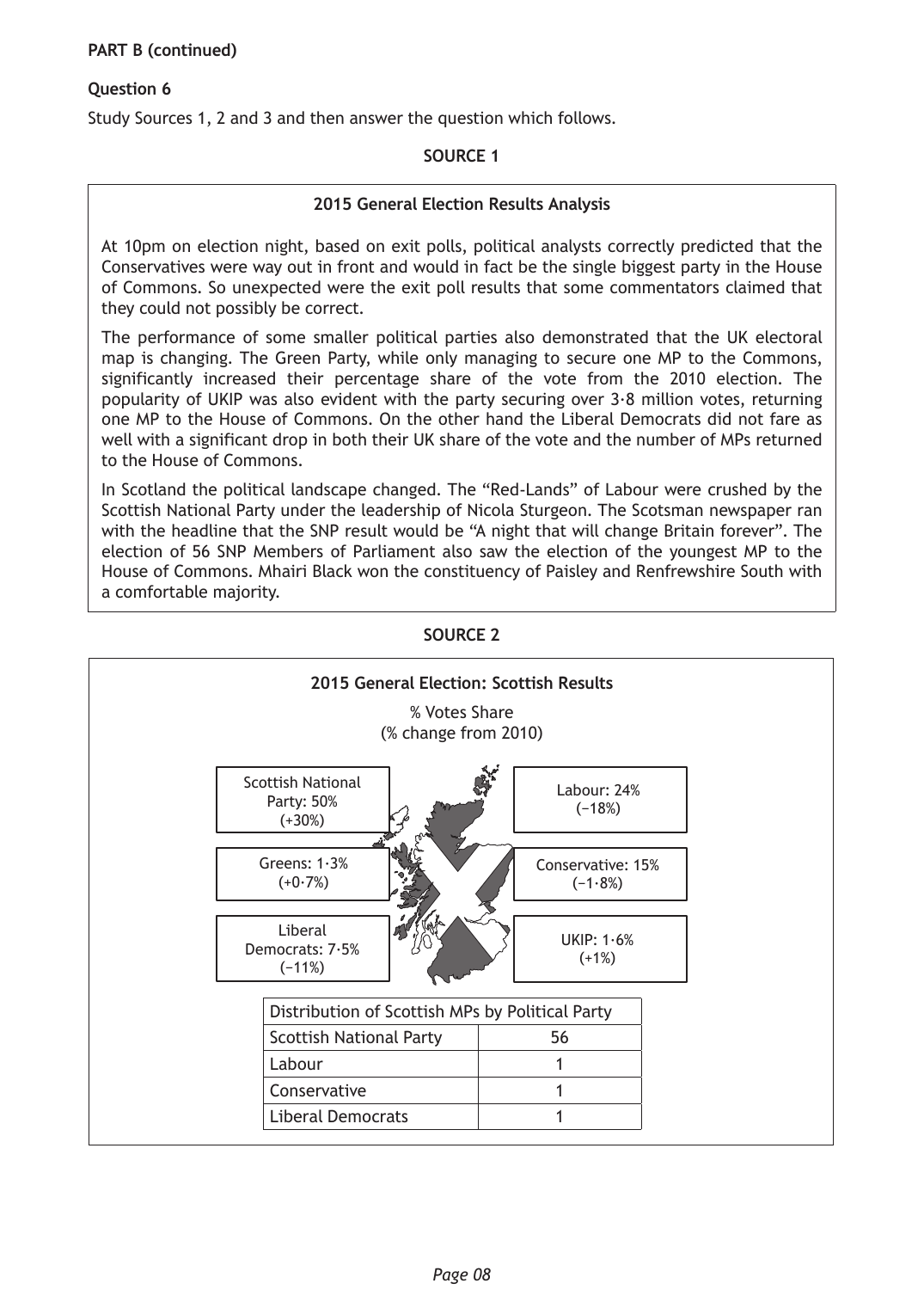
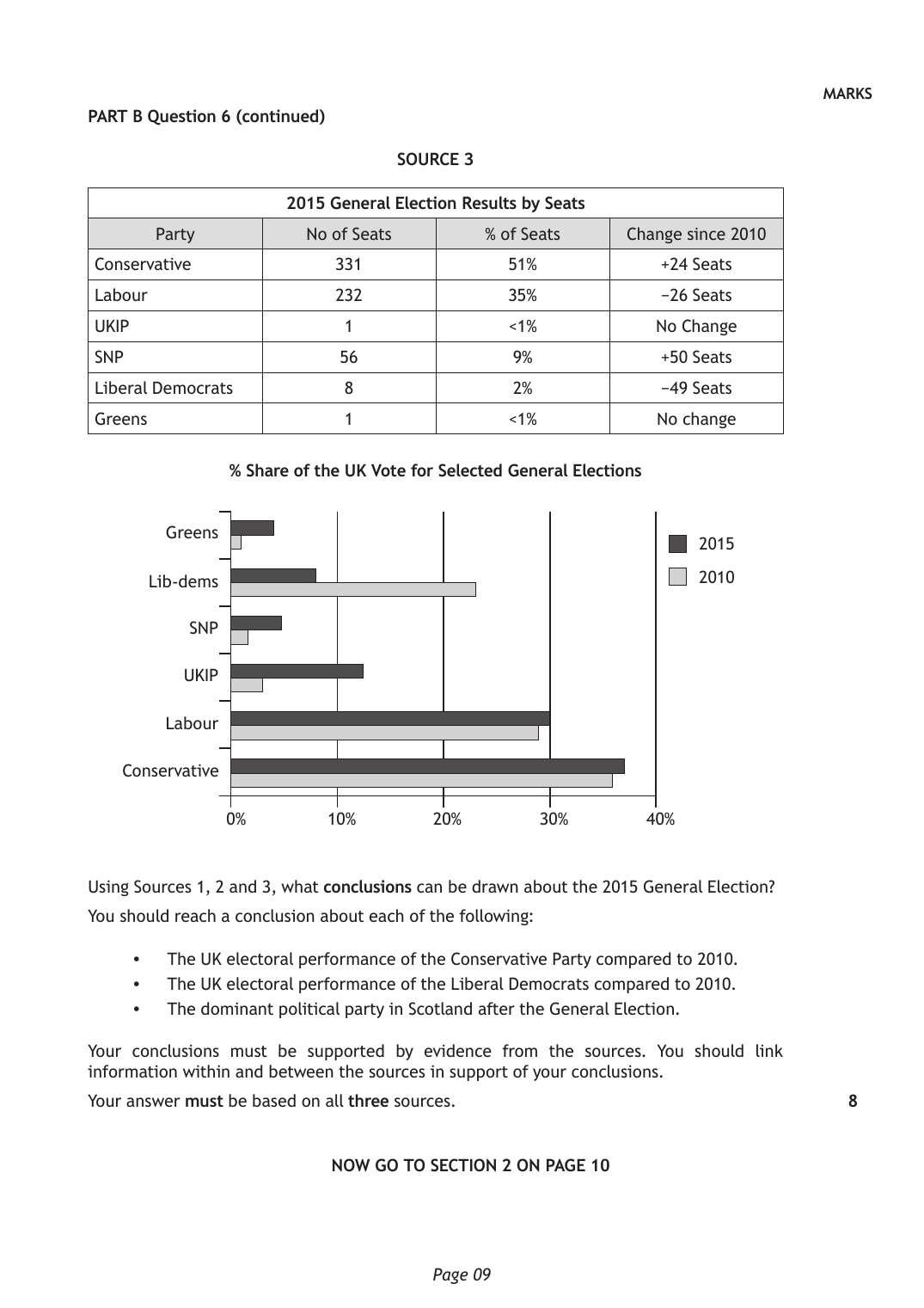
Using Sources 1, 2 and 3, what conclusions can be drawn about the 2015 General Election?

You should reach a conclusion about each of the following:

  • The UK electoral performance of the Conservative Party compared to 2010.
  • The UK electoral performance of the Liberal Democrats compared to 2010.
  • The dominant political party in Scotland after the General Election.

Your conclusions must be supported by evidence from the sources. You should link information within and between the sources in support of your conclusions.

Your answer must be based on all three sources.

Sources (Source 1, Source 2, Source 3)

Source page 1 for this questionSource page 2 for this question
📝 Structure template — how to structure your answer

Conclusions · A source-based skills question

WFQ (words from the question)

  1. For EACH bullet point in the question, write the bullet point as a subheading, then:
  2. One conclusion that can be made about insert bullet point is insert valid conclusion.✓ 1 mark — valid conclusion
  3. Evidence to support this is shown in insert source which says/shows “insert evidence”.✓ 1 mark — evidence
  4. This clearly shows / strongly suggests insert valid conclusion — evaluative language earns the 3rd mark.✓ 1 mark — evaluative language

How it's marked

  • Conclusion + one piece of evidence = 2 marks. That is all you need for two of the three marks.
  • The 3rd mark does NOT come from a second piece of evidence linked to the same point — it comes from using evaluative terminology (e.g. “this clearly shows”, “the strongest evidence is”, “significantly”, “overwhelmingly”).
  • Comparison bullets (e.g. the UK compared with another country): you must give evidence about BOTH sides — but two pieces of evidence together still earn only ONE evidence mark, not two. You can still earn the 3rd mark with evaluative language, exactly as normal.
  • Up to 3 marks per bullet point; four conclusions (one per bullet point) are needed for full marks (10).
  • Tip: turn each bullet point into a question (e.g. “What is…?”, “What are…?”, “Which…?”, “How…?”) — the answer you give is your conclusion.
  • Conclusion + evidence = 2 marks. For the 3rd mark add evaluative language — a second quote linked to the same point does NOT earn it.
  • For a comparison bullet you must back BOTH sides with evidence — but that is still only one evidence mark, not two. The 3rd mark still comes from evaluative language.
✓ Reveal marking scheme
Max 8 marks

These are possible/exemplar answers from the marking instructions — other valid points can also gain marks.

How marks are awarded
  • The candidate is required to use a limited range of sources and draw valid conclusions from them, with supporting evidence.

The UK electoral performance of the Conservative Party compared to 2010

  1. Conclusion – The Conservative Party performed better in the 2015 General Election than 2010. (1 mark – valid conclusion)
  2. Conclusion – The Conservative Party performed better in the 2015 General Election than 2010. In source 1 it states that the exit polls correctly predicted they would be the biggest single party in the House of Commons. (2 marks – valid conclusion and evidence from one source)
  3. Conclusion – The Conservative Party performed better in the 2015 General Election than 2010. In source 1 it stated that the exit polls correctly predicted they would be the biggest single party in the House of Commons. This can be linked to source 2 which tells us the Conservative gained the share of the UK vote, 37% which was an increase from 2010. (3 marks – valid conclusion and evidence from two sources)

The UK electoral performance of the Liberal Democrats compared to 2010

  1. Conclusion – The Liberal Democrats performed very poorly in 2015 compared to their 2010 result. (1 mark – valid conclusion)
  2. Conclusion – The Liberal Democrats performed very poorly in 2015 compared to their 2010 result. In source 1 it states that the Liberal Democrats saw a significant drop in both their UK share of the vote and in the number of MPs returned to the House of Commons. (2 marks – valid conclusion and evidence from one source)
  3. Conclusion – The Liberal Democrats performed very poorly in 2015 compared to their 2010 result. In source 1 it states that the Liberal Democrats saw a significant drop in both their UK share of the vote and in the number of MPs returned to the House of Commons. This can be supported by source 2 that shows that the seats won by the Liberal Democrats fell by 49, which means they only managed to get 8 MPs elected compared to their 57 MPs in 2010. (3 marks – valid conclusion and evidence from two sources)

The dominant political party in Scotland after the General Election.

  1. Conclusion - The Scottish National Party (SNP) was the dominant political party in Scotland after the 2015 general election. (1 mark – valid conclusion)
  2. Conclusion - The Scottish National Party (SNP) was the dominant political party in Scotland after the 2015 General Election. In source 1 it states that Labour was crushed by the Scottish National Party under the leadership of Nicola Sturgeon with 56 MPs elected to the House of Commons. (2 marks – valid conclusion and evidence from one source)
  3. Conclusion - The Scottish National Party (SNP) was the dominant political party in Scotland after the 2015 General Election. In source 1 it states that Labour was crushed by the Scottish National Party under the leadership of Nicola Sturgeon with 56 MPs elected to the House of Commons. This can be linked to source 3 that clearly shows that the SNP won 50% of the vote in Scotland which was an increase of 30% since the 2010 general election. (3 marks – valid conclusion and evidence from two sources)
Describe, in detail4 marks2017Q4⏳ Older formatDemocracy in the United Kingdom

People in the UK have many political rights.

Describe, in detail, two political rights that people in the UK have.

WFQ = words from the question — reuse in every point.

📝 Structure template — how to structure your answer

Describe, in detail · A knowledge (KU) question · use PEE

Remember PEE

  • Point — make your point
  • Explanation — develop it
  • Example — a specific, recent example

WFQ (words from the question)

  1. One words from the question is insert point.✓ 1 mark — Point
  2. This means that … (explain your point).✓ 1 mark — Explanation
  3. For example, … (give a specific, recent example).✓ 1 mark — Example
  4. Then repeat with a second point — two developed points are needed for full marks.

How it's marked

  • 1 mark for an accurate but undeveloped point (P).
  • +1 mark for developing/explaining it (E).
  • +1 mark for a specific example (E). Up to 3 marks per description; two descriptions needed for full marks.
  • The example is where learners most often drop the mark — always add “For example, …”.
✓ Reveal marking scheme
Max 4 marks

These are possible/exemplar answers from the marking instructions — other valid points can also gain marks.

How marks are awarded
  • Award up to 3 marks for a single description, depending on quality, level of detail, relevance, accuracy and exemplification. At least two descriptions are necessary for full marks.

Possible approaches to answering the question

  1. People in the UK have the right to vote in elections. (1 mark – accurate but undeveloped point)
  2. People in the UK have the right to vote in elections such as the General Election. (2 marks – accurate with development)
  3. People in the UK have the right to vote in elections such as the General Election. For example, the last General Election was held in May 2015 when the Conservative Party won 331 seats in the House of Commons, allowing them to form the government. (3 marks – accurate point with development and exemplification)

Credit reference to aspects of the following

  1. Right to free speech
  2. Right to protest
  3. Right to join a group (pressure group, trade union or political party)
  4. Right to lobby a representative
  5. Right to organise/sign a petition.
Source: 2017 N5 History · X749/75/11 · Q4Question paper (PDF, p.6) ↗Marking instructions (PDF, p.8) ↗
Explain, in detail8 marks2017Q5⏳ Older formatDemocracy in the United Kingdom

Some political parties’ election campaigns are successful during General Elections.

Explain, in detail, the reasons why some political parties’ election campaigns are successful during General Elections. You should give a maximum of three reasons in your answer.

WFQ = words from the question — reuse in every point.

📝 Structure template — how to structure your answer

Explain, in detail · A knowledge (KU) question · use PEE (+ analysis)

Remember PEE

  • Point — give your reason
  • Explanation — “this means that…”
  • Example — a specific, recent example

WFQ (words from the question)

  1. One reason words from the question is insert point.✓ 1 mark — Point
  2. This means that … (explain the reason).✓ 1 mark — Explanation
  3. For example, … (give a specific, recent example).✓ 1 mark — Example
  4. This is important because … (analysis — how it links to other factors).✓ 1 mark — Analysis
  5. Then repeat with a second reason — a maximum of two explanations are credited.

How it's marked

  • 1 mark for an accurate but undeveloped reason (P).
  • +1 for explanation (E), +1 for a specific example (E), +1 for analysis. Up to 4 marks per explanation.
  • A maximum of two explanations are credited.
  • Build each reason: Point → Explanation → Example → Analysis.
✓ Reveal marking scheme
Max 8 marks

These are possible/exemplar answers from the marking instructions — other valid points can also gain marks.

How marks are awarded
  • Award up to 4 marks for a single explanation, depending on quality, level of detail, relevance, accuracy, exemplification and answers which show the interaction of various factors.

Possible approaches to answering the question

  1. Some political parties’ election campaigns are successful because of their use of social media. (1 mark accurate but undeveloped)
  2. Some political parties’ election campaigns are successful because of their use of social media. This allows them to reach a large number of voters and tell them about their policies. (2 marks accurate with development)
  3. Some political parties’ election campaigns are successful because of their use of social media. This allows them to reach a large number of voters and tell them about their policies. Most political parties now have Facebook and Twitter pages. For example, the Conservatives have over 220,000 followers on Twitter. (4 marks accurate with development and exemplification)

Credit reference to aspects of the following

  1. Party membership
  2. Party funding
  3. Use of other media, eg television, radio
  4. Support of the printed press
  5. Party image
  6. Party leader
  7. Constituency party activists.
Source: 2017 N5 History · X749/75/11 · Q5Question paper (PDF, p.6) ↗Marking instructions (PDF, p.9) ↗
Decision making10 marks2017Q15⏳ Older formatInternational Issues

Study Sources 1, 2 and 3 and then answer the question which follows.

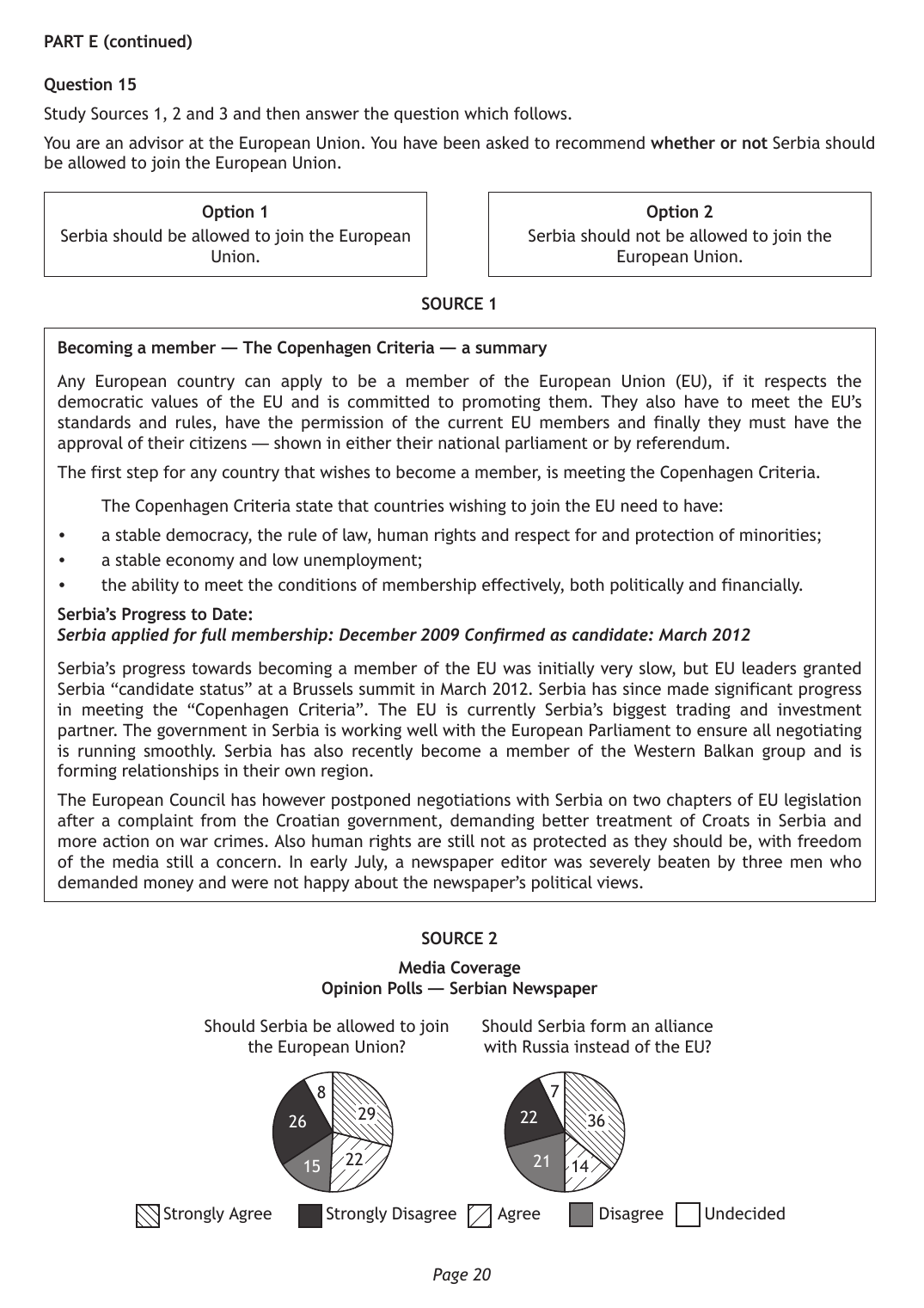
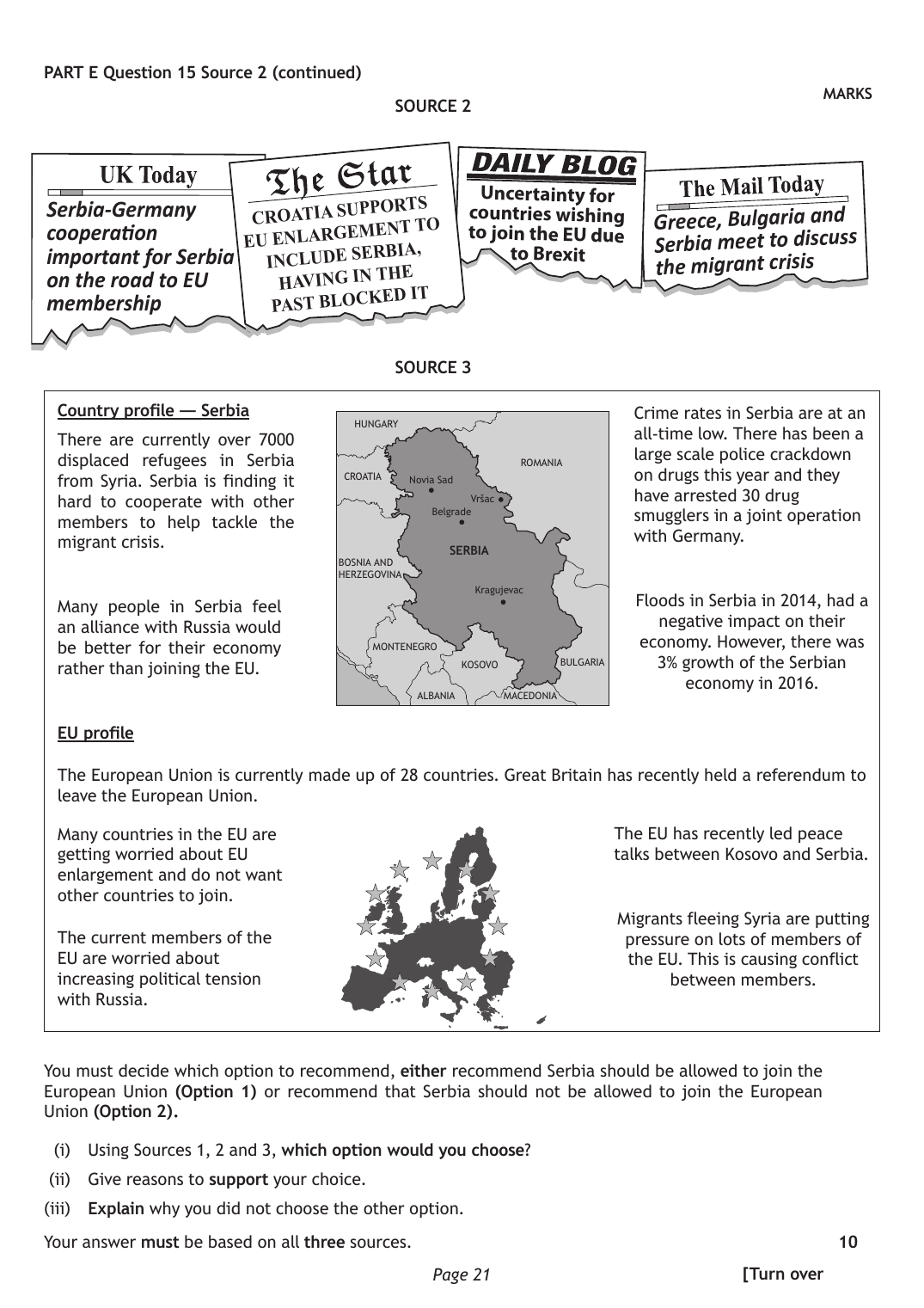
You are an advisor at the European Union. You have been asked to recommend whether or not Serbia should be allowed to join the European Union.

Option 1

Serbia should be allowed to join the European Union.

Option 2

Serbia should not be allowed to join the European Union.

You must decide which option to recommend, either recommend Serbia should be allowed to join the European Union (Option 1) or recommend that Serbia should not be allowed to join the European Union (Option 2).

(i) Using Sources 1, 2 and 3, which option would you choose?

(ii) Give reasons to support your choice.

(iii) Explain why you did not choose the other option.

Your answer must be based on all three sources.

Sources (Source 1, Source 2, Source 3)

Source page 1 for this questionSource page 2 for this question
📝 Structure template — how to structure your answer

Decision making · A source-based skills question

WFQ (words from the question)

  1. I chose insert option name.
  2. Evidence to support this is in insert source which says/shows “insert evidence”.✓ 1 mark per piece of evidence (up to 8)
  3. This is further supported by evidence in insert source which says/shows “insert evidence”. (Repeat until you have 8 pieces of evidence = 8 marks.)
  4. Rebuttal: I rejected insert option name because insert source says/shows “insert evidence”.✓ needed for full marks

How it's marked

  • Up to 3 marks for a developed justification; credit highly where you link evidence between sources.
  • For full marks you must justify your decision AND explain why you rejected the other option.
  • Maximum 8 marks if you only deal with one option.
  • Aim for around 8 pieces of evidence to build up the marks.
  • Don’t forget the rebuttal — say why you rejected the other option.
✓ Reveal marking scheme
Max 10 marks

These are possible/exemplar answers from the marking instructions — other valid points can also gain marks.

How marks are awarded
  • The candidate is required to evaluate a limited range of sources, in order to make and justify a decision/recommendation. The candidate must also explain why they have rejected the other option.
  • In order to achieve full marks candidates must say why they did not choose the other option. An answer which deals with only one option should be awarded a maximum of 8 marks.

For Option One: Serbia is allowed to join the European Union

  1. Serbia should be allowed to join the European Union, evidence to support this can be found in source 1 where it states that “Serbia has made significant progress in meeting the Copenhagen Criteria”. The Copenhagen Criteria states that countries who wish to join should have “a stable democracy, the rule of law, human rights and respect for and protection of minorities”. This is backed up in source 3 where it states that “crime rates in Serbia are at an all-time low.” (3 Marks – detailed evidence linked from sources 1 and 3)
  2. Credit reference to aspects of the following:
  3. The government in Serbia is working well with the European Parliament to ensure all negotiating is running smoothly (source 1)
  4. Serbia has also recently become a member of the Western Balkan group and is forming relationships in their own region (source 1)
  5. The EU is currently Serbia’s biggest trading and investment partner (source 1)
  6. 51% of the public in Serbia either agree or strongly agree with Serbia joining the European Union (source 2)
  7. Serbia-Germany cooperation is important for Serbia on the road to EU membership (source 2)
  8. Croatia supports EU enlargement to include Serbia, having in the past blocked it (source 2)
  9. Crime rates in Serbia are at an all-time low. There has been a large scale police crackdown on drugs this year and they arrested 30 drug smugglers in a joint operation with Germany (source 3)
  10. 3% growth of the Serbian economy in 2016 (source 3).

Reasons for rejecting other option: Option 2: Serbia should not be allowed to join the European Union.

  1. I did not choose option 2 as although some people may say that Serbia have not made a lot of progress, they have recently taken part in EU-led peace talks between Serbia and Kosovo. (1 mark awarded for use of one piece of information with no linking. Do not credit if marks have already been awarded for this point)
  2. Serbia should not be allowed to join the European Union as “many people in Serbia feel an alliance with Russia would be better for their economy rather than joining the EU”. (1 mark – evidence drawn from source 3)
  3. Serbia should not be allowed to join the European Union as they have not made great progress toward meeting the Copenhagen criteria, they have still not met the following criteria discussed in source 1, “a stable economy and low unemployment” as it states in source 3 that “floods in Serbia in 2014, had a negative impact on their economy”. (2 marks – evidence linked from sources 1 and 3)
  4. The European Council has however postponed negotiations with Serbia on two chapters of EU legislation after a complaint from the Croatian government, demanding better treatment of Croats in Serbia and more action on war crimes (source 1)
  5. Human rights are still not as protected as they should be, with freedom of the media still a concern. In early July, a newspaper editor was severely beaten by three men who demanded money and were not happy about the newspaper’s political views (source 1)
  6. Uncertainty for countries wishing to join the EU due to Brexit (source 2)
  7. Greece, Bulgaria and Serbia meet to discuss the migrant crisis (source 2)
  8. Migrants fleeing Syria are putting pressure on lots of members of the EU, this is causing conflict between members (source 3)
  9. Many countries in the EU are getting worried about enlargement and don’t want other countries to join (source 3)

Reasons for rejecting the other option (rejecting Option 1)

  1. Although many people would argue that Serbia has made great progress in meeting their targets, Serbia should not be allowed to join the European Union as in source 3 it states that many people in Serbia “feel an alliance with Russia would be better for their economy rather than joining the EU”. This is backed up in source 2 where the graph shows that 50% of the people in the opinion poll either agreed or strongly agreed that Serbia would be better off in an alliance with Russia rather than in the EU. This shows that lots of people do in fact think that Russia would be a better economic alliance that the EU. (3 marks – evidence drawn from two sources, with evaluative comment)
Source: 2017 N5 History · X749/75/11 · Q15Question paper (PDF, p.20) ↗Marking instructions (PDF, p.23) ↗
Decision making10 marks2017Q18⏳ Older formatInternational Issues

Study Sources 1, 2 and 3 and then answer the question which follows.

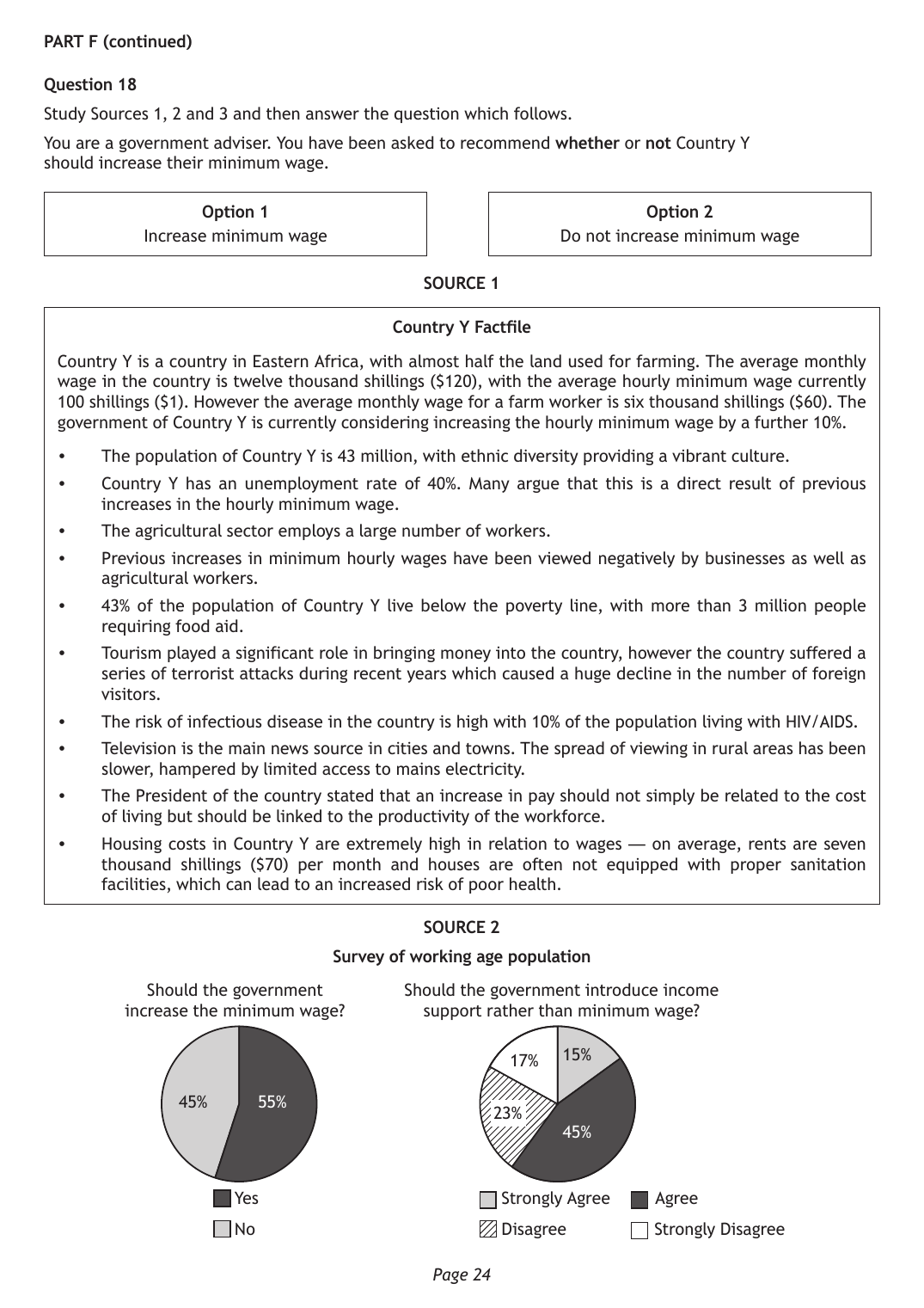
You are a government adviser. You have been asked to recommend whether or not Country Y should increase their minimum wage.

Option 1

Increase minimum wage

Option 2

Do not increase minimum wage

You must decide which option to recommend, either increase minimum wage (Option 1) or do not increase minimum wage (Option 2).

(i) Using Sources 1, 2 and 3, which option would you choose?

(ii) Give reasons to support your choice.

(iii) Explain why you did not choose the other option.

Your answer must be based on all three sources.

Sources (Source 1, Source 2, Source 3)

Source page 1 for this questionSource page 2 for this question
📝 Structure template — how to structure your answer

Decision making · A source-based skills question

WFQ (words from the question)

  1. I chose insert option name.
  2. Evidence to support this is in insert source which says/shows “insert evidence”.✓ 1 mark per piece of evidence (up to 8)
  3. This is further supported by evidence in insert source which says/shows “insert evidence”. (Repeat until you have 8 pieces of evidence = 8 marks.)
  4. Rebuttal: I rejected insert option name because insert source says/shows “insert evidence”.✓ needed for full marks

How it's marked

  • Up to 3 marks for a developed justification; credit highly where you link evidence between sources.
  • For full marks you must justify your decision AND explain why you rejected the other option.
  • Maximum 8 marks if you only deal with one option.
  • Aim for around 8 pieces of evidence to build up the marks.
  • Don’t forget the rebuttal — say why you rejected the other option.
✓ Reveal marking scheme
Max 10 marks

These are possible/exemplar answers from the marking instructions — other valid points can also gain marks.

How marks are awarded
  • The candidate is required to evaluate a limited range of sources, in order to make and justify a decision/recommendation. The candidate must also explain why they have rejected the other option.
  • In order to achieve full marks candidates must say why they did not choose the other option. An answer which deals with only one option should be awarded a maximum of 8 marks.

For Option 1

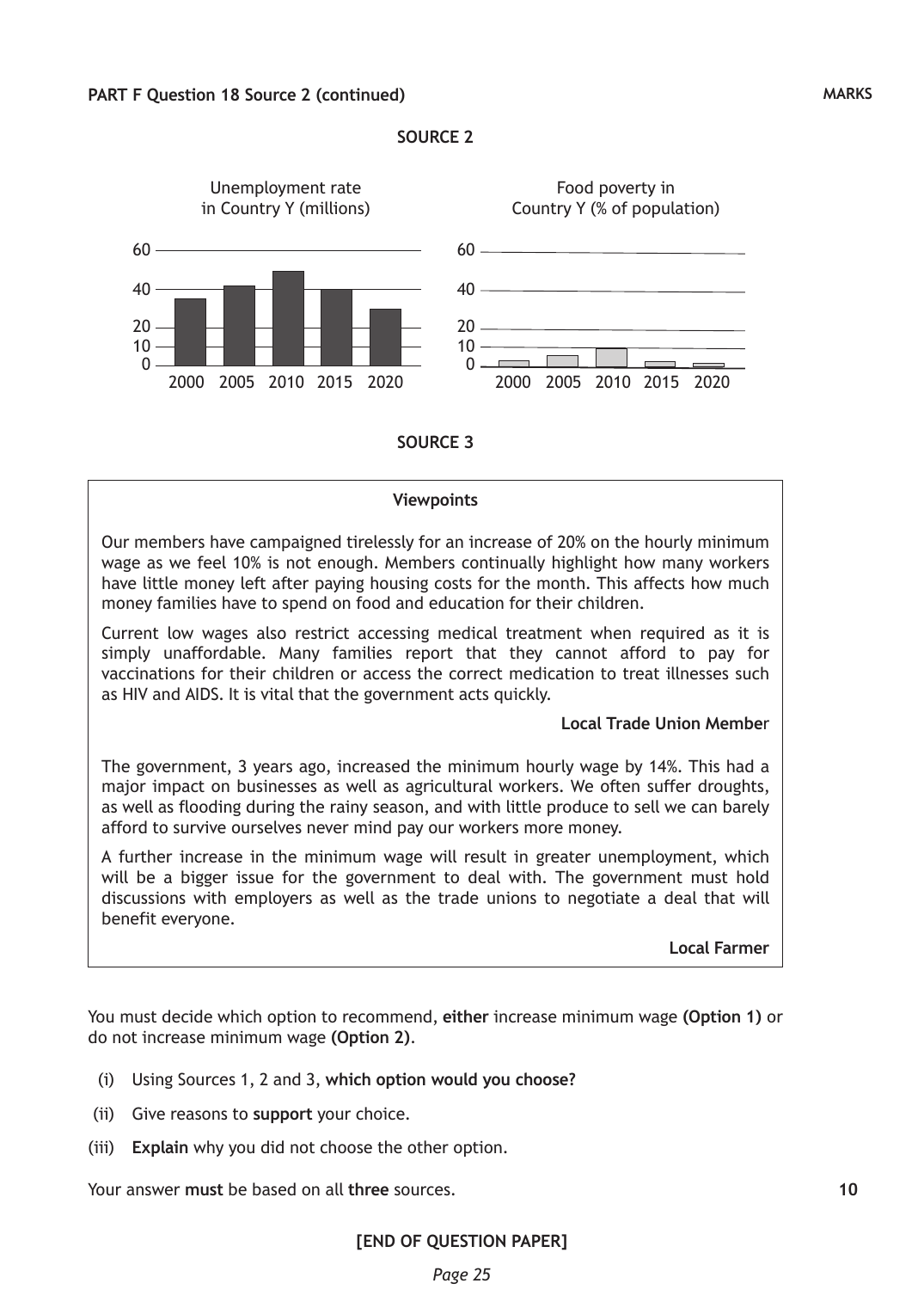
  1. I would choose option 1 because source 1 states 43% of the population of country Y live below the poverty line. This is supported in source 2 when 55% of people surveyed said the government should increase the minimum wage. (2 marks evidence linked from sources 1 and 2)
  2. I would choose option 1 because source 1 states 43% of the population of country Y live below the poverty line. This is supported in source 2 when 55% of people surveyed said the government should increase the minimum wage. This highlights that there are huge numbers of people living in poverty and more than half of the people surveyed support option 1. (3 marks evidence linked from sources 1 and 2 with evaluation)
  3. Reference to aspects of the following will be credited:
  4. More than 3 million people requiring food aid (source 1)
  5. Housing costs are extremely high in relation to wages (source 1)
  6. Many workers have little money left after housing costs (source 3)
  7. Low wages restrict access to medical treatment (source 3).
  8. Reason for rejecting other option:
  9. I could have chosen option 2 because in source 1 it states previous increases in minimum hourly wages have been viewed negatively by businesses, however, I picked option 1 because in source 3, it states many workers have little money left after housing costs. (2 marks – evidence linked between two sources)

For Option 2

  1. I would choose option 2 because source 1 states that many people think that the high unemployment rate is a direct result of previous increases in the hourly minimum wage. This is supported in source 2 where the opinion poll highlights 60% either agree or strongly agree that the government should introduce income support rather than minimum wage. (2 marks evidence linked from sources 1 and 2)
  2. I would choose option 2 because source 1 states that many people think that the high unemployment rate is a direct result of previous increases in the hourly minimum wage. This is supported in source 2 where the opinion poll highlights 60% either agree or strongly agree that the government should introduce income support rather than minimum wage. This highlights that the majority of people are against the minimum wage. (3 marks evidence linked from sources 1 and 2 with evaluation)
  3. The President of country Y stated an increase in pay should not be related to the cost of living but should be linked to productivity (source 1)
  4. Increases in minimum wage are viewed negatively by businesses as well as agricultural workers (source 1)
  5. Recent increases in minimum wage have a major impact on businesses (source 3)
  6. A further increase will result in greater unemployment (source 3).
  7. Reasons for rejecting the other option:
  8. I could have chosen option 1 because in source 3 it states many workers have little money left after housing costs, however, I picked option 2 because it states in source 1, previous increases in minimum hourly wages have been viewed negatively by businesses. (2 marks – evidence linked between two sources)
Source: 2017 N5 History · X749/75/11 · Q18Question paper (PDF, p.24) ↗Marking instructions (PDF, p.29) ↗
Describe, in detail4 marks2017Q16⏳ Older formatWorld Issues

International issues and conflicts have many consequences.

Describe, in detail, two consequences of an international conflict or issue you have studied. In your answer you should state the world issue or conflict you have studied.

WFQ = words from the question — reuse in every point.

📝 Structure template — how to structure your answer

Describe, in detail · A knowledge (KU) question · use PEE

Remember PEE

  • Point — make your point
  • Explanation — develop it
  • Example — a specific, recent example

WFQ (words from the question)

  1. One words from the question is insert point.✓ 1 mark — Point
  2. This means that … (explain your point).✓ 1 mark — Explanation
  3. For example, … (give a specific, recent example).✓ 1 mark — Example
  4. Then repeat with a second point — two developed points are needed for full marks.

How it's marked

  • 1 mark for an accurate but undeveloped point (P).
  • +1 mark for developing/explaining it (E).
  • +1 mark for a specific example (E). Up to 3 marks per description; two descriptions needed for full marks.
  • The example is where learners most often drop the mark — always add “For example, …”.
✓ Reveal marking scheme
Max 4 marks

These are possible/exemplar answers from the marking instructions — other valid points can also gain marks.

How marks are awarded
  • Award up to 3 marks for a single description, depending on quality, level of detail, relevance, accuracy and exemplification. At least two descriptions are necessary for full marks.

Possible approaches to answering the question

  1. The civil war in Syria has led to many refugees. (1 mark - accurate but undeveloped point)
  2. The civil war in Syria has led to many refugees and forced people to leave their homes and go to countries such as Lebanon. (2 marks - accurate with exemplification)
  3. The civil war in Syria has led to many refugees and forced people to leave their homes and go to countries such as Lebanon. People left the city of Homs as the Syrian army and opposition fighters were fighting for control of the city and over sixteen thousand people died. (3 marks - accurate point with development and detailed exemplification)

Credit reference to aspects of the following

  1. Migration
  2. Piracy
  3. Terrorism
  4. Child soldiers
  5. Poverty
  6. Hunger
  7. Climate change.
Source: 2017 N5 History · X749/75/11 · Q16Question paper (PDF, p.22) ↗Marking instructions (PDF, p.26) ↗
Explain, in detail6 marks2017Q17⏳ Older formatWorld Issues

International organisations have many reasons for attempting to resolve international issues and conflicts.

Selected International Organisations United Nations NATO European Union Charities African Union NGOs Select an International Organisation you have studied. Explain, in detail, two reasons why it has attempted to resolve an international issue or conflict. In your answer you should state the world issue or conflict you have studied.

WFQ = words from the question — reuse in every point.

📝 Structure template — how to structure your answer

Explain, in detail · A knowledge (KU) question · use PEE (+ analysis)

Remember PEE

  • Point — give your reason
  • Explanation — “this means that…”
  • Example — a specific, recent example

WFQ (words from the question)

  1. One reason words from the question is insert point.✓ 1 mark — Point
  2. This means that … (explain the reason).✓ 1 mark — Explanation
  3. For example, … (give a specific, recent example).✓ 1 mark — Example
  4. This is important because … (analysis — how it links to other factors).✓ 1 mark — Analysis
  5. Then repeat with a second reason — a maximum of two explanations are credited.

How it's marked

  • 1 mark for an accurate but undeveloped reason (P).
  • +1 for explanation (E), +1 for a specific example (E), +1 for analysis. Up to 4 marks per explanation.
  • A maximum of two explanations are credited.
  • Build each reason: Point → Explanation → Example → Analysis.
✓ Reveal marking scheme
Max 6 marks

These are possible/exemplar answers from the marking instructions — other valid points can also gain marks.

How marks are awarded
  • Award up to 4 marks for a single explanation, depending on quality, level of detail, relevance, accuracy, exemplification and answers which show the interaction of various factors.

Possible approaches to answering the question

  1. The United Nations has provided aid to Sierra Leone to stop ebola spreading further. (1 mark - accurate but undeveloped point)
  2. The United Nations has provided aid to Sierra Leone to stop ebola spreading further. UN agencies such as WHO have sent medical staff to train local healthcare workers so that they have the skills to be self-sufficient. (2 marks - accurate with development)
  3. The United Nations has provided aid to Sierra Leone to stop ebola spreading further. UN agencies such as WHO have sent medical staff to train local healthcare workers so that they have the skills to be self-sufficient. WHO has also worked in partnership with developed countries such as the UK to build local treatment centres to care for those affected. (3 marks - accurate point with development and exemplification)

Credit reference to aspects of the following

  1. UN
  2. African Union - Common borders mean conflicts can have a direct impact eg in Zimbabwe and Kenya - AU has a Child’s Charter and so must work to prevent child soldiers, exploitation
  3. NATO - Charter sets out collective responsibilities Crisis management one of its aims; political, military or humanitarian
  4. EU -impact on member states eg migration, refugees, nearby conflicts such as Syria and Georgia
  5. NGO -Purpose is to work in specific field eg Oxfam in famine hit areas.
Source: 2017 N5 History · X749/75/11 · Q17Question paper (PDF, p.22) ↗Marking instructions (PDF, p.27) ↗
Describe, in detail4 marks2017Q13⏳ Older formatWorld Powers

There are many causes of socio-economic issues.

Describe, in detail, two causes of socio-economic issues in the world power you have studied. In your answer you should state the world power you have studied.

WFQ = words from the question — reuse in every point.

📝 Structure template — how to structure your answer

Describe, in detail · A knowledge (KU) question · use PEE

Remember PEE

  • Point — make your point
  • Explanation — develop it
  • Example — a specific, recent example

WFQ (words from the question)

  1. One words from the question is insert point.✓ 1 mark — Point
  2. This means that … (explain your point).✓ 1 mark — Explanation
  3. For example, … (give a specific, recent example).✓ 1 mark — Example
  4. Then repeat with a second point — two developed points are needed for full marks.

How it's marked

  • 1 mark for an accurate but undeveloped point (P).
  • +1 mark for developing/explaining it (E).
  • +1 mark for a specific example (E). Up to 3 marks per description; two descriptions needed for full marks.
  • The example is where learners most often drop the mark — always add “For example, …”.
✓ Reveal marking scheme
Max 4 marks

These are possible/exemplar answers from the marking instructions — other valid points can also gain marks.

How marks are awarded
  • Award up to 3 marks for a single description, depending on quality, level of detail, relevance, accuracy and exemplification. At least two descriptions are necessary for full marks.

Possible approaches to answering the question

  1. The world power that I have studied is the USA. One of the causes of socio-economic issues is unemployment. (1 mark accurate but undeveloped)
  2. The world power that I have studied is the USA. One of the causes of socio-economic issues is unemployment. This can lead to people living in poverty and struggling to meet their needs. (2 marks accurate and developed)
  3. The world power that I have studied is China. One of the causes of socio-economic issues is migration. This can lead to people living in poverty and struggling to meet their needs. For example, migrant workers can struggle to find employment and are unable to support their families. (3 marks accurate with development and exemplification)

Credit reference to aspects of the following

  1. Low income
  2. Low education attainment
  3. Poor health
  4. Discrimination eg racism
  5. Illegal immigration
  6. Government strategies.
Source: 2017 N5 History · X749/75/11 · Q13Question paper (PDF, p.18) ↗Marking instructions (PDF, p.21) ↗
Explain, in detail6 marks2017Q14⏳ Older formatWorld Powers

Some groups of people are less likely to participate in politics than others.

Explain, in detail, two reasons why some groups of people are less likely to participate in politics than others in the world power you have studied. In your answer you should state the world power you have studied.

WFQ = words from the question — reuse in every point.

📝 Structure template — how to structure your answer

Explain, in detail · A knowledge (KU) question · use PEE (+ analysis)

Remember PEE

  • Point — give your reason
  • Explanation — “this means that…”
  • Example — a specific, recent example

WFQ (words from the question)

  1. One reason words from the question is insert point.✓ 1 mark — Point
  2. This means that … (explain the reason).✓ 1 mark — Explanation
  3. For example, … (give a specific, recent example).✓ 1 mark — Example
  4. This is important because … (analysis — how it links to other factors).✓ 1 mark — Analysis
  5. Then repeat with a second reason — a maximum of two explanations are credited.

How it's marked

  • 1 mark for an accurate but undeveloped reason (P).
  • +1 for explanation (E), +1 for a specific example (E), +1 for analysis. Up to 4 marks per explanation.
  • A maximum of two explanations are credited.
  • Build each reason: Point → Explanation → Example → Analysis.
✓ Reveal marking scheme
Max 6 marks

These are possible/exemplar answers from the marking instructions — other valid points can also gain marks.

How marks are awarded
  • Award up to 4 marks for a single explanation, depending on quality, level of detail, relevance, accuracy, exemplification and answers which show the interaction of various factors.

Possible approaches to answering the question

  1. The world power that I have studied is Brazil. One reason why many people who live in the Favelas are less likely to participate in politics is because of lack of education. (1 mark accurate but undeveloped)
  2. The world power that I have studied is Brazil. One reason why many people who live in the Favelas are less likely to participate in politics is because of lack of education. They often do not attend school because they have to work to support their families from a young age. (2 marks accurate and developed)
  3. The world power that I have studied is Brazil. One reason why many people who live in the Favelas are less likely to participate in politics is because of lack of education. They often do not attend school because they have to work to support their families from a young age. For example, in the recent government impeachment “coup”, many residents of the Favelas stated that their priority was to survive daily life, rather than participate in politics. (3 marks accurate with development and exemplification)

Credit reference to aspects of the following

  1. Lack of role models
  2. Language barriers
  3. Corrupt officials/government leaders
  4. Discrimination eg gender, ethnicity
  5. Human rights
  6. Geographical location eg rural/urban.
Source: 2017 N5 History · X749/75/11 · Q14Question paper (PDF, p.18) ↗Marking instructions (PDF, p.22) ↗
Describe, in detail6 marks2017Q10⏳ Older formatCrime and the Law

There are many consequences of crime on communities.

Describe, in detail, two consequences of crime on communities.

WFQ = words from the question — reuse in every point.

📝 Structure template — how to structure your answer

Describe, in detail · A knowledge (KU) question · use PEE

Remember PEE

  • Point — make your point
  • Explanation — develop it
  • Example — a specific, recent example

WFQ (words from the question)

  1. One words from the question is insert point.✓ 1 mark — Point
  2. This means that … (explain your point).✓ 1 mark — Explanation
  3. For example, … (give a specific, recent example).✓ 1 mark — Example
  4. Then repeat with a second point — two developed points are needed for full marks.

How it's marked

  • 1 mark for an accurate but undeveloped point (P).
  • +1 mark for developing/explaining it (E).
  • +1 mark for a specific example (E). Up to 3 marks per description; two descriptions needed for full marks.
  • The example is where learners most often drop the mark — always add “For example, …”.
✓ Reveal marking scheme
Max 6 marks

These are possible/exemplar answers from the marking instructions — other valid points can also gain marks.

How marks are awarded
  • Award up to 3 marks for a single description, depending on quality, level of detail, relevance, accuracy and exemplification. At least two descriptions are necessary for full marks.

Possible approaches to answering the question

  1. One consequence of crime on communities is that local business may leave an area with high crime rates. (1 mark—accurate but undeveloped point)
  2. Communities with high crime rates will gain a negative reputation. People may start to stereotype individuals from areas of high crime, leading to social problems and a lack of opportunities in that area. For example, the provision of local services will suffer as businesses will not want to set up in areas with high crime rates, which will limit employment opportunities. (3 marks—accurate point with development and exemplification)

Consequences of crime on communities

  1. Areas will become run down, vandalism
  2. Rise in unemployment rate
  3. Businesses will leave
  4. Fear created
  5. People will move in order to find safety
  6. Lower house price values
  7. Lack of successful role models in the area
  8. Empower local communities – fight against crime.
Source: 2017 N5 History · X749/75/11 · Q10Question paper (PDF, p.14) ↗Marking instructions (PDF, p.16) ↗
Explain, in detail6 marks2017Q11⏳ Older formatCrime and the Law

Some people are more likely to commit crimes than others.

Explain, in detail, two reasons why some people are more likely to commit crime than others.

WFQ = words from the question — reuse in every point.

📝 Structure template — how to structure your answer

Explain, in detail · A knowledge (KU) question · use PEE (+ analysis)

Remember PEE

  • Point — give your reason
  • Explanation — “this means that…”
  • Example — a specific, recent example

WFQ (words from the question)

  1. One reason words from the question is insert point.✓ 1 mark — Point
  2. This means that … (explain the reason).✓ 1 mark — Explanation
  3. For example, … (give a specific, recent example).✓ 1 mark — Example
  4. This is important because … (analysis — how it links to other factors).✓ 1 mark — Analysis
  5. Then repeat with a second reason — a maximum of two explanations are credited.

How it's marked

  • 1 mark for an accurate but undeveloped reason (P).
  • +1 for explanation (E), +1 for a specific example (E), +1 for analysis. Up to 4 marks per explanation.
  • A maximum of two explanations are credited.
  • Build each reason: Point → Explanation → Example → Analysis.
✓ Reveal marking scheme
Max 6 marks

These are possible/exemplar answers from the marking instructions — other valid points can also gain marks.

How marks are awarded
  • Award up to 4 marks for a single explanation, depending on quality, level of detail, relevance, accuracy, exemplification and answers which show the interaction of various factors.

Possible approaches to answering the question

  1. One reason why some people are more likely to commit crime than others is due to peer pressure. (1 mark - accurate but undeveloped point)
  2. One reason that some people are more likely to commit crimes than others is due to peer pressure. Young people can be pressurised into joining gangs and are sometimes forced to take part in initiation tasks. (2 marks - accurate and developed)
  3. One reason that some people are more likely to commit crimes than others is due to peer pressure. Young people can be pressurised into joining gangs and are sometimes forced to take part in initiation tasks. This can lead to other criminal activities associated with gangs such as knife crime, vandalism and anti-social behaviour. (3 marks - accurate with development and exemplification)

Credit reference to aspects of the following

  1. Poverty/deprivation
  2. Peer pressure
  3. Family influence
  4. Alcohol abuse
  5. Mental illness
  6. Violent media images
  7. Homelessness
  8. Poor educational attainment
  9. Social exclusion
  10. Greed – white collar crime.
Source: 2017 N5 History · X749/75/11 · Q11Question paper (PDF, p.14) ↗Marking instructions (PDF, p.17) ↗
Describe, in detail6 marks2017Q7⏳ Older formatSocial Inequality

There are many consequences of social inequalities on communities.

Describe, in detail, two consequences of social inequalities on communities.

WFQ = words from the question — reuse in every point.

📝 Structure template — how to structure your answer

Describe, in detail · A knowledge (KU) question · use PEE

Remember PEE

  • Point — make your point
  • Explanation — develop it
  • Example — a specific, recent example

WFQ (words from the question)

  1. One words from the question is insert point.✓ 1 mark — Point
  2. This means that … (explain your point).✓ 1 mark — Explanation
  3. For example, … (give a specific, recent example).✓ 1 mark — Example
  4. Then repeat with a second point — two developed points are needed for full marks.

How it's marked

  • 1 mark for an accurate but undeveloped point (P).
  • +1 mark for developing/explaining it (E).
  • +1 mark for a specific example (E). Up to 3 marks per description; two descriptions needed for full marks.
  • The example is where learners most often drop the mark — always add “For example, …”.
✓ Reveal marking scheme
Max 6 marks

These are possible/exemplar answers from the marking instructions — other valid points can also gain marks.

How marks are awarded
  • Award up to 3 marks for a single description, depending on quality, level of detail, relevance, accuracy and exemplification. At least 2 descriptions are necessary for full marks.

Possible approaches to answering the question

  1. One consequence of social inequalities on communities is that businesses may leave the area. (1 mark accurate but undeveloped)
  2. One consequence of social inequalities on communities is that businesses may leave the area. This means that people living in the area have less access to certain services. (2 marks accurate and developed)
  3. One consequence of social inequalities on communities is that businesses may leave the area. This means that people living in the area have less access to certain services and have to travel further to meet their needs. For example, people may have to spend money in order to travel to large retail parks to access a supermarket. (3 marks accurate with development and exemplification)

Credit reference to aspects of the following

  1. Lower educational attainment
  2. Higher crime rates eg vandalism and anti-social behaviour
  3. Unemployment
  4. House prices
  5. Social exclusion.
Explain, in detail6 marks2017Q8⏳ Older formatSocial Inequality

Some people are more likely to suffer social inequalities than others.

Explain, in detail, two reasons why some people are more likely to suffer social inequalities than others.

WFQ = words from the question — reuse in every point.

📝 Structure template — how to structure your answer

Explain, in detail · A knowledge (KU) question · use PEE (+ analysis)

Remember PEE

  • Point — give your reason
  • Explanation — “this means that…”
  • Example — a specific, recent example

WFQ (words from the question)

  1. One reason words from the question is insert point.✓ 1 mark — Point
  2. This means that … (explain the reason).✓ 1 mark — Explanation
  3. For example, … (give a specific, recent example).✓ 1 mark — Example
  4. This is important because … (analysis — how it links to other factors).✓ 1 mark — Analysis
  5. Then repeat with a second reason — a maximum of two explanations are credited.

How it's marked

  • 1 mark for an accurate but undeveloped reason (P).
  • +1 for explanation (E), +1 for a specific example (E), +1 for analysis. Up to 4 marks per explanation.
  • A maximum of two explanations are credited.
  • Build each reason: Point → Explanation → Example → Analysis.
✓ Reveal marking scheme
Max 6 marks

These are possible/exemplar answers from the marking instructions — other valid points can also gain marks.

How marks are awarded
  • Award up to 4 marks for a single explanation, depending on quality, level of detail, relevance, accuracy, exemplification and answers which show the interaction of various factors.

Possible approaches to answering the question

  1. One reason why people are more likely to suffer social inequalities is discrimination. (1 mark accurate but undeveloped)
  2. One reason why people are more likely to suffer social inequalities is discrimination. Women are often paid less than men even when they do the same job. (2 marks accurate and developed)
  3. One reason why people are more likely to suffer social inequalities is discrimination. Women are often paid less than men even when they do the same job. For example, in the UK, the pay-gap is approximately 19%. (3 marks accurate with development and exemplification)

Credit reference to aspects of the following

  1. Other forms of discrimination, eg ageism, racism
  2. Unemployment
  3. Lone parents
  4. Low income
  5. Geographical location
  6. Poverty cycle.
Support or oppose8 marks2017Q9⏳ Older formatSocial Issues in the United Kingdom

Study Sources 1, 2 and 3 and then answer the question which follows.

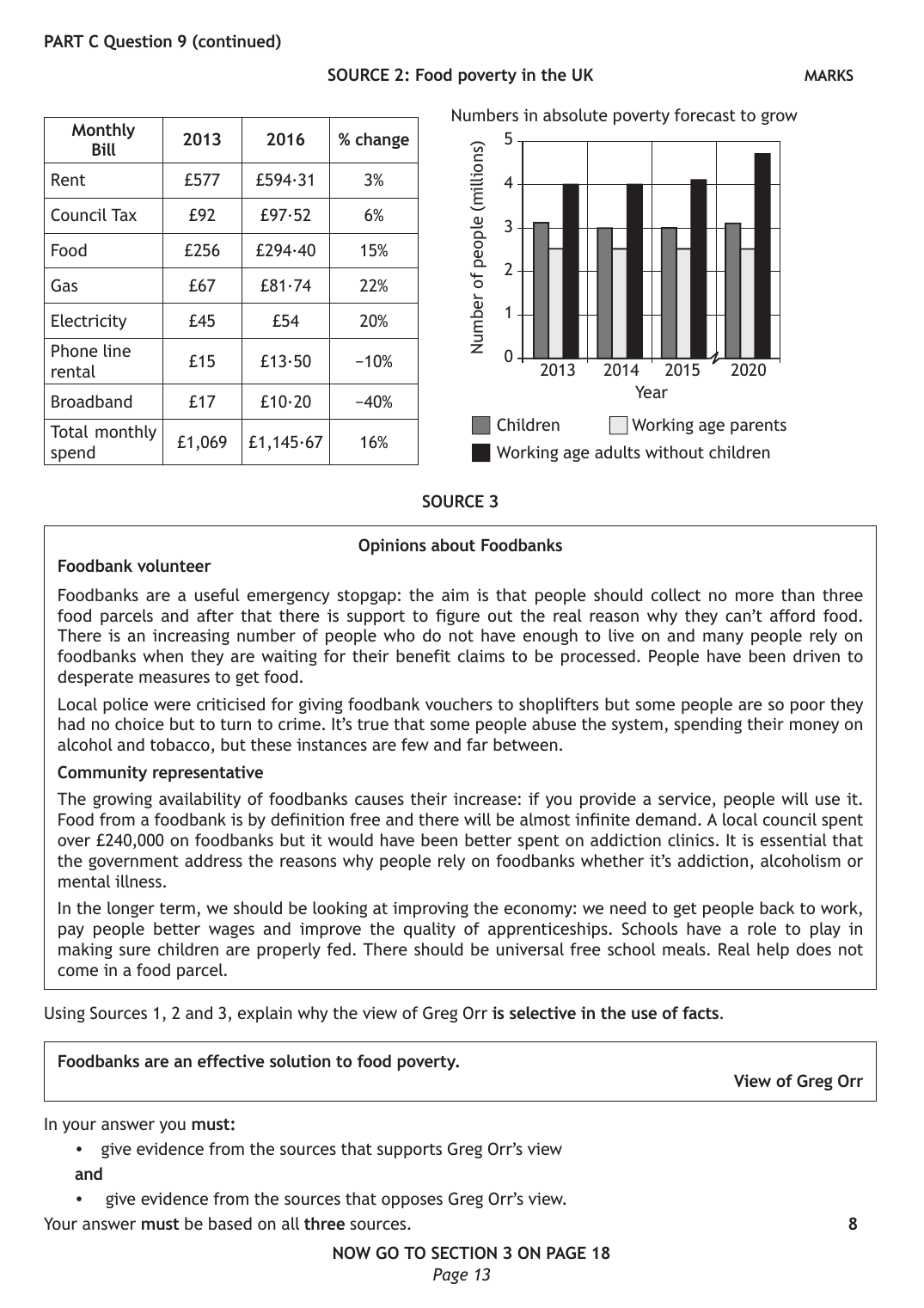
Using Sources 1, 2 and 3, explain why the view of Greg Orr is selective in the use of facts.

Foodbanks are an effective solution to food poverty.
— View of Greg Orr

In your answer you must:

  • give evidence from the sources that supports Greg Orr’s view

and

  • give evidence from the sources that opposes Greg Orr’s view.

Your answer must be based on all three sources.

Sources (Source 1, Source 2, Source 3)

Source page 1 for this questionSource page 2 for this question
📝 Structure template — how to structure your answer

Support or oppose · A source-based skills question

WFQ (words from the question)

  1. I can support the view of insert name that “insert view” because Source 1 says “insert evidence”.✓ up to 3 marks
  2. Source 2 also supports the view when it says “insert evidence”.✓ up to 3 marks
  3. Source 3 also supports the view when it says “insert evidence”.✓ up to 3 marks
  4. I can oppose the view of insert name that “insert view” because Source 1 says “insert evidence”.✓ up to 3 marks
  5. Source 2 also opposes the view when it says “insert evidence”.✓ up to 3 marks
  6. Source 3 also opposes the view when it says “insert evidence”.✓ up to 3 marks

How it's marked

  • Up to 3 marks for each developed point using accurate source evidence.
  • Maximum 6 marks if you only support OR only oppose.
  • For full marks you must use all sources and give evidence that supports AND opposes the view.
  • Do as many support / oppose points as you like (e.g. 8 support + 2 oppose)…
  • …but you MUST have evidence for BOTH support and oppose to reach full marks.
✓ Reveal marking scheme
Max 8 marks

These are possible/exemplar answers from the marking instructions — other valid points can also gain marks.

How marks are awarded
  • The candidate is required to evaluate a limited range of sources, detecting and explaining instances of exaggeration and/or selective use of facts, giving developed arguments.
  • In order to achieve full marks candidates must show evidence that has been selected as it supports the view and show evidence that has not been selected as it does not support the view. An answer which deals with only one side of the explanation should be awarded a maximum of 6 marks.

Supporting the view ‘Foodbanks are an effective solution to food poverty.’

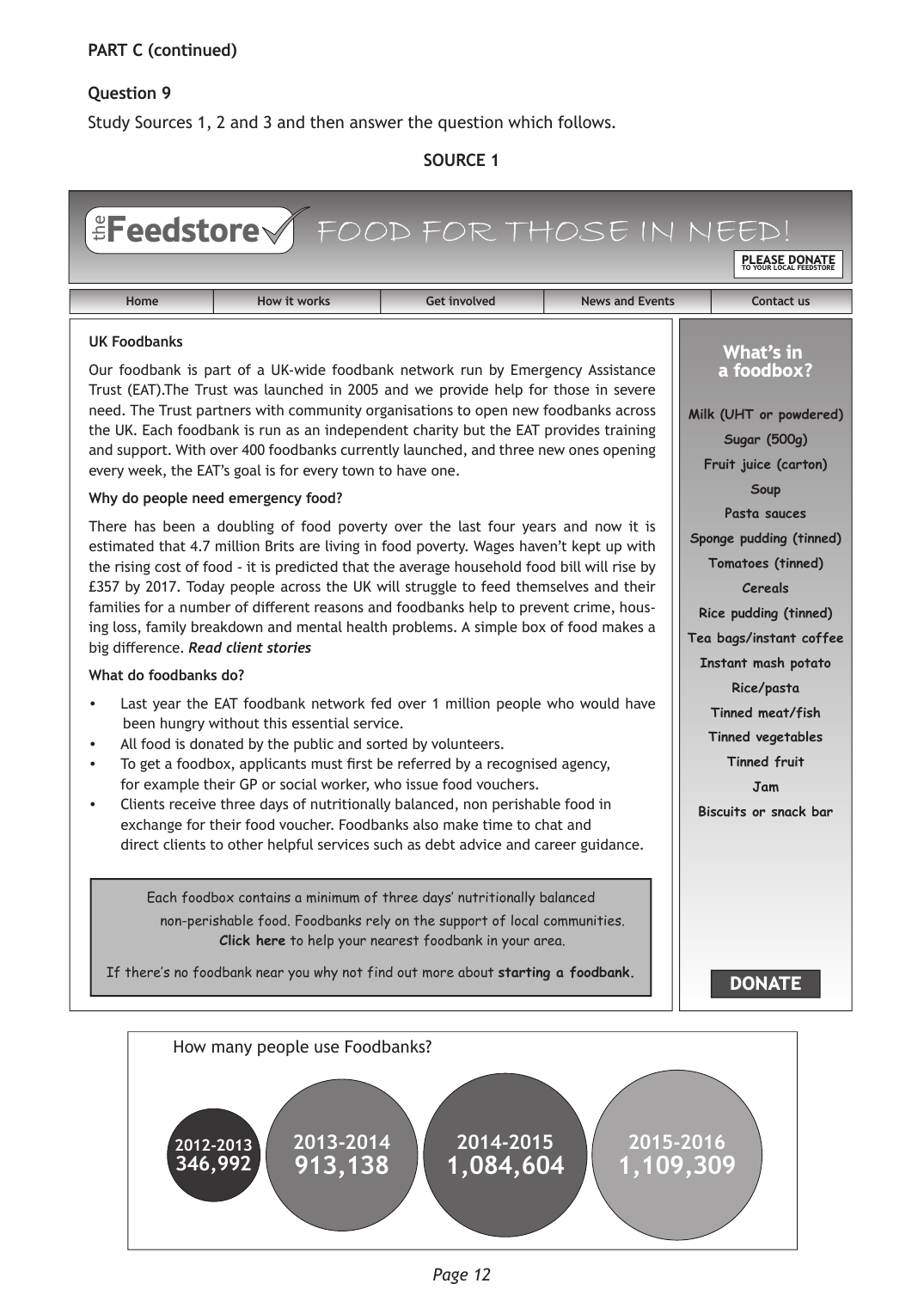
  1. Foodbanks have fed over 1 million people who would have been hungry without this essential service. (1 mark — evidence drawn from source 1)
  2. Foodbanks help to prevent crime, housing loss, family breakdown and mental health problems (source 1). Local police have issued food vouchers to prevent shoplifting (source 3). (2 marks — evidence linked from source 1 and source 3)
  3. Source 1 shows there has been a huge rise from 346,992 to over 1 million people using foodbanks which shows that they are needed. This can be linked to the 15% rise in the cost of food shown in source 2 and the rise in the numbers of children and working age adults without children who live in absolute poverty. (3 marks — evidence linked from source 1 and 2 with evaluative terminology)
  4. Credit reference to aspects of the following:
  5. Foodbanks also make time to chat and direct clients to other helpful services such as debt advice and career guidance (source 1)
  6. Large increases in household bills eg gas and electricity, mean people have less money to spend on food (source 2)
  7. There has been a doubling in food poverty over the last four years (source 1).

Opposing the view ‘Foodbanks are an effective solution to food poverty.’

  1. Foodbanks are not an effective solution: the community representative in source 3 points out that they are only on the rise because it’s free and because it’s there. (1 mark—evidence drawn from source 3)
  2. Some household bills have actually decreased: broadband bills are 40% less in 2016 than they were in 2013 and rent and council tax have only gone up by a small percentage therefore people should have enough money to spend on food. The number of working age parents living in absolute poverty has not increased much since 2009 and so there is no need for food banks. (3 marks—evidence linked from within source 2 with evaluative terminology)
  3. A useful emergency stopgap: not a long term solution
  4. Not really needed: people who spend all their benefits use foodbanks (source 3)
  5. Foodbanks don’t help people with long-term issues, such as addiction, alcoholism and mental illness. A local council is spending over £240,000 on foodbanks. It’d be better spent on addiction clinics (source 3)
  6. Must address the real reasons why people can’t afford food (source 3)
  7. Higher wages are a better solution to food poverty (source 3)
  8. Free school meals are a better solution to food poverty (source 3).
Support or oppose8 marks2017Q12⏳ Older formatSocial Issues in the United Kingdom

Study Sources 1, 2 and 3 and then answer the question which follows.

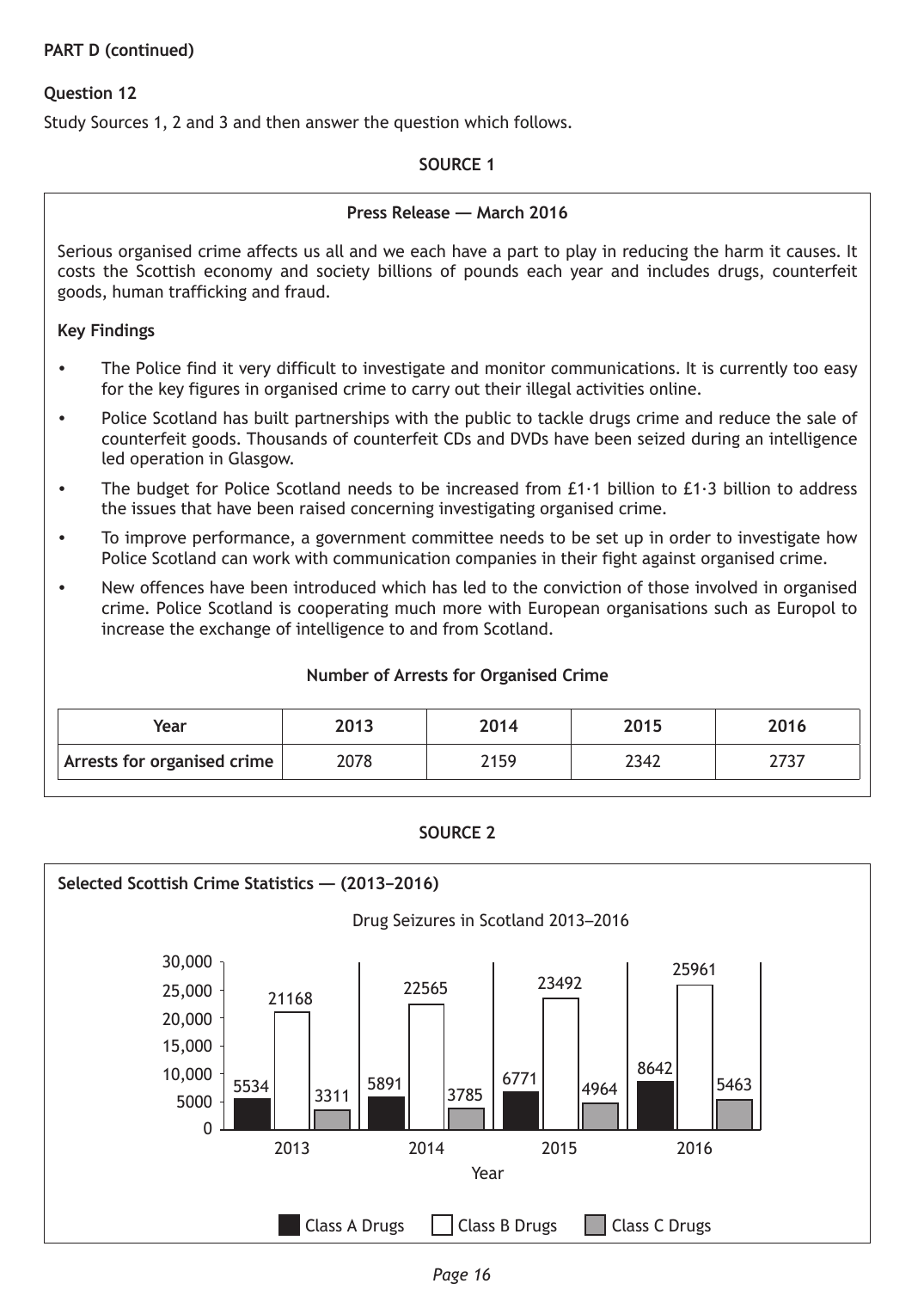
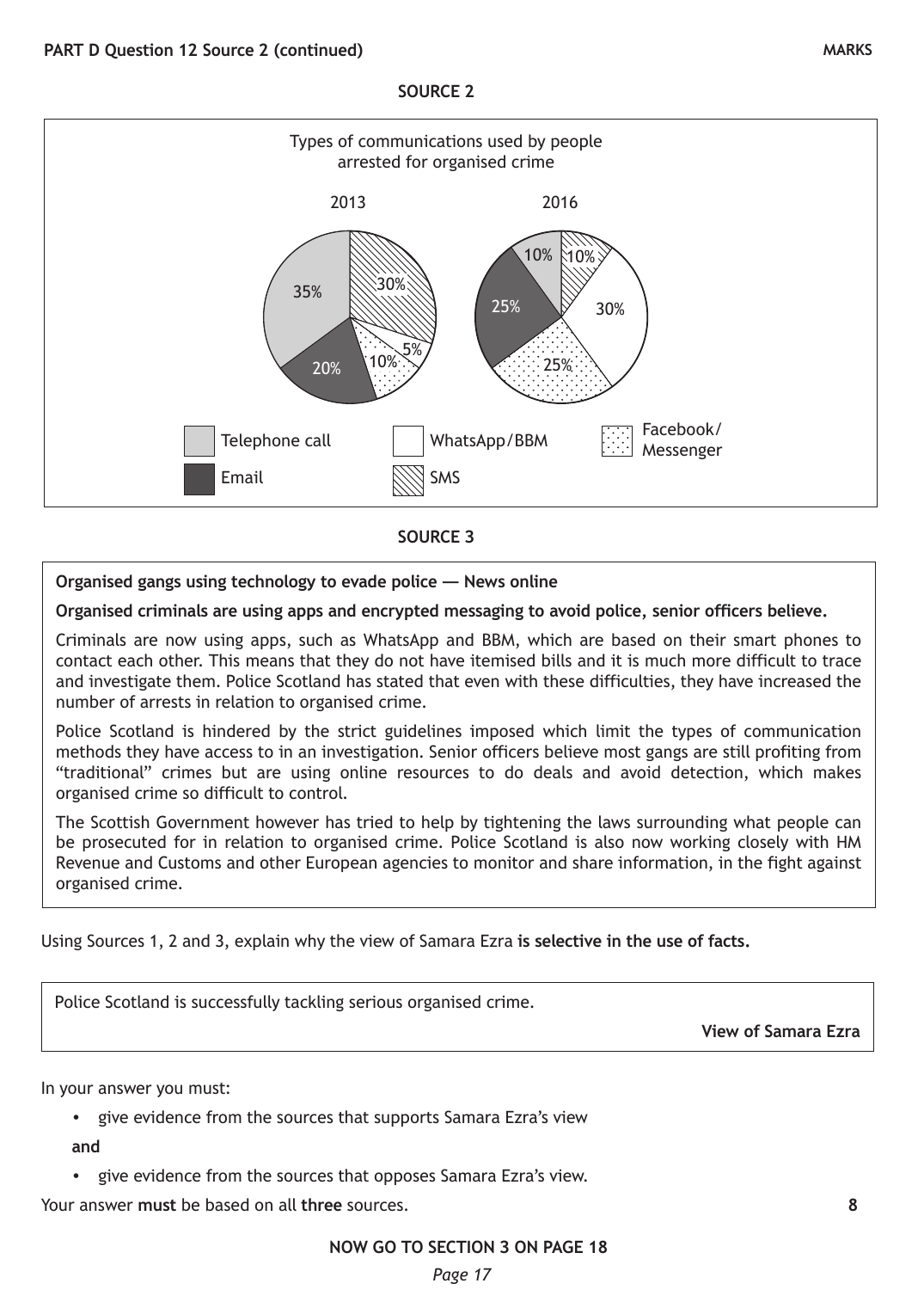
Using Sources 1, 2 and 3, explain why the view of Samara Ezra is selective in the use of facts.

Police Scotland is successfully tackling serious organised crime.
— View of Samara Ezra

In your answer you must:

  • give evidence from the sources that supports Samara Ezra’s view

and

  • give evidence from the sources that opposes Samara Ezra’s view.

Your answer must be based on all three sources.

Sources (Source 1, Source 2, Source 3)

Source page 1 for this questionSource page 2 for this question
📝 Structure template — how to structure your answer

Support or oppose · A source-based skills question

WFQ (words from the question)

  1. I can support the view of insert name that “insert view” because Source 1 says “insert evidence”.✓ up to 3 marks
  2. Source 2 also supports the view when it says “insert evidence”.✓ up to 3 marks
  3. Source 3 also supports the view when it says “insert evidence”.✓ up to 3 marks
  4. I can oppose the view of insert name that “insert view” because Source 1 says “insert evidence”.✓ up to 3 marks
  5. Source 2 also opposes the view when it says “insert evidence”.✓ up to 3 marks
  6. Source 3 also opposes the view when it says “insert evidence”.✓ up to 3 marks

How it's marked

  • Up to 3 marks for each developed point using accurate source evidence.
  • Maximum 6 marks if you only support OR only oppose.
  • For full marks you must use all sources and give evidence that supports AND opposes the view.
  • Do as many support / oppose points as you like (e.g. 8 support + 2 oppose)…
  • …but you MUST have evidence for BOTH support and oppose to reach full marks.
✓ Reveal marking scheme
Max 8 marks

These are possible/exemplar answers from the marking instructions — other valid points can also gain marks.

How marks are awarded
  • The candidate is required to evaluate a limited range of sources, detecting and explaining instances of exaggeration and/or selective use of facts, giving developed arguments.
  • In order to achieve full marks candidates must show evidence that has been selected as it supports the view and show evidence that has not been selected as it does not support the view. An answer which deals with only one side of the explanation should be awarded a maximum of 6 marks.

Samara Ezra is supported (not selective) in her view, “Police Scotland is successfully tackling serious organised crime”.

  1. Candidates should give evidence from the Sources that support Samara Ezra’s view.
  2. Samara’s view is supported (not selective) as source 1 states that Police Scotland has built partnerships with the public to tackle drugs crime and reduce the sale of counterfeit goods. Thousands of counterfeit CDs and DVDs have been seized during an intelligence led operation in Glasgow. (1 mark – accurate use of source 1 but no development).
  3. Samara’s view is supported (not selective) as Police Scotland are cooperating much more with European organisations such as Europol to increase the exchange of intelligence to and from Scotland. This is supported by source 3 which says Police Scotland are also now working closely with HM Revenues and Customs and other European agencies to monitor and share information, in the fight against organised crime. (2 marks – evidence linked from sources 1 and 3).
  4. Credit reference to aspects of the following:
  5. Police Scotland has built partnerships with the public to tackle drugs crime and reduce the sale of counterfeit goods. Thousands of counterfeit CDs and DVDs have been seized during an intelligence led operation in Glasgow. This can be demonstrated in the dramatic increase in the amount of drug seizures that have happened between 2013 and 2016. For example, class C drugs have nearly doubled from 3311 to 5463 between 2013 and 2016. (sources 1 and 2)
  6. Source 3 states that “The Scottish Government however have tried to help by tightening the laws surrounding what people can be prosecuted for in relation to organised crime”. This links with source 1 which states that “New offences have been introduced which has led to the conviction of those involved in organised crime.” and “Police Scotland has stated that even with these difficulties, they have increased the number of arrests in relation to organised crime.” Finally, if you look at source 2 that has been a steady increase between 2013 and 2016 in the number of arrests associated with organised crime. (sources 1, 2 and 3)

Samara Ezra is opposed (selective) in her view, “Police Scotland is successfully tackling serious organised crime.”

  1. Candidates should give evidence from the Sources that oppose Samara Ezra’s view.
  2. Samara Ezra’s view is opposed (selective) because it says in source 1, “the Police find it very difficult to investigate and monitor communications. It is currently too easy for the key figures in organised crime to carry out their illegal activities online”. This is supported by source 3 which says that “Criminals are now using apps, such as WhatsApp and BBM, which are based on their smart phones to contact each other. This means that they do not have itemised bills and it is much more difficult to trace and investigate them.” This is supported further in source 2 where it shows that between 2013 and 2016 the most of the communications that was done in 2013 by people involved in organised crime was telephone calls and this had changed to WhatsApp and BBM in 2016. (3 marks—accurate information from three sources with some evaluative terminology used regarding the pie charts in source 2, ie “most”)
  3. The budget for Police Scotland needs to be increased from £1.1 billion to £1.3 billion to address the issues that have arisen concerning investigating organised crime (sources 1)
  4. Police Scotland is hindered by the strict guidelines imposed which limits the types of communication methods they have access to in an investigation. This links with source 1 which states “To improve performance, a government committee needs to be set up in order to investigate how Police Scotland can work with communication companies in their fight against organised crime.” (sources 1 and 3)
Source: 2017 N5 History · X749/75/11 · Q12Question paper (PDF, p.16) ↗Marking instructions (PDF, p.18) ↗