Revise Nat 5
← All years & topics

National 5 Modern Studies

2021 exam paper

Every question from the 2021 paper. Refine by section, topic or question type.

Filter
Section
Topic
Type
View

Showing 23 of 23 questions

Describe, in detail4 marks2021Q1Democracy in Scotland

The First Minister has many roles.

Describe, in detail, two roles of the First Minister.

WFQ = words from the question — reuse in every point.

📝 Structure template — how to structure your answer

Describe, in detail · A knowledge (KU) question · use PEE

Remember PEE

  • Point — make your point
  • Explanation — develop it
  • Example — a specific, recent example

WFQ (words from the question)

  1. One words from the question is insert point.✓ 1 mark — Point
  2. This means that … (explain your point).✓ 1 mark — Explanation
  3. For example, … (give a specific, recent example).✓ 1 mark — Example
  4. Then repeat with a second point — two developed points are needed for full marks.

How it's marked

  • 1 mark for an accurate but undeveloped point (P).
  • +1 mark for developing/explaining it (E).
  • +1 mark for a specific example (E). Up to 3 marks per description; two descriptions needed for full marks.
  • The example is where learners most often drop the mark — always add “For example, …”.
✓ Reveal marking scheme
Max 4 marks

These are possible/exemplar answers from the marking instructions — other valid points can also gain marks.

How marks are awarded
  • Award up to 3 marks for a single description, depending on quality, level of detail, relevance, accuracy and exemplification.
  • Two descriptions are necessary for full marks.

Possible approaches to answering the question:

  1. One role of the First Minister is to give public information briefings during a pandemic. (1 mark — accurate but underdeveloped point)
  2. One role of the First Minister is to give public information briefings during a pandemic. From March 2020, Nicola Sturgeon has been giving regular briefings on the coronavirus. (2 marks — accurate point with development)
  3. One role of the First Minister is to give public information briefings during a pandemic. From March 2020, Nicola Sturgeon has been giving regular briefings on the coronavirus. This has informed the public in relation to confirmed cases, numbers of deaths related to the disease and measures being introduced to try and prevent further spread of the virus. (3 marks — accurate point with development and exemplification)

Credit reference to aspects of the following:

  1. leader of the Scottish Government
  2. implementation and presentation of government policies
  3. appoints other Ministers
  4. chairs the Cabinet
  5. responsible for nominating judges.
Source: 2021 N5 History · X849/75/11 · Q1Question paper (PDF, p.3) ↗Marking instructions (PDF, p.4) ↗
Explain, in detail6 marks2021Q2Democracy in Scotland

Women are underrepresented in the Scottish Parliament.

Explain, in detail, two reasons why women are underrepresented in the Scottish Parliament.

WFQ = words from the question — reuse in every point.

📝 Structure template — how to structure your answer

Explain, in detail · A knowledge (KU) question · use PEE (+ analysis)

Remember PEE

  • Point — give your reason
  • Explanation — “this means that…”
  • Example — a specific, recent example

WFQ (words from the question)

  1. One reason words from the question is insert point.✓ 1 mark — Point
  2. This means that … (explain the reason).✓ 1 mark — Explanation
  3. For example, … (give a specific, recent example).✓ 1 mark — Example
  4. This is important because … (analysis — how it links to other factors).✓ 1 mark — Analysis
  5. Then repeat with a second reason — a maximum of two explanations are credited.

How it's marked

  • 1 mark for an accurate but undeveloped reason (P).
  • +1 for explanation (E), +1 for a specific example (E), +1 for analysis. Up to 4 marks per explanation.
  • A maximum of two explanations are credited.
  • Build each reason: Point → Explanation → Example → Analysis.
✓ Reveal marking scheme
Max 6 marks

These are possible/exemplar answers from the marking instructions — other valid points can also gain marks.

How marks are awarded
  • Award up to 4 marks for a single explanation, depending on quality, level of detail, relevance, accuracy, exemplification and answers which show the interaction of various factors.
  • A maximum of two explanations should be credited.

Possible approaches to answering the question:

  1. Women are underrepresented in the Scottish Parliament because they may have caring responsibilities to deal with. (1 mark — accurate but undeveloped point)
  2. Women are underrepresented in the Scottish Parliament because they may have caring responsibilities to deal with. Women, with children, are often the main carer and might find it difficult working in Edinburgh depending on where they live in Scotland. (2 marks — accurate point with development)
  3. Women are underrepresented in the Scottish Parliament because they may have caring responsibilities to deal with. Women, with children, are often the main carer and might find it difficult working in Edinburgh depending on where they live in Scotland. For example, a single female parent, living in Aberdeen with young children may find it extremely difficult to manage a family and a career as an MSP given the travelling to and from the Scottish Parliament as well as finding suitable childcare. (3 marks — accurate point with development and exemplification)
  4. Women are underrepresented in the Scottish Parliament because they may have caring responsibilities to deal with. Women, with children, are often the main carer and might find it difficult working in Edinburgh depending on where they live in Scotland. For example, a single female parent, living in Aberdeen with young children may find it extremely difficult to manage a family and a career as an MSP given the travelling to and from the Scottish Parliament as well as finding suitable childcare. The underrepresentation is clearly evident with only 36% of MSPs being female in March 2020. (4 marks — accurate point with development, exemplification and analysis)

Credit reference to aspects of the following:

  1. less likely to stand as candidates
  2. culture of politics/parliament
  3. selection process
  4. sexist attitudes
  5. lack of role models
  6. self-esteem/confidence issue
  7. other opportunities
  8. working conditions.
Source: 2021 N5 History · X849/75/11 · Q2Question paper (PDF, p.3) ↗Marking instructions (PDF, p.5) ↗
Explain, in detail6 marks2021Q3Democracy in Scotland

Some people in Scotland join pressure groups or trade unions.

Explain, in detail, two reasons why some people in Scotland may choose to join a pressure group or a trade union.

WFQ = words from the question — reuse in every point.

📝 Structure template — how to structure your answer

Explain, in detail · A knowledge (KU) question · use PEE (+ analysis)

Remember PEE

  • Point — give your reason
  • Explanation — “this means that…”
  • Example — a specific, recent example

WFQ (words from the question)

  1. One reason words from the question is insert point.✓ 1 mark — Point
  2. This means that … (explain the reason).✓ 1 mark — Explanation
  3. For example, … (give a specific, recent example).✓ 1 mark — Example
  4. This is important because … (analysis — how it links to other factors).✓ 1 mark — Analysis
  5. Then repeat with a second reason — a maximum of two explanations are credited.

How it's marked

  • 1 mark for an accurate but undeveloped reason (P).
  • +1 for explanation (E), +1 for a specific example (E), +1 for analysis. Up to 4 marks per explanation.
  • A maximum of two explanations are credited.
  • Build each reason: Point → Explanation → Example → Analysis.
✓ Reveal marking scheme
Max 6 marks

These are possible/exemplar answers from the marking instructions — other valid points can also gain marks.

How marks are awarded
  • Award up to 4 marks for a single explanation, depending on quality, level of detail, relevance, accuracy, exemplification and answers which show the interaction of various factors.
  • A maximum of two explanations should be credited.

Possible approaches to answering the question:

  1. People may wish to join a pressure group because they are interested in the cause. (1 mark — accurate but underdeveloped point)
  2. People may wish to join a pressure group because they are interested in the cause. They may want to support the group to influence the government and/or public. (2 marks — accurate point with development)
  3. People may wish to join a pressure group because they are interested in the cause. They may want to support the group to influence the government and/or public. For example, a person who felt strongly about climate change might have joined Extinction Rebellion and take part in their ‘die-in’ protest in Central Station in Glasgow. (3 marks — accurate point with development and exemplification)
  4. Some people in Scotland may join a trade union because they want to improve their pay. If the trade union members were unhappy with their level of pay, they can ask their trade union to speak on their behalf to employers. For example, during the coronavirus pandemic the trade union, UNISON Scotland, began the ‘Pay up Now’ campaign to get their members a decent pay rise. This campaign was a success because the Scottish Government agreed to talks about a pay rise for NHS workers. (4 marks — accurate point with development, exemplification and analysis)

Credit reference to aspects of the following:

  1. Pressure groups:
  2. to participate in pressure group actions
  3. to offer support
  4. to provide financial assistance
  5. to improve chances of success
  6. influenced by pressure group campaigns
  7. peer influence
  8. social media activities.
  9. Trade unions:
  10. to improve wages
  11. to improve working conditions
  12. financial benefits
  13. to participate within union democracy
  14. influence of colleagues.
Source: 2021 N5 History · X849/75/11 · Q3Question paper (PDF, p.3) ↗Marking instructions (PDF, p.7) ↗
Decision making10 marks2021Q7Democracy in Scotland and the UK

Study Sources 1, 2 and 3 and then answer the question which follows.

You are a UK government advisor. You have been asked to recommend whether or not the voting age should be lowered to 16 in UK general elections.

Option 1

Lower the voting age to 16

Option 2

Do not lower the voting age to 16

You must decide which option to recommend, either lower the voting age to 16 (Option 1) or do not lower the voting age to 16 (Option 2).

(i) Using Sources 1, 2 and 3, which option would you choose?

(ii) Give reasons to support your choice.

(iii) Explain why you did not choose the other option.

Your answer must be based on all three sources.

Sources (Source 1, Source 2, Source 3)

Source page 1 for this questionSource page 2 for this question
📝 Structure template — how to structure your answer

Decision making · A source-based skills question

WFQ (words from the question)

  1. I chose insert option name.
  2. Evidence to support this is in insert source which says/shows “insert evidence”.✓ 1 mark per piece of evidence (up to 8)
  3. This is further supported by evidence in insert source which says/shows “insert evidence”. (Repeat until you have 8 pieces of evidence = 8 marks.)
  4. Rebuttal: I rejected insert option name because insert source says/shows “insert evidence”.✓ needed for full marks

How it's marked

  • Up to 3 marks for a developed justification; credit highly where you link evidence between sources.
  • For full marks you must justify your decision AND explain why you rejected the other option.
  • Maximum 8 marks if you only deal with one option.
  • Aim for around 8 pieces of evidence to build up the marks.
  • Don’t forget the rebuttal — say why you rejected the other option.
✓ Reveal marking scheme
Max 10 marks

These are possible/exemplar answers from the marking instructions — other valid points can also gain marks.

How marks are awarded
  • The candidate is required to evaluate a limited range of sources, in order to justify a decision/recommendation.
  • The candidate must also explain why they have rejected the other option.
  • In order to achieve full marks candidates must say why they did not choose the other option. An answer which deals with only one option should be awarded a maximum of 8 marks.

Option 1 — Lower the voting age to 16.

  1. The UK Government should lower the voting age to 16 years in UK general elections. Evidence to support this can be found in Source 3 where it states that lowering the voting age has proved a great success and led to excellent turnout by first time voters in recent Scottish elections. This is backed up by Source 1 where it states that 75% of 16 and 17 year olds who registered to vote, voted in the Scottish independence referendum. (2 marks — evidence linked from Source 1 and 3)

Credit reference to aspects of the following:

  1. 16 and 17 years olds in Scotland have been given the right to vote in Scottish Parliament and local council elections (Source 1)
  2. by 2022, 16 and 17 year olds will be given the right to vote in elections to the Welsh Assembly (Source 1)
  3. some argue that it is important that young people have a say in matters that directly affect them (Source 1)
  4. Austria became the first country to successfully lower the voting age to 16 which led to increased political participation by young people (Source 1)
  5. 97% of 16 and 17 year olds who voted in the Scottish independence referendum said they would vote again (Source 1)
  6. many modern democracies allow 16 and 17 year olds to vote in all or some elections (Source 1)
  7. a study of the Scottish independence referendum found that young people were able to make an informed decision on how to vote rather than copy their peers or parents (Source 1)
  8. five out of the seven political parties support lowering the voting age (Source 2)
  9. young people already have many legal rights at the age of 16 including joining the army and getting married (Source 1)
  10. ten countries around the world allow 16 year olds to vote (Source 2)
  11. lowering the voting age for general elections has received cross-party support in the UK (Source 3)
  12. voting at a young age is habit forming (Source 3)

Reasons for rejecting the other option:

  1. I did not choose Option 2 as although Source 3 states there is no public support for allowing 16 year olds to vote in UK general elections, this is untrue as Source 2 shows that a third of those surveyed supported the idea of lowering the voting age to 16. (2 marks — Evidence linked from Source 2 and Source 3)

Option 2 — Do not lower the voting age to 16.

  1. The UK Government should not lower the voting age to 16 years for UK general elections. Evidence to support this can be found in Source 3 which states there are very few countries in the world that have a voting age of 16 years. This is backed up by Source 2 that shows only ten countries of the world allow voting at 16, whereas the majority of countries (165) enforce a voting age of 18. (3 marks — evidence drawn from two sources, with evaluative comment)

Credit reference to aspects of the following:

  1. 16 year olds have not matured enough and should not be allowed to vote in general elections (Source 1)
  2. it was thought that most 16 year olds would vote the way their parents voted or deliberately vote the other way (Source 1)
  3. rather than lowering the voting age in line with other rights the government should explore raising the age of such rights in line with the current voting age (Source 1)
  4. Norway experimented with lowering the voting age but not all teenagers exercised their right to vote (Source 1)
  5. at the 2017 UK general election only 54% of the youngest age-group, 18-24 year olds, voted compared to average overall turnout of 69% (Source 1)
  6. over half of those surveyed did not support lowering the voting age to 16 (Source 2)
  7. 165 countries of the world do not allow voting until the age of 18 (Source 2)
  8. 14 countries of the world expect voters to be older than 18 years before being allowed to vote (Source 2)
  9. there is no public support for allowing 16 year olds to vote in UK general elections (Source 3)
  10. there are very few countries in the world that have a voting age of 16 years (Source 3)
  11. where countries have lowered the voting age of elections this has not led to improved turnout (source 3)
  12. young people don’t have high turnout in elections with 18-24 year olds having the lowest turnout of any other group in general elections in the UK. (Source 3)

Reasons for rejecting the other option:

  1. I have not chosen Option 1 as although some would argue that young people have many legal rights at the age of 16, including joining the army and getting married (Source 1), Norway experimented with lowering the voting age but not all teenagers exercised their right to vote. (2 marks — evidence drawn from Source 1)
Describe, in detail4 marks2021Q4Democracy in the United Kingdom

The Prime Minister has many roles.

Describe, in detail, two roles of the Prime Minister.

WFQ = words from the question — reuse in every point.

📝 Structure template — how to structure your answer

Describe, in detail · A knowledge (KU) question · use PEE

Remember PEE

  • Point — make your point
  • Explanation — develop it
  • Example — a specific, recent example

WFQ (words from the question)

  1. One words from the question is insert point.✓ 1 mark — Point
  2. This means that … (explain your point).✓ 1 mark — Explanation
  3. For example, … (give a specific, recent example).✓ 1 mark — Example
  4. Then repeat with a second point — two developed points are needed for full marks.

How it's marked

  • 1 mark for an accurate but undeveloped point (P).
  • +1 mark for developing/explaining it (E).
  • +1 mark for a specific example (E). Up to 3 marks per description; two descriptions needed for full marks.
  • The example is where learners most often drop the mark — always add “For example, …”.
✓ Reveal marking scheme
Max 4 marks

These are possible/exemplar answers from the marking instructions — other valid points can also gain marks.

How marks are awarded
  • Award up to 3 marks for a single description, depending on quality, level of detail, relevance, accuracy and exemplification.
  • Two descriptions are necessary for full marks.

Possible approaches to answering the question:

  1. One role of the Prime Minister is to give public information briefings during a pandemic. (1 mark — accurate but underdeveloped point)
  2. One role of the Prime Minister is to give public information briefings during a pandemic. From March 2020, Boris Johnson has been giving regular briefings on the coronavirus. (2 marks — accurate point with development)
  3. One role of the Prime Minister is to give public information briefings during a pandemic. From March 2020, Boris Johnson has been giving regular briefings on the coronavirus. This has informed the public in relation to confirmed cases, numbers of deaths related to the disease and measures being introduced to try and prevent further spread of the virus. (3 marks — accurate point with development and exemplification)

Credit reference to aspects of the following:

  1. leader of the Government
  2. implementation and presentation of government policies
  3. chairs the Cabinet
  4. oversees the operation of the Civil Service
  5. represents the UK overseas.
Source: 2021 N5 History · X849/75/11 · Q4Question paper (PDF, p.4) ↗Marking instructions (PDF, p.9) ↗
Explain, in detail6 marks2021Q5Democracy in the United Kingdom

Women are underrepresented in the UK Parliament.

Explain, in detail, two reasons why women are underrepresented in the UK Parliament.

WFQ = words from the question — reuse in every point.

📝 Structure template — how to structure your answer

Explain, in detail · A knowledge (KU) question · use PEE (+ analysis)

Remember PEE

  • Point — give your reason
  • Explanation — “this means that…”
  • Example — a specific, recent example

WFQ (words from the question)

  1. One reason words from the question is insert point.✓ 1 mark — Point
  2. This means that … (explain the reason).✓ 1 mark — Explanation
  3. For example, … (give a specific, recent example).✓ 1 mark — Example
  4. This is important because … (analysis — how it links to other factors).✓ 1 mark — Analysis
  5. Then repeat with a second reason — a maximum of two explanations are credited.

How it's marked

  • 1 mark for an accurate but undeveloped reason (P).
  • +1 for explanation (E), +1 for a specific example (E), +1 for analysis. Up to 4 marks per explanation.
  • A maximum of two explanations are credited.
  • Build each reason: Point → Explanation → Example → Analysis.
✓ Reveal marking scheme
Max 6 marks

These are possible/exemplar answers from the marking instructions — other valid points can also gain marks.

How marks are awarded
  • Award up to 4 marks for a single explanation, depending on quality, level of detail, relevance, accuracy, exemplification and answers which show the interaction of various factors.
  • A maximum of two explanations should be credited.

Possible approaches to answering the question:

  1. Women are underrepresented in the UK Parliament because they may have caring responsibilities to deal with. (1 mark — accurate but undeveloped point)
  2. Women are underrepresented in the UK Parliament because they may have caring responsibilities to deal with. Women, with children, are often the main carer and might find it difficult working in London depending on where they live in the UK. (2 marks — accurate point with development)
  3. Women are underrepresented in the UK Parliament because they may have caring responsibilities to deal with. Women, with children, are often the main carer and might find it difficult working in London depending on where they live in the UK. For example, a single female parent, living in Aberdeen with young children may find it extremely difficult to manage a family and a career as an MP given the travelling to and from London as well as finding suitable childcare. (3 marks — accurate point with development and exemplification)
  4. Women are underrepresented in the UK Parliament because they may have caring responsibilities to deal with. Women, with children, are often the main carer and might find it difficult working in London depending on where they live in the UK. For example, a single female parent, living in Aberdeen with young children may find it extremely difficult to manage a family and a career as an MP given the travelling to and from London as well as finding suitable childcare. The underrepresentation is clearly evident with only 34% of MPs being female in March 2020. (4 marks — accurate point with development, exemplification and analysis)

Credit reference to aspects of the following:

  1. less likely to stand as candidates
  2. culture of politics/parliament
  3. selection process
  4. sexist attitudes
  5. lack of role models
  6. self-esteem/confidence issue
  7. other opportunities
  8. working conditions.
Explain, in detail6 marks2021Q6Democracy in the United Kingdom

Some people in the UK join pressure groups or trade unions.

Explain, in detail, two reasons why some people in the UK may choose to join a pressure group or a trade union.

WFQ = words from the question — reuse in every point.

📝 Structure template — how to structure your answer

Explain, in detail · A knowledge (KU) question · use PEE (+ analysis)

Remember PEE

  • Point — give your reason
  • Explanation — “this means that…”
  • Example — a specific, recent example

WFQ (words from the question)

  1. One reason words from the question is insert point.✓ 1 mark — Point
  2. This means that … (explain the reason).✓ 1 mark — Explanation
  3. For example, … (give a specific, recent example).✓ 1 mark — Example
  4. This is important because … (analysis — how it links to other factors).✓ 1 mark — Analysis
  5. Then repeat with a second reason — a maximum of two explanations are credited.

How it's marked

  • 1 mark for an accurate but undeveloped reason (P).
  • +1 for explanation (E), +1 for a specific example (E), +1 for analysis. Up to 4 marks per explanation.
  • A maximum of two explanations are credited.
  • Build each reason: Point → Explanation → Example → Analysis.
✓ Reveal marking scheme
Max 6 marks

These are possible/exemplar answers from the marking instructions — other valid points can also gain marks.

How marks are awarded
  • Award up to 4 marks for a single explanation, depending on quality, level of detail, relevance, accuracy, exemplification and answers which show the interaction of various factors.
  • A maximum of two explanations should be credited.

Possible approaches to answering the question:

  1. People may wish to join a pressure group because they are interested in the cause. (1 mark — accurate but underdeveloped point)
  2. People may wish to join a pressure group because they are interested in the cause. They may want to support the group to influence the government and/or public. (2 marks — accurate point with development)
  3. People may wish to join a pressure group because they are interested in the cause. They may want to support the group to influence the government and/or public. For example, a person who felt strongly about climate change might join Greenpeace and pay the minimum £2 monthly membership to support the pressure groups activities. (3 marks — accurate point with development and exemplification)
  4. Some people may join a trade union because they believe it will protect them in their workplace. If the trade union members were unhappy with an issue in their workplace, they could ask their trade union to help resolve the issue. For example, during the coronavirus pandemic the trade union, UNISON, began a campaign ‘PPE not Promises’ to make sure their members had the correct PPE equipment to keep them safe. Many NHS and care workers were worried about the shortage and quality of PPE available which meant they did not feel safe at work. (4 marks — accurate point with development, exemplification and analysis)

Credit reference to aspects of the following:

  1. Pressure groups:
  2. to participate in pressure group actions
  3. to offer support
  4. to provide financial assistance
  5. to improve chances of success
  6. influenced by pressure group campaigns
  7. peer influence
  8. social media activities.
  9. Trade unions:
  10. to improve wages
  11. to improve working conditions
  12. financial benefits
  13. to participate within union democracy
  14. influence of colleagues.
Support or oppose10 marks2021Q21International Issues

Study Sources 1, 2 and 3 and then answer the question which follows.

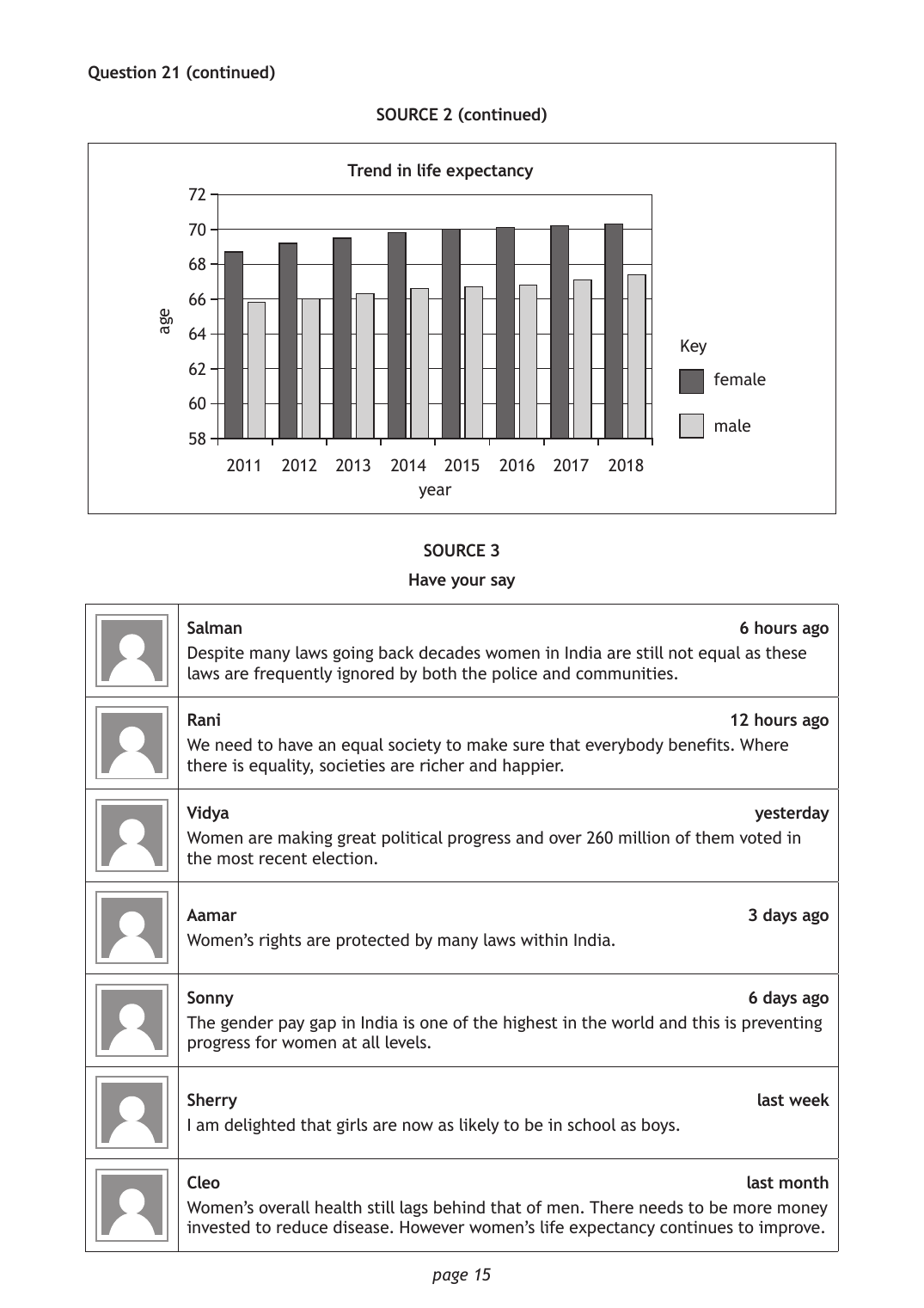
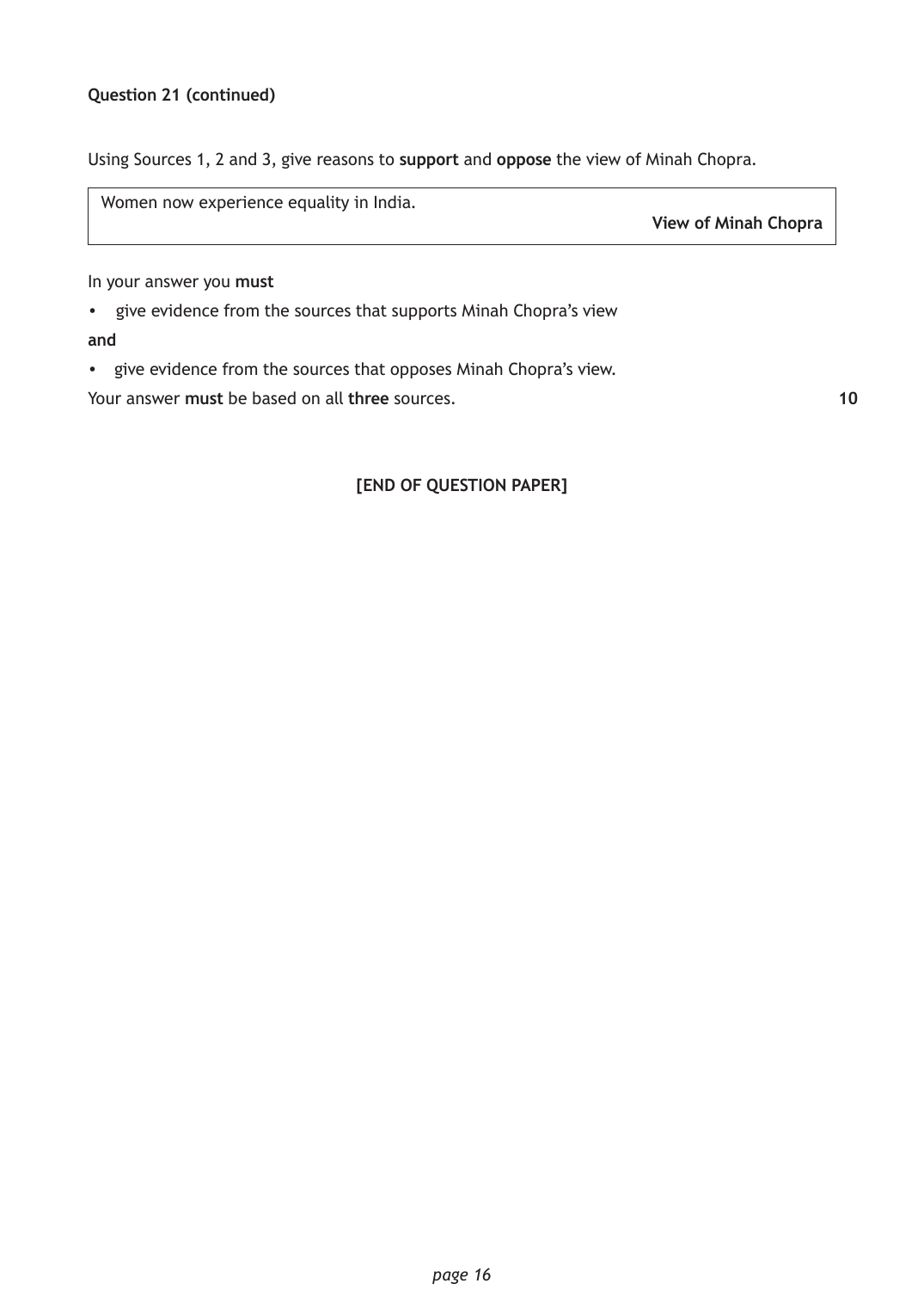
Using Sources 1, 2 and 3, give reasons to support and oppose the view of Minah Chopra.

Women now experience equality in India. (View of Minah Chopra)

In your answer you must

  • give evidence from the sources that supports Minah Chopra’s view

and

  • give evidence from the sources that opposes Minah Chopra’s view.

Your answer must be based on all three sources.

Sources (Source 1, Source 2, Source 3)

Source page 1 for this questionSource page 2 for this question
📝 Structure template — how to structure your answer

Support or oppose · A source-based skills question

WFQ (words from the question)

  1. I can support the view of insert name that “insert view” because Source 1 says “insert evidence”.✓ up to 3 marks
  2. Source 2 also supports the view when it says “insert evidence”.✓ up to 3 marks
  3. Source 3 also supports the view when it says “insert evidence”.✓ up to 3 marks
  4. I can oppose the view of insert name that “insert view” because Source 1 says “insert evidence”.✓ up to 3 marks
  5. Source 2 also opposes the view when it says “insert evidence”.✓ up to 3 marks
  6. Source 3 also opposes the view when it says “insert evidence”.✓ up to 3 marks

How it's marked

  • Up to 3 marks for each developed point using accurate source evidence.
  • Maximum 6 marks if you only support OR only oppose.
  • For full marks you must use all sources and give evidence that supports AND opposes the view.
  • Do as many support / oppose points as you like (e.g. 8 support + 2 oppose)…
  • …but you MUST have evidence for BOTH support and oppose to reach full marks.
✓ Reveal marking scheme
Max 10 marks

These are possible/exemplar answers from the marking instructions — other valid points can also gain marks.

How marks are awarded
  • The candidate is required to evaluate a limited range of sources, to support and oppose a point of view.
  • In order to achieve full marks candidates must show evidence that supports the view and show evidence that does not support the view.
  • An answer which deals with only one side of the explanation should be awarded a maximum of 6 marks.

Support

  1. I can support Minah Chopra when she says that ‘Women now experience equality in India’ as Source 1 states that ‘The Indian government has many laws in place to protect its citizens and create an equal society’. (1 mark — accurate use of Source 1 but minimal development)
  2. I can support Minah Chopra when she says that ‘Women now experience equality in India’ because Source 1 says ‘The government in India was set the Millennium Development Goal of having gender equality in education by 2015’. This links to Source 2 which shows that there are 92·9% girls in primary education and 91·7% boys. (2 marks — accurate use of sources 1 and 2, linking two pieces of evidence)
  3. I can support Minah Chopra when she says that ‘Women now experience equality in India’ as in Source 3 Vidya says ‘Women are making great political progress and over 260 million of them voted in the most recent election.’ This links to Source 1 which claims ‘Women participate in Indian politics with the country ranked 15th out of 144 countries for female participation’. This shows that many women are participating in politics and that India has a high global ranking for women’s participation. (3 marks — accurate information linked from two sources with some evaluation of the information, for example, ‘This shows . . .’)

Credit reference to aspects of the following:

  1. there is a law ensuring people are given equal pay for equal work and also to prevent any discrimination at work (Source 1)
  2. women outlive men by close to three years (Source 2)
  3. although women’s health is poor, compared to men, 5% less of them die from heart disease (Source 2)
  4. Aamar — Women’s rights are protected by many laws within India (Source 3).

Oppose

  1. I can oppose Minah Chopra when she says that ‘Women now experience equality in India’ as in Source 3 Salman states ‘Despite many laws going back decades women in India are still not equal as these laws are frequently ignored by both the police and communities.’ (1 mark — accurate use of source 3 but minimal development)
  2. I can oppose Minah Chopra when she says that ‘Women now experience equality in India’ as according to Sonny in Source 3 ‘The gender pay gap in India is one of the highest in the world and this is preventing progress for women at all levels.’ This links to source 1 which states ‘India is ranked 139th in the world for female economic equality according to The World Economic Forum.’ (2 marks — accurate use of Source 1 and Source 3, linking two pieces of evidence)
  3. I can oppose Minah Chopra when she says that ‘Women now experience equality in India’ as according to Sonny in Source 3 ‘The gender pay gap in India is one of the highest in the world and this is preventing progress for women at all levels.’ This links to source 1 which states ‘India is ranked 139th in the world for female economic equality according to The World Economic Forum.’ There is further support for this in Source 2 which shows that women’s average earnings are only 196 rupees compared to 242 rupees for men. (3 marks — accurate information linked from three sources)

Credit reference to aspects of the following:

  1. literacy rates remain a concern as only 60% of girls are described as literate compared to 81% of boys (Source 1)
  2. there is a higher death rate for baby girls with many believing that some baby girls are left to die (Source 1)
  3. economic data — only 26% women hold a bank account (Source 2)
  4. Cleo — Women’s health still lags behind that of men. There needs to be more money invested to reduce disease (Source 3).
Source: 2021 N5 History · X849/75/11 · Q21Question paper (PDF, p.15) ↗Marking instructions (PDF, p.39) ↗
Describe, in detail4 marks2021Q18World issues

International conflicts and issues have political causes.

Describe, in detail, two political causes of an international conflict or issue you have studied. In your answer you must state the world conflict or issue you have studied.

WFQ = words from the question — reuse in every point.

📝 Structure template — how to structure your answer

Describe, in detail · A knowledge (KU) question · use PEE

Remember PEE

  • Point — make your point
  • Explanation — develop it
  • Example — a specific, recent example

WFQ (words from the question)

  1. One words from the question is insert point.✓ 1 mark — Point
  2. This means that … (explain your point).✓ 1 mark — Explanation
  3. For example, … (give a specific, recent example).✓ 1 mark — Example
  4. Then repeat with a second point — two developed points are needed for full marks.

How it's marked

  • 1 mark for an accurate but undeveloped point (P).
  • +1 mark for developing/explaining it (E).
  • +1 mark for a specific example (E). Up to 3 marks per description; two descriptions needed for full marks.
  • The example is where learners most often drop the mark — always add “For example, …”.
✓ Reveal marking scheme
Max 4 marks

These are possible/exemplar answers from the marking instructions — other valid points can also gain marks.

How marks are awarded
  • Award up to 3 marks for a single description, depending on quality, level of detail, relevance, accuracy and exemplification.
  • Two descriptions are necessary for full marks.

Possible approaches to answering the question:

  1. TERRORISM
  2. One political cause of terrorism is a lack of rights. (1 mark — accurate but undeveloped point)
  3. One political cause of terrorism is a lack of rights. Terrorists are motivated to carry out attacks to get a government to agree to changes in land ownership. (2 marks — accurate point with development)
  4. One political cause of terrorism is a lack of rights. Terrorists are motivated to carry out attacks to get a government to agree to changes in land ownership. For example, in Gaza, Hezbollah believe Israel has taken land from the Palestinians. (3 marks — accurate point with development and exemplification)

Credit reference to aspects of the following:

  1. some groups use terrorism to try and further the cause of an ideology they believe in
  2. religious groups seeking political dominance
  3. human rights violations, including dispossession and humiliation
  4. corruption.
Source: 2021 N5 History · X849/75/11 · Q18Question paper (PDF, p.13) ↗Marking instructions (PDF, p.34) ↗
Describe, in detail6 marks2021Q19World issues

International organisations have had both success and failure in tackling international conflicts and issues.

Describe, in detail, two successes or failures of an international organisation in tackling the international conflict or issue you have studied. In your answer you must state the world conflict or issue you have studied.

WFQ = words from the question — reuse in every point.

📝 Structure template — how to structure your answer

Describe, in detail · A knowledge (KU) question · use PEE

Remember PEE

  • Point — make your point
  • Explanation — develop it
  • Example — a specific, recent example

WFQ (words from the question)

  1. One words from the question is insert point.✓ 1 mark — Point
  2. This means that … (explain your point).✓ 1 mark — Explanation
  3. For example, … (give a specific, recent example).✓ 1 mark — Example
  4. Then repeat with a second point — two developed points are needed for full marks.

How it's marked

  • 1 mark for an accurate but undeveloped point (P).
  • +1 mark for developing/explaining it (E).
  • +1 mark for a specific example (E). Up to 3 marks per description; two descriptions needed for full marks.
  • The example is where learners most often drop the mark — always add “For example, …”.
✓ Reveal marking scheme
Max 6 marks

These are possible/exemplar answers from the marking instructions — other valid points can also gain marks.

How marks are awarded
  • Award up to 3 marks for a single description, depending on quality, level of detail, relevance, accuracy and exemplification.
  • Two descriptions are necessary for full marks.

Possible approaches to answering the question:

  1. UN — Syria
  2. The UN, despite passing three resolutions, has failed to reduce violence in Syria. (1 mark — accurate but underdeveloped point)
  3. The UN, despite passing three resolutions, has failed to reduce violence in Syria. It is estimated that after nine years of civil war over 115,000 civilians have been killed including 22,000 children. (2 marks — accurate point with development)
  4. The UN, despite passing three resolutions, has failed to reduce violence in Syria. It is thought the Syrian government has carried out at least 50 chemical weapons attacks. The Security Council did want to investigate the use of these weapons, but Russia used their veto to prevent the Security Council from passing a resolution on this. (3 marks — accurate point with development and exemplification)

Credit reference to aspects of the following:

  1. UN — humanitarian access has diminished; growing number of refugees
  2. EU — Europol; sharing intelligence
  3. UNICEF — immunisations; reduction in infant mortality
  4. Global Zero — greater partnership working.
Source: 2021 N5 History · X849/75/11 · Q19Question paper (PDF, p.13) ↗Marking instructions (PDF, p.35) ↗
Explain, in detail8 marks2021Q20(a)World issues

International conflicts and issues have many consequences.

Explain, in detail, why the international conflict or issue you have studied has many consequences. In your answer you must state the world conflict or issue you have studied. You should give a maximum of three reasons in your answer.

WFQ = words from the question — reuse in every point.

📝 Structure template — how to structure your answer

Explain, in detail · A knowledge (KU) question · use PEE (+ analysis)

Remember PEE

  • Point — give your reason
  • Explanation — “this means that…”
  • Example — a specific, recent example

WFQ (words from the question)

  1. One reason words from the question is insert point.✓ 1 mark — Point
  2. This means that … (explain the reason).✓ 1 mark — Explanation
  3. For example, … (give a specific, recent example).✓ 1 mark — Example
  4. This is important because … (analysis — how it links to other factors).✓ 1 mark — Analysis
  5. Then repeat with a second reason — a maximum of two explanations are credited.

How it's marked

  • 1 mark for an accurate but undeveloped reason (P).
  • +1 for explanation (E), +1 for a specific example (E), +1 for analysis. Up to 4 marks per explanation.
  • A maximum of two explanations are credited.
  • Build each reason: Point → Explanation → Example → Analysis.
✓ Reveal marking scheme
Max 8 marks

These are possible/exemplar answers from the marking instructions — other valid points can also gain marks.

How marks are awarded
  • Award up to 4 marks for a single explanation, depending on quality, level of detail, relevance, accuracy, exemplification and answers which show the interaction of various factors.
  • A maximum of three explanations should be credited.

Possible approaches to answering the question:

  1. ISSUE — UNDERDEVELOPMENT IN AFRICA
  2. Underdevelopment in Africa has an impact on the international community due to the large amount of aid they require. (1 mark — accurate but undeveloped point)
  3. Underdevelopment in Africa has an impact on the international community due to the large amount of aid they require. The European Development Fund has donated over 20 billion Euros through bilateral and multilateral aid. (2 marks — accurate point with exemplification)
  4. Underdevelopment in Africa has an impact on the international community due to the large amount of aid they require. The European Development Fund has donated over 20 billion Euros through bilateral and multilateral aid. This is a large proportion of the EU’s budget however it benefits EU member states in terms of exports. (4 marks — accurate point with development, exemplification and analysis)

Credit reference to aspects of the following:

  1. health
  2. education
  3. refugees
  4. waste of economic potential
  5. Brexit
  6. international relations
  7. legislation
  8. increase in defence spending.
Source: 2021 N5 History · X849/75/11 · Q20(a)Question paper (PDF, p.14) ↗Marking instructions (PDF, p.36) ↗
Explain, in detail8 marks2021Q20(b)World issues

International organisations attempt to resolve international conflicts and issues.

Explain, in detail, why international organisations attempt to resolve an international conflict or issue you have studied. In your answer you must state the world conflict or issue you have studied. You should give a maximum of three reasons in your answer.

WFQ = words from the question — reuse in every point.

📝 Structure template — how to structure your answer

Explain, in detail · A knowledge (KU) question · use PEE (+ analysis)

Remember PEE

  • Point — give your reason
  • Explanation — “this means that…”
  • Example — a specific, recent example

WFQ (words from the question)

  1. One reason words from the question is insert point.✓ 1 mark — Point
  2. This means that … (explain the reason).✓ 1 mark — Explanation
  3. For example, … (give a specific, recent example).✓ 1 mark — Example
  4. This is important because … (analysis — how it links to other factors).✓ 1 mark — Analysis
  5. Then repeat with a second reason — a maximum of two explanations are credited.

How it's marked

  • 1 mark for an accurate but undeveloped reason (P).
  • +1 for explanation (E), +1 for a specific example (E), +1 for analysis. Up to 4 marks per explanation.
  • A maximum of two explanations are credited.
  • Build each reason: Point → Explanation → Example → Analysis.
✓ Reveal marking scheme
Max 8 marks

These are possible/exemplar answers from the marking instructions — other valid points can also gain marks.

How marks are awarded
  • Award up to 4 marks for a single explanation, depending on quality, level of detail, relevance, accuracy, exemplification and answers which show the interaction of various factors.
  • A maximum of three explanations should be credited.

Possible approaches to answering the question:

  1. ISSUE — UNDERDEVELOPMENT IN AFRICA
  2. The UN has attempted to improve education in Ghana for girls to reduce inequalities. (1 mark — accurate but undeveloped point)
  3. The UN has attempted to improve education in Ghana for girls to reduce inequalities. This can break the cycle of poverty and promote gender equality. (2 marks — accurate point with exemplification)
  4. The UN has attempted to improve education in Ghana for girls to reduce inequalities. This can break the cycle of poverty and promote gender equality. For example, the United Nations Girls Education Initiative has developed mother groups to help promote and encourage young girls back to school. By providing an education these girls will become more empowered and able to realise their full potential. (4 marks — accurate point with development, exemplification and analysis)

Credit reference to aspects of the following:

  1. African Union:
  2. can face direct impact of conflict spilling over, for example, in Zimbabwe and Kenya
  3. AU has a Child’s Charter and so must work to prevent child soldiers, exploitation.
  4. NATO:
  5. charter sets out collective responsibilities, crisis management one of its aims; political, military or humanitarian
  6. impact on member states, for example, migration, refugees, nearby conflicts such as Syria and Georgia.
  7. NGO
  8. purpose is to work in specific field, for example, Oxfam in famine hit areas.
Source: 2021 N5 History · X849/75/11 · Q20(b)Question paper (PDF, p.14) ↗Marking instructions (PDF, p.37) ↗
Describe, in detail4 marks2021Q15World powers

Individuals can participate in their political system.

Describe, in detail, two ways in which individuals can participate in their political system. In your answer you must state the world power you have studied.

WFQ = words from the question — reuse in every point.

📝 Structure template — how to structure your answer

Describe, in detail · A knowledge (KU) question · use PEE

Remember PEE

  • Point — make your point
  • Explanation — develop it
  • Example — a specific, recent example

WFQ (words from the question)

  1. One words from the question is insert point.✓ 1 mark — Point
  2. This means that … (explain your point).✓ 1 mark — Explanation
  3. For example, … (give a specific, recent example).✓ 1 mark — Example
  4. Then repeat with a second point — two developed points are needed for full marks.

How it's marked

  • 1 mark for an accurate but undeveloped point (P).
  • +1 mark for developing/explaining it (E).
  • +1 mark for a specific example (E). Up to 3 marks per description; two descriptions needed for full marks.
  • The example is where learners most often drop the mark — always add “For example, …”.
✓ Reveal marking scheme
Max 4 marks

These are possible/exemplar answers from the marking instructions — other valid points can also gain marks.

How marks are awarded
  • Award up to 3 marks for a single description, depending on quality, level of detail, relevance, accuracy and exemplification.
  • Two descriptions are necessary for full marks.

Possible approaches to answering the question:

  1. South Africa
  2. One way individuals can participate in their political system is by voting. (1 mark — accurate but undeveloped point)
  3. One way individuals can participate in their political system is by voting. For example, individuals in South Africa can vote for the ANC. (2 marks — accurate point with development)
  4. One way individuals can participate in their political system is by voting. For example, individuals in South Africa can vote for the ANC. In 2019 around 60% of the electorate voted for the ANC. (3 marks — accurate point with development and exemplification)

Credit reference to aspects of the following:

  1. stand as a candidate
  2. join a political party
  3. join a pressure/interest group
  4. campaign
  5. protest.
Source: 2021 N5 History · X849/75/11 · Q15Question paper (PDF, p.11) ↗Marking instructions (PDF, p.29) ↗
Describe, in detail6 marks2021Q16World powers

World powers have attempted to tackle social and economic issues.

Describe, in detail, two ways in which world powers attempt to tackle either social or economic issues. In your answer you must state the world power you have studied.

WFQ = words from the question — reuse in every point.

📝 Structure template — how to structure your answer

Describe, in detail · A knowledge (KU) question · use PEE

Remember PEE

  • Point — make your point
  • Explanation — develop it
  • Example — a specific, recent example

WFQ (words from the question)

  1. One words from the question is insert point.✓ 1 mark — Point
  2. This means that … (explain your point).✓ 1 mark — Explanation
  3. For example, … (give a specific, recent example).✓ 1 mark — Example
  4. Then repeat with a second point — two developed points are needed for full marks.

How it's marked

  • 1 mark for an accurate but undeveloped point (P).
  • +1 mark for developing/explaining it (E).
  • +1 mark for a specific example (E). Up to 3 marks per description; two descriptions needed for full marks.
  • The example is where learners most often drop the mark — always add “For example, …”.
✓ Reveal marking scheme
Max 6 marks

These are possible/exemplar answers from the marking instructions — other valid points can also gain marks.

How marks are awarded
  • Award up to 3 marks for a single description, depending on quality, level of detail, relevance, accuracy and exemplification.
  • Two descriptions are necessary for full marks.

Possible approaches to answering the question:

  1. USA
  2. Obamacare was introduced in the US to tackle a lack of health insurance. (1 mark — accurate but undeveloped point)
  3. Obamacare was introduced in the US to tackle a lack of health insurance. It is officially known as the Affordable Care Act. (2 marks — accurate point with development)
  4. Obamacare was introduced in the US to tackle a lack of health insurance. It is officially known as the Affordable Care Act. This enabled 20 million more poorer Americans to get health insurance. (3 marks — accurate point with development and exemplification)

Credit reference to aspects of the following:

  1. education initiatives, for example Every Student Succeeds (USA), Teacher Laptop Initiative (South Africa)
  2. crime reduction, for example legalising of marijuana in US states
  3. migration
  4. fair trial, for example Constitutional Court (South Africa)
  5. development and engagement programme in Brazil
  6. the ‘silk road’ initiative in China
  7. women’s economic empowerment initiative in the USA.
Source: 2021 N5 History · X849/75/11 · Q16Question paper (PDF, p.11) ↗Marking instructions (PDF, p.30) ↗
Explain, in detail8 marks2021Q17(a)World powers

Some groups are less successful than others due to social and economic issues.

Explain, in detail, why some groups are less successful than others due to social and economic issues. In your answer you must state the world power you have studied. You should give a maximum of three reasons in your answer.

WFQ = words from the question — reuse in every point.

📝 Structure template — how to structure your answer

Explain, in detail · A knowledge (KU) question · use PEE (+ analysis)

Remember PEE

  • Point — give your reason
  • Explanation — “this means that…”
  • Example — a specific, recent example

WFQ (words from the question)

  1. One reason words from the question is insert point.✓ 1 mark — Point
  2. This means that … (explain the reason).✓ 1 mark — Explanation
  3. For example, … (give a specific, recent example).✓ 1 mark — Example
  4. This is important because … (analysis — how it links to other factors).✓ 1 mark — Analysis
  5. Then repeat with a second reason — a maximum of two explanations are credited.

How it's marked

  • 1 mark for an accurate but undeveloped reason (P).
  • +1 for explanation (E), +1 for a specific example (E), +1 for analysis. Up to 4 marks per explanation.
  • A maximum of two explanations are credited.
  • Build each reason: Point → Explanation → Example → Analysis.
✓ Reveal marking scheme
Max 8 marks

These are possible/exemplar answers from the marking instructions — other valid points can also gain marks.

How marks are awarded
  • Award up to 4 marks for a single explanation, depending on quality, level of detail, relevance, accuracy, exemplification and answers which show the interaction of various factors.
  • A maximum of three explanations should be credited.

Possible approaches to answering the question:

  1. USA
  2. In the USA, African Americans are less economically successful because they are more likely to be unemployed. (1 mark — accurate but underdeveloped point)
  3. In the USA, African Americans are less economically successful because they are more likely to be unemployed. They have higher dropout rates in school than other groups which leads to them gaining fewer qualifications. (2 marks — accurate point with development)
  4. In the USA, African Americans are less economically successful because they are more likely to be unemployed. They have higher dropout rates in school than other groups which leads to them gaining fewer qualifications. Black unemployment increased due to the coronavirus pandemic; in October 2020 it was 13.2%. (3 marks — accurate point with development and exemplification)
  5. In the USA, African Americans are less economically successful because they are more likely to be unemployed. They have higher dropout rates in school than other groups which leads to them gaining fewer qualifications. Black unemployment in October 2020 was 13.2% due to the unemployment caused by the coronavirus pandemic. This was 5% higher than White unemployment and more than double the rate of Black unemployment in 2019. (4 marks — accurate point with development, exemplification and analysis)

Credit reference to aspects of the following:

  1. poverty
  2. economic system
  3. discrimination
  4. crime.
Source: 2021 N5 History · X849/75/11 · Q17(a)Question paper (PDF, p.12) ↗Marking instructions (PDF, p.31) ↗
Explain, in detail8 marks2021Q17(b)World powers

World powers try to gain influence over other countries in a variety of ways.

Explain, in detail, why world powers try to gain influence over other countries. In your answer you must state the world power you have studied. You should give a maximum of three ways in your answer.

WFQ = words from the question — reuse in every point.

📝 Structure template — how to structure your answer

Explain, in detail · A knowledge (KU) question · use PEE (+ analysis)

Remember PEE

  • Point — give your reason
  • Explanation — “this means that…”
  • Example — a specific, recent example

WFQ (words from the question)

  1. One reason words from the question is insert point.✓ 1 mark — Point
  2. This means that … (explain the reason).✓ 1 mark — Explanation
  3. For example, … (give a specific, recent example).✓ 1 mark — Example
  4. This is important because … (analysis — how it links to other factors).✓ 1 mark — Analysis
  5. Then repeat with a second reason — a maximum of two explanations are credited.

How it's marked

  • 1 mark for an accurate but undeveloped reason (P).
  • +1 for explanation (E), +1 for a specific example (E), +1 for analysis. Up to 4 marks per explanation.
  • A maximum of two explanations are credited.
  • Build each reason: Point → Explanation → Example → Analysis.
✓ Reveal marking scheme
Max 8 marks

These are possible/exemplar answers from the marking instructions — other valid points can also gain marks.

How marks are awarded
  • Award up to 4 marks for a single explanation, depending on quality, level of detail, relevance, accuracy, exemplification and answers which show the interaction of various factors.
  • A maximum of three explanations should be credited.

Possible approaches to answering the question:

  1. USA
  2. The USA tries to gain influence over other countries to protect its citizens. (1 mark — accurate but undeveloped point)
  3. The USA tries to gain influence over other countries to protect its citizens. This has increased in recent years due to the rise in terrorist threats. (2 marks — accurate point with development)
  4. The USA tries to gain influence over other countries to protect its citizens. This has increased in recent years due to the rise in terrorist threats. For example, the USA influenced South American countries to adopt similar migration policies. (3 marks — accurate point with development and exemplification)
  5. The USA tries to gain influence over other countries to protect its citizens. This has increased in recent years due to the rise in terrorist threats. For example, the USA influenced South American countries to adopt similar migration policies. In Guatemala the authorities fully adopted President Trump’s plans for controlled immigration to the United States. (4 marks — accurate point with development, exemplification and analysis)

Credit reference to aspects of the following

  1. trade/economic gain
  2. defence
  3. ideology
  4. diplomacy.
Source: 2021 N5 History · X849/75/11 · Q17(b)Question paper (PDF, p.12) ↗Marking instructions (PDF, p.33) ↗
Describe, in detail4 marks2021Q11Crime and the law

Economic factors can cause crime.

Describe, in detail, two economic factors that can cause crime.

WFQ = words from the question — reuse in every point.

📝 Structure template — how to structure your answer

Describe, in detail · A knowledge (KU) question · use PEE

Remember PEE

  • Point — make your point
  • Explanation — develop it
  • Example — a specific, recent example

WFQ (words from the question)

  1. One words from the question is insert point.✓ 1 mark — Point
  2. This means that … (explain your point).✓ 1 mark — Explanation
  3. For example, … (give a specific, recent example).✓ 1 mark — Example
  4. Then repeat with a second point — two developed points are needed for full marks.

How it's marked

  • 1 mark for an accurate but undeveloped point (P).
  • +1 mark for developing/explaining it (E).
  • +1 mark for a specific example (E). Up to 3 marks per description; two descriptions needed for full marks.
  • The example is where learners most often drop the mark — always add “For example, …”.
✓ Reveal marking scheme
Max 4 marks

These are possible/exemplar answers from the marking instructions — other valid points can also gain marks.

How marks are awarded
  • Award up to 3 marks for a single description, depending on quality, level of detail, relevance, accuracy and exemplification.
  • Two descriptions are necessary for full marks.

Possible approaches to answering the question:

  1. One economic factor that can cause crime is unemployment. (1 mark — accurate but undeveloped point)
  2. One economic factor that can cause crime is unemployment. A lack of income may lead to some people shoplifting food. (2 marks — accurate point with development)
  3. One economic factor that can cause crime is unemployment. A lack of income may lead to some people shoplifting food. For example, Scotland has seen a rise in ‘survival shoplifting’. (3 marks — accurate point with development and exemplification)

Credit reference to aspects of the following:

  1. poverty
  2. debt
  3. greed
  4. austerity measures
  5. benefit cap
  6. zero-hour contracts.
Source: 2021 N5 History · X849/75/11 · Q11Question paper (PDF, p.8) ↗Marking instructions (PDF, p.22) ↗
Describe, in detail6 marks2021Q12Crime and the law

There are many consequences of crime on wider society.

Describe, in detail, two consequences of crime on wider society.

WFQ = words from the question — reuse in every point.

📝 Structure template — how to structure your answer

Describe, in detail · A knowledge (KU) question · use PEE

Remember PEE

  • Point — make your point
  • Explanation — develop it
  • Example — a specific, recent example

WFQ (words from the question)

  1. One words from the question is insert point.✓ 1 mark — Point
  2. This means that … (explain your point).✓ 1 mark — Explanation
  3. For example, … (give a specific, recent example).✓ 1 mark — Example
  4. Then repeat with a second point — two developed points are needed for full marks.

How it's marked

  • 1 mark for an accurate but undeveloped point (P).
  • +1 mark for developing/explaining it (E).
  • +1 mark for a specific example (E). Up to 3 marks per description; two descriptions needed for full marks.
  • The example is where learners most often drop the mark — always add “For example, …”.
✓ Reveal marking scheme
Max 6 marks

These are possible/exemplar answers from the marking instructions — other valid points can also gain marks.

How marks are awarded
  • Award up to 3 marks for a single description, depending on quality, level of detail, relevance, accuracy and exemplification.
  • Two descriptions are necessary for full marks.

Possible approaches to answering the question:

  1. One consequence of crime on wider society is that it is very expensive for the government. (1 mark — accurate but undeveloped point)
  2. One consequence of crime on wider society is that it is very expensive for the government. Increases in crime rates result in an increased demand for more prison places. (2 marks — accurate point with development)
  3. One consequence of crime on wider society is that it is very expensive for the government. Increases in crime rates result in an increased demand for more prison places. This diverts vital funding that could be used in other public services such as education. (3 marks — accurate point with development and exemplification)

Credit reference to aspects of the following:

  1. rising taxes — new prisons needed/more police required
  2. new laws needing to be created — effects on government
  3. effects on tourism — economic decline
  4. glorifying crime — organised crime viewed as prosperous
  5. reputation of the country/city — ‘murder capital’.
Source: 2021 N5 History · X849/75/11 · Q12Question paper (PDF, p.8) ↗Marking instructions (PDF, p.23) ↗
Explain, in detail6 marks2021Q13Crime and the law

The police in Scotland are effective in tackling crime.

Explain, in detail, two reasons why the police in Scotland are effective in tackling crime.

WFQ = words from the question — reuse in every point.

📝 Structure template — how to structure your answer

Explain, in detail · A knowledge (KU) question · use PEE (+ analysis)

Remember PEE

  • Point — give your reason
  • Explanation — “this means that…”
  • Example — a specific, recent example

WFQ (words from the question)

  1. One reason words from the question is insert point.✓ 1 mark — Point
  2. This means that … (explain the reason).✓ 1 mark — Explanation
  3. For example, … (give a specific, recent example).✓ 1 mark — Example
  4. This is important because … (analysis — how it links to other factors).✓ 1 mark — Analysis
  5. Then repeat with a second reason — a maximum of two explanations are credited.

How it's marked

  • 1 mark for an accurate but undeveloped reason (P).
  • +1 for explanation (E), +1 for a specific example (E), +1 for analysis. Up to 4 marks per explanation.
  • A maximum of two explanations are credited.
  • Build each reason: Point → Explanation → Example → Analysis.
✓ Reveal marking scheme
Max 6 marks

These are possible/exemplar answers from the marking instructions — other valid points can also gain marks.

How marks are awarded
  • Award up to 4 marks for a single explanation, depending on quality, level of detail, relevance, accuracy, exemplification and answers which show the interaction of various factors.
  • A maximum of two explanations should be credited.

Possible approaches to answering the question:

  1. The police are effective in tackling crime in Scotland as a result of early intervention strategies. (1 mark — accurate but undeveloped point)
  2. The police are effective in tackling crime in Scotland as a result of early intervention strategies, for example community police officers in secondary schools. (2 marks — accurate point with development)
  3. The police are effective in tackling crime in Scotland as a result of early intervention strategies, for example community police officers in secondary schools. This gets young people used to a police presence and reduces criminal activity and anti-social behaviour in local communities. (3 marks — accurate point with development and exemplification)
  4. The police are effective in tackling crime in Scotland as a result of early intervention strategies, for example community police officers in secondary schools. This gets young people used to a police presence and reduces criminal activity and anti-social behaviour in local communities. This is effective because young people may be more likely to report criminal activity having established a relationship with the police officer. (4 marks — accurate point with development, exemplification and analysis)

Credit reference to aspects of the following:

  1. targeted approaches to reduce crime work
  2. use of stop and search — crime prevention
  3. police presence reduces criminal activity
  4. analysis of problems and key issues identified, with strategies put in place
  5. enforcement — key to success/reduces fear
  6. tackling causes of crime.
Source: 2021 N5 History · X849/75/11 · Q13Question paper (PDF, p.8) ↗Marking instructions (PDF, p.24) ↗
Describe, in detail4 marks2021Q8Social inequality

Discrimination causes social and economic inequality.

Describe, in detail, two ways discrimination causes social and economic inequality.

WFQ = words from the question — reuse in every point.

📝 Structure template — how to structure your answer

Describe, in detail · A knowledge (KU) question · use PEE

Remember PEE

  • Point — make your point
  • Explanation — develop it
  • Example — a specific, recent example

WFQ (words from the question)

  1. One words from the question is insert point.✓ 1 mark — Point
  2. This means that … (explain your point).✓ 1 mark — Explanation
  3. For example, … (give a specific, recent example).✓ 1 mark — Example
  4. Then repeat with a second point — two developed points are needed for full marks.

How it's marked

  • 1 mark for an accurate but undeveloped point (P).
  • +1 mark for developing/explaining it (E).
  • +1 mark for a specific example (E). Up to 3 marks per description; two descriptions needed for full marks.
  • The example is where learners most often drop the mark — always add “For example, …”.
✓ Reveal marking scheme
Max 4 marks

These are possible/exemplar answers from the marking instructions — other valid points can also gain marks.

How marks are awarded
  • Award up to 3 marks for a single description, depending on quality, level of detail, relevance, accuracy and exemplification.
  • Two descriptions are necessary for full marks.

Possible approaches to answering the question:

  1. One way that discrimination causes social and economic inequality is that women are often paid less than men. (1 mark — accurate but undeveloped point)
  2. One way that discrimination causes social and economic inequality is that women are often paid less than men. Women find it hard to get promoted into senior positions due to a ‘glass ceiling’. (2 marks — accurate point with development)
  3. One way that discrimination causes social and economic inequality is that women are often paid less than men. Women find it hard to get promoted into senior positions due to a ‘glass ceiling’. This means that women are more likely to live in poverty — 5·2 million women were in poverty in the UK in 2018, compared with 4·7 million men. (3 marks — accurate point with development and exemplification)

Credit reference to aspects of the following:

  1. ‘motherhood penalty’
  2. presenteeism
  3. higher unemployment rate among ethnic minorities
  4. ethnic minority income
  5. ageism in employment
  6. financial discrimination — for example, insurance premiums.
Describe, in detail6 marks2021Q9Social inequality

There are many consequences of social and economic inequality on wider society.

Describe, in detail, two consequences of social and economic inequality on wider society.

WFQ = words from the question — reuse in every point.

📝 Structure template — how to structure your answer

Describe, in detail · A knowledge (KU) question · use PEE

Remember PEE

  • Point — make your point
  • Explanation — develop it
  • Example — a specific, recent example

WFQ (words from the question)

  1. One words from the question is insert point.✓ 1 mark — Point
  2. This means that … (explain your point).✓ 1 mark — Explanation
  3. For example, … (give a specific, recent example).✓ 1 mark — Example
  4. Then repeat with a second point — two developed points are needed for full marks.

How it's marked

  • 1 mark for an accurate but undeveloped point (P).
  • +1 mark for developing/explaining it (E).
  • +1 mark for a specific example (E). Up to 3 marks per description; two descriptions needed for full marks.
  • The example is where learners most often drop the mark — always add “For example, …”.
✓ Reveal marking scheme
Max 6 marks

These are possible/exemplar answers from the marking instructions — other valid points can also gain marks.

How marks are awarded
  • Award up to 3 marks for a single description, depending on quality, level of detail, relevance, accuracy and exemplification.
  • Two descriptions are necessary for full marks.

Possible approaches to answering the question:

  1. One consequence of social inequality on wider society is that taxation may increase. (1 mark — accurate but undeveloped point)
  2. One consequence of social inequality on wider society is that taxation may increase. More public money is needed to close the inequality gap on poverty. (2 marks — accurate point with development)
  3. One consequence of social inequality on wider society is that taxation may increase. More public money is needed to close the inequality gap on poverty. For example the Scottish Government introduced an income tax rate of 41% for higher earners. (3 marks — accurate point with development and exemplification)

Credit reference to aspects of the following:

  1. lower education attainment
  2. social exclusion
  3. higher crime rates
  4. vandalism and anti-social behaviour associated with deprivation
  5. unemployment
  6. house prices decline
  7. lower life expectancy
  8. health inequalities
  9. north/south divide.
Explain, in detail6 marks2021Q10Social inequality

Governments are effective in tackling social and economic inequality.

Explain, in detail, two reasons why governments are effective in tackling social and economic inequality.

WFQ = words from the question — reuse in every point.

📝 Structure template — how to structure your answer

Explain, in detail · A knowledge (KU) question · use PEE (+ analysis)

Remember PEE

  • Point — give your reason
  • Explanation — “this means that…”
  • Example — a specific, recent example

WFQ (words from the question)

  1. One reason words from the question is insert point.✓ 1 mark — Point
  2. This means that … (explain the reason).✓ 1 mark — Explanation
  3. For example, … (give a specific, recent example).✓ 1 mark — Example
  4. This is important because … (analysis — how it links to other factors).✓ 1 mark — Analysis
  5. Then repeat with a second reason — a maximum of two explanations are credited.

How it's marked

  • 1 mark for an accurate but undeveloped reason (P).
  • +1 for explanation (E), +1 for a specific example (E), +1 for analysis. Up to 4 marks per explanation.
  • A maximum of two explanations are credited.
  • Build each reason: Point → Explanation → Example → Analysis.
✓ Reveal marking scheme
Max 6 marks

These are possible/exemplar answers from the marking instructions — other valid points can also gain marks.

How marks are awarded
  • Award up to 4 marks for a single explanation, depending on quality, level of detail, relevance, accuracy, exemplification and answers which show the interaction of various factors.
  • A maximum of two explanations should be credited.

Possible approaches to answering the question:

  1. Government are effective in tackling social and economic inequality because it can pass legislation. (1 mark — accurate but undeveloped point)
  2. Government are effective in tackling social and economic inequality because it can pass legislation. The Equality Act 2010 makes it illegal to pay women less if they are doing the same job as men. (2 marks — accurate point with development)
  3. Government are effective in tackling social and economic inequality because it can pass legislation. The Equality Act 2010 makes it illegal to pay women less if they are doing the same job as men. For example, female workers from Glasgow City Council were awarded compensation for being underpaid for 12 years. (3 marks — accurate point with development and exemplification)
  4. Government is effective in tackling social and economic inequality because it can pass legislation. The Equality Act 2010 makes it illegal to pay women less if they are doing the same job as men. For example, female workers from Glasgow City Council were awarded compensation for being underpaid for 12 years. This is effective because it will discourage other employers from underpaying staff due to gender or race. (4 marks — accurate point with development, exemplification and analysis)

Credit reference to aspects of the following:

  1. universal credit
  2. free school meals
  3. EMA
  4. clothing grants
  5. baby box
  6. free prescriptions
  7. jobseeker’s allowance
  8. PEF funding
  9. state pension.
Source: 2021 N5 History · X849/75/11 · Q10Question paper (PDF, p.7) ↗Marking instructions (PDF, p.20) ↗
Conclusions10 marks2021Q14Social Issues in the United Kingdom

Study Sources 1, 2 and 3 and then answer the question which follows.

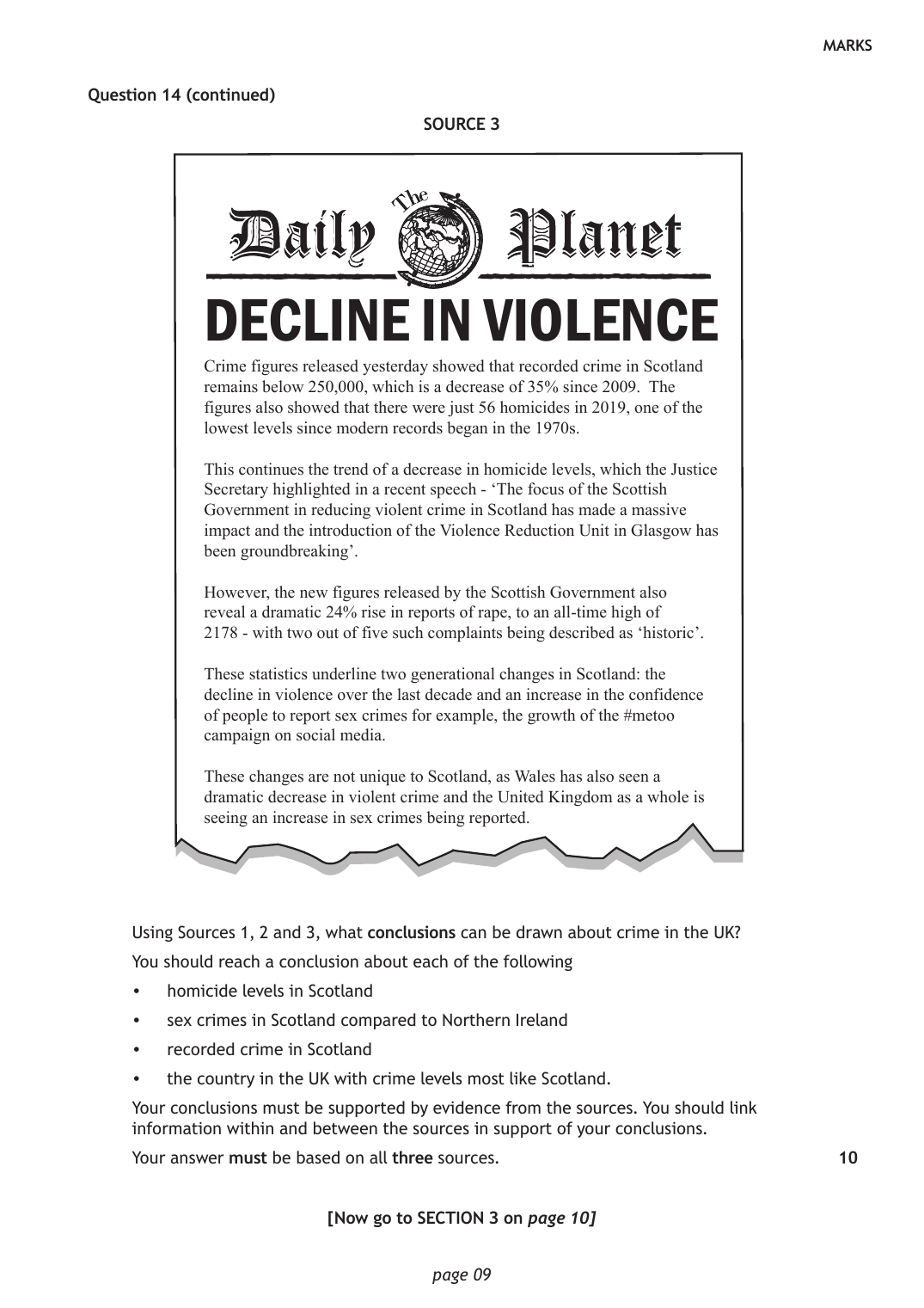
Using Sources 1, 2 and 3, what conclusions can be drawn about crime in the UK?

You should reach a conclusion about each of the following

  • homicide levels in Scotland
  • sex crimes in Scotland compared to Northern Ireland
  • recorded crime in Scotland
  • the country in the UK with crime levels most like Scotland.

Your conclusions must be supported by evidence from the sources. You should link information within and between the sources in support of your conclusions.

Your answer must be based on all three sources.

Sources (Source 1, Source 2, Source 3)

Source page 1 for this questionSource page 2 for this question
📝 Structure template — how to structure your answer

Conclusions · A source-based skills question

WFQ (words from the question)

  1. For EACH bullet point in the question, write the bullet point as a subheading, then:
  2. One conclusion that can be made about insert bullet point is insert valid conclusion.✓ 1 mark — valid conclusion
  3. Evidence to support this is shown in insert source which says/shows “insert evidence”.✓ 1 mark — evidence
  4. This clearly shows / strongly suggests insert valid conclusion — evaluative language earns the 3rd mark.✓ 1 mark — evaluative language

How it's marked

  • Conclusion + one piece of evidence = 2 marks. That is all you need for two of the three marks.
  • The 3rd mark does NOT come from a second piece of evidence linked to the same point — it comes from using evaluative terminology (e.g. “this clearly shows”, “the strongest evidence is”, “significantly”, “overwhelmingly”).
  • Comparison bullets (e.g. the UK compared with another country): you must give evidence about BOTH sides — but two pieces of evidence together still earn only ONE evidence mark, not two. You can still earn the 3rd mark with evaluative language, exactly as normal.
  • Up to 3 marks per bullet point; four conclusions (one per bullet point) are needed for full marks (10).
  • Tip: turn each bullet point into a question (e.g. “What is…?”, “What are…?”, “Which…?”, “How…?”) — the answer you give is your conclusion.
  • Conclusion + evidence = 2 marks. For the 3rd mark add evaluative language — a second quote linked to the same point does NOT earn it.
  • For a comparison bullet you must back BOTH sides with evidence — but that is still only one evidence mark, not two. The 3rd mark still comes from evaluative language.
✓ Reveal marking scheme
Max 10 marks

These are possible/exemplar answers from the marking instructions — other valid points can also gain marks.

How marks are awarded
  • The candidate is required to use a limited range of sources and draw valid conclusions from them, with supporting evidence.
  • Candidates should draw conclusions using the headings/bullet points in the question.
  • Candidates should be highly credited if they draw conclusions which show interaction between the sources.
  • For full marks, four developed conclusions must be given.

HOMICIDE LEVELS IN SCOTLAND

  1. Conclusion: Homicide levels in Scotland have decreased. (1 mark — valid conclusion)
  2. Conclusion: Homicide levels in Scotland have decreased. Evidence: This is supported by Source 3 which states ‘Crime figures released yesterday….in Scotland….showed that there were just 56 homicides in 2019, one of the lowest levels since modern records began in the 1970s’. (2 marks — valid conclusion with evidence)
  3. Conclusion: Homicide levels in Scotland have decreased. Evidence: This is supported by Source 3 which states ‘Crime figures released yesterday…..in Scotland…..showed that there were just 56 homicides in 2019, one of the lowest levels since modern records began in the 1970s.’ In 2016 there were 62 homicides in Scotland and every year since this number has decreased (Source 2). This shows a decrease of 6 homicides over three years. (3 marks — valid conclusion with evidence and evaluative terminology)

SEX CRIMES IN SCOTLAND COMPARED TO NORTHERN IRELAND

  1. Conclusion: There are more sex crimes in Scotland than in Northern Ireland. (1 mark — valid conclusion)
  2. Conclusion: There are more sex crimes in Scotland than in Northern Ireland. Evidence: Source 1 states Scotland has 10,822 sex crimes compared to 2,336 in Northern Ireland. (2 marks — valid conclusion with evidence)
  3. Conclusion: There are more sex crimes in Scotland than in Northern Ireland. Evidence: Source 1 states Scotland has 10,822 sex crimes, an increase of 10%, compared to 2,336 in Northern Ireland where sex crimes have not increased. This shows Scotland’s total is more than four times greater than Northern Ireland’s. (3 marks — valid conclusion with evidence and evaluative terminology)

RECORDED CRIME IN SCOTLAND

  1. Conclusion: None Evidence: ‘In 1991, over 500,000 crimes were recorded in Scotland, but in 2019 this was just under 250,000.’ (1 mark - correct identification of information)
  2. Conclusion: Recorded crime in Scotland has fallen over the years. Evidence: Source 1 states that ‘In 1991, over 500,000 crimes were recorded in Scotland, but in 2019 this was just under 250,000.’ (2 marks — valid conclusion with evidence)
  3. Conclusion: Recorded crime in Scotland has fallen over the years. Evidence: Source 1 states that ‘In 1991, over 500,000 crimes were recorded in Scotland, but in 2019 this was under 250,000.’ This is backed up in Source 3 where it states ‘crime figures released yesterday showed that recorded crime in Scotland remains below 250,000, which is a decrease of 35% since 2009’. This shows that recorded crime has more than halved since 1991. (3 marks — valid conclusion with evidence and evaluative terminology)

THE COUNTRY IN THE UK WITH CRIME LEVELS MOST LIKE SCOTLAND

  1. Conclusion: The country in the UK which has crime levels most like Scotland is Wales. (1 mark — valid conclusion)
  2. Conclusion: The country in the UK which has crime levels most like Scotland is Wales. Evidence: Source 1 shows that the figure for recorded crime in Scotland is 238,406 and for Wales is 219,111. (2 marks — valid conclusion with evidence)
  3. Conclusion: The country in the UK which has crime levels most like Scotland is Wales. Evidence: Source 1 shows that the figure for recorded crime in Scotland is 238,406 and for Wales is 219,111. Amongst UK countries, this is the figure which is closest to Scotland. This is also backed up in Source 3 where it states ‘These changes are not unique to Scotland as Wales has also seen a dramatic decrease in violent crime’. (3 marks — valid conclusion with evidence and evaluative terminology)
Source: 2021 N5 History · X849/75/11 · Q14Question paper (PDF, p.8) ↗Marking instructions (PDF, p.26) ↗